
*This is the 2nd book of the 13 Books of Fall.
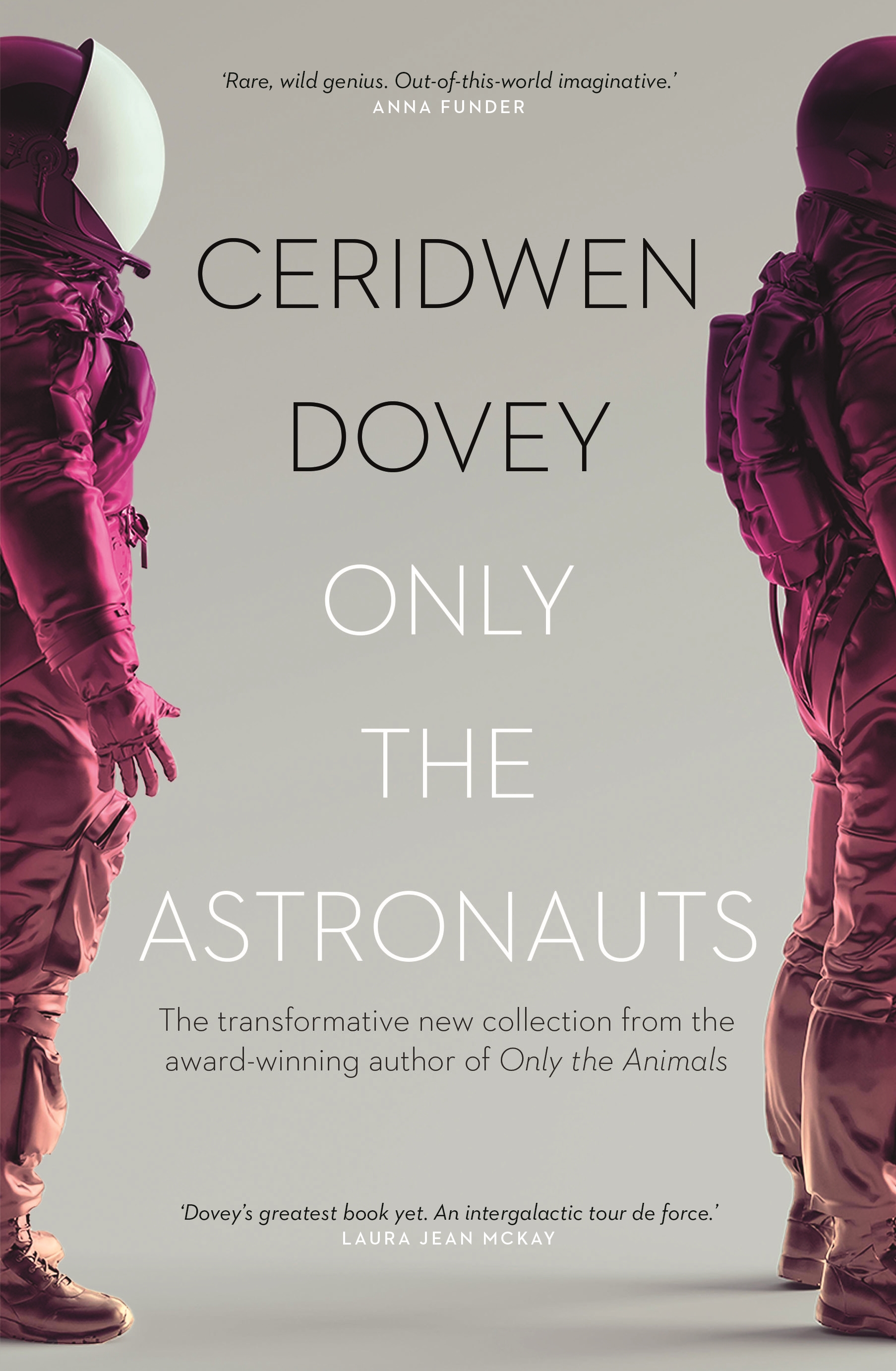
I want to thank Sue @ Whispering Gums for mailing me this copy of Only the Astronauts by Ceridwen Dovey. Sue sent it alllll the way from Australia, meaning Dovey’s book is more well-travelled than I am. But Dovey’s collection took me even further: outer space.
Many years ago I read Limber by Angela Pelster, which was a beautiful book about trees that read like facts covered in a fictional blanket. The result was a lovely, pleasurable read. Dovey does something similar in her collection, except we get fiction with a blanket of facts. Only the Astronauts is 271 pages and contains five stories, some which are long enough to feel like novellas.
In each of the five pieces we meet the technology of outer space; that is, the robots and probes and space stations that humans sent up decades ago. All the tech is anthropomorphized, so a space station shares its feelings about the astronauts that have spent time there, Voyager 1 describes being rescued/kidnapped by an alien race, and Starman (the crash test dummy for space) recalls the musical likes of Rocket Man and Major Tom. Not regrettably, I could not get David Bowie’s “Space Oddity” out of my head the entire time I read Dovey’s collection.
I particularly liked the longest story, “Requim,” in which a space station recounts the secrets of astronauts that came and went over the years. Some left poems as a sort of goodbye. An agnostic writes, “This station means everything! goes the refrain. / No. You’re nothing but space infrastructure / that’s past its expiry date. It hurts the others / to admit this because it’s a rupture / in the story of salvation.” Here, I paused and thought about what humans worship that isn’t a god and contemplated how even atheists and agnostics use words like “blessed,” “soul,” “spirit,” and phrases like “Oh, my god!” Should we tout the majesty of the space station as if it were a miracle? In what ways do we sanctify science?
Later, in the last story, “Hackgold/Hacksilver,” Dovey adds in another small moment that acknowledges religion. The “Carl” referenced is Carl Sagan, but because the narrator is Voyager 1, it’s just “Carl” to them. After Voyager 1 is taken by an alien race, it thinks, “And [Carl] always blindly assumed [extraterrestrials] would be kind and good, as if a religious faith and angels could be replaced with a belief in gentle aliens.” I wasn’t aware of Sagan’s thoughts on space beings or angels, but this moment surprised me because I hadn’t considered the ways in which faith interjects into science of the cosmos.
Largely, On the Astronauts is not about religion, but those two moments stood out to me. Dovey’s mechanical characters use a cold, analytic tone that interjects warmth and humanity, such as Voyager 1 longing for its twin, Voyager 2, calling V2 its “sister.”
The most interesting of Dovey’s stories is called “We, The Tamponauts,” and I seriously hoped it would be about women in space and the controversy over how to menstruate in zero gravity. Well, I got one even better: a young woman writes a TV script about personified tampons going into outer space and sends pages to her grandmother to read, because her grandmother used to be a space traveler. It’s a great story. When the grandma asks what a “tamponaut” is, the granddaughter replies, “Gran! Don’t play dumb. It’s a tampon-astronaut, of course. Like you once were.” And because the grandma’s reply is so funny I missed the obvious here (these characters are also tampons). Anyway, the grandma replies, “Let me tell you, I’ve been called many things in my life, but tampon-astronaut is not one of them.”
Dovey’s collection is unique, written with an unusual tone, unexpected characters in machines, and complete immersion in the space setting. You won’t get pew-pew science fiction, but this is, indeed, science fiction.
 Grab the Lapels
I’m so glad you enjoyed it Melanie … I was a bit nervous because I thought it was edgy SF which I think you like but I know you don’t like nonhuman narrators much. I had my fingers crossed! Thanks so much for bringing it to the attention of your followers!
LikeLike
Oh! I don’t remember saying I don’t like non-human characters….with sci-fi, I struggle when there is so much info dumping in order to do world building. There’s no point of recognition, nothing that I would know, for me to attach the new idea to. That’s why I struggle with Le Guin, for example. In Dovey’s stories, we may be at a total loss for who is who, but not at a loss for where I am or what I can see. In the last story, it took me a moment to realize the narrator was yet again an old relic of space history, Voyager 1. And then through its eyes, we learn about who the aliens are, what the world is like, and what their society is founded on–their values and culture. Therefore, the character is learning with us, and so the pacing is wonderful. I really loved it. The only think I didn’t like about it was how hard it was to write a review! You really become part of the story. Nothing pulled me out. I felt like I was in space. All of that is hard to explain–well, the why of it. I think that’s the reason I so often point to Limber as a comparison for these kinds of books. I’m not lost in a fantasy world, I’m not lost in the drama of a thriller, it’s like I’m THERE.
LikeLike
It was on my post on Chris Flynn’s Here be Leviathans, Melanie. Flynn’s was the book I first thought of sending you, then I remembered two things – one, your comment about non-human narrators, and two, he’s a male writer and you don’t review them on your blog! So, then I had to think again! I knew you liked SF and weren’t averse to short stories, but Dovey did have the unusual narrators and I hadn’t read it (like the Flynn!) So, I was nervous.
I’m with you about massive world building. I’m just not fascinated but that. I want to get to the characters and the point. I haven’t read Le Guin. Your comment confirms my concerns!
LikeLiked by 1 person
This sounds really good! I like the idea that sometimes people are expecting extraterrestrials to be like angels. I read that bit to Ron and he observed that often we equate intelligence with goodness.
LikeLike
Oooooh, Ron. Good point. I think that’s true, especially now that the U.S. is divided. We’re always surprised when we find a college-educated person who is voting for Trump. There seems to be a “how could you!” attitude.
LikeLike
Well, yeah. Like David Sedaris says, it’s like being on an airplane and getting a choice between chicken and shit with crushed glass in it. Who asks “how is the chicken cooked?”
LikeLike
Ah hahahaha, I hadn’t heard that one.
LikeLiked by 1 person
I’m going to email you at the address on your blog. Be on the lookout!
LikeLiked by 1 person
Tamponauts! I’m laughing with delight over this! I’m not a short story reader in general but this sounds like a great collection.
As for the cosmos/science/religion, you may find Thomas Berry interesting: https://thomasberry.org/
LikeLike
You might like this one because the short stories are not short at all. They’re quite immersive, too. You feel like you’re in space.
LikeLiked by 1 person
This sounds great, though not sure it will be available in the UK.
LikeLike
It’s an Australian book, so I foolishly assumed the Brits would get it, too.
LikeLiked by 1 person
Ah, sadly not! We seem to get nothing but UK and US… Canada, Australia etc are all out!
LikeLiked by 1 person
Your description of the longest story reminds me of an Anne McCaffrey short story that I just read a day or two ago – The Ship who Sang, which she eventually turned into a novel. That has a ship that is powered by a “shell person”, who is technically a human but is raised inside a mechanical for complicated in-universe reasons and then turned into a ship, and a non-shell person. It focues on the close partnership between the two (“brain” and “brawn”). It’s a weird story but I really liked it, and I like the sound of this too.
I’ll keep an eye in case it comes out here – or maybe I will request it from the library, who have shown extraordinary willingness to buy in books from all over the globe that I am sure only I have requested! They acquired some Bolivian cyberpunk a couple of years ago that would have cost me a fortune to have shipped to the UK.
LikeLike
Laura was just saying she’s not sure it’s available in the UK, but I thought the UK and Australia got a lot of the same books. Maybe that was a poor assumption.
I just realized that The Long Way to a Small, Angry Planet by Becky Chambers also had a machine that was personified. There was even another non-machine character that loved her. I think they were basically married.
LikeLike
I LOL’d at ‘pew pew’ science fiction because I know EXACTLY what that means haha
This sounds like a really unique book indeed. Personified mechanical equipment? Love that! I always think of that story, and who knows if it’s true, that men, even NASA scientists have no idea how many tampons an average woman uses, so they send up thousands with each female astronaut just to be safe haha
LikeLike
The tamponauts story opens with a quote from Sally Ride in which she says she was asked if 100 tampons were the right number for a week. She was like, “no, no, it is not.”
I’ve been using the phrase “pew-pew science fiction” just long enough that it has crossed the globe into Australia, lol.
LikeLiked by 1 person
100 tampons a week. Jeez if you needed 100 tampons a week, space is the last place you should be! A hospital is more like it hahah
LikeLike
Just a giant space diaper for all the bleedin’.
LikeLiked by 1 person
like actually, you would be bedridden really
LikeLike
🤣 that’s not funny except it is
LikeLiked by 1 person
[…] of September 22: Just Before Daybreak by Audrey CouloumbisWeek of September 29: Only the Astronauts by Ceridwen DoveyWeek of October 6: Black Sheep by Rachel HarrisonWeek of October 13: Pretty Girls […]
LikeLike
This sounds excellent. The library and amazon don’t have it. I also want to read her book about animals. Thanks for letting us know about this book. I would never have heard of it otherwise.
x The Captain
LikeLike
This book is pretty new, so I’m not surprised that it’s not in the US. As I mentioned in the post, it was sent to me by an Australian blogger. I know you enjoy books that are set in space, so I hope this one fits the kind of writing that you enjoy or are interested in.
LikeLike
This would be a good companion to the book I’m currently reading — Orbital — which is set on a space station orbiting the earth. It’s beautifully written with a lot of content which makes you stop and think about our relationship with the planet.
LikeLike
That sounds wonderful, Karen! Did you also get David Bowie stuck in your head? ☺️
LikeLike
[…] Ceridwen Dovey, Only the Astronauts (Cassie McCullagh, ABC RN) (Melanie’s review) […]
LikeLike
[…] Dovey, Once were astronauts (to Melanie of Grab the Lapels – her review, short […]
LikeLike