
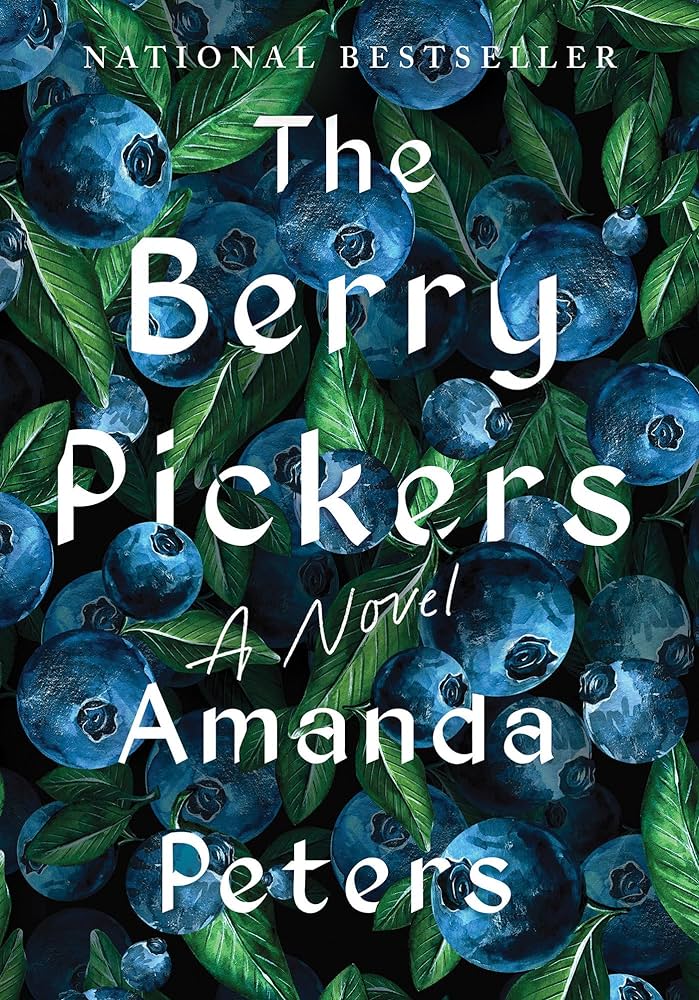
In 1962, a Mi’kmaq family that crosses between Nova Scotia and Maine for seasonal work on berry farms faces the unthinkable: the youngest member, a four-year-old little girl named Ruthie, goes missing, and the last person to see her was her brother, Joe, age six. Their parents, and older siblings Ben, Mae, and Charlie search for Ruthie all season, with no success.
In the next chapter, titled “Norma,” we meet a little girl who keeps dreaming of another family. Her parents tell her it’s nothing, just ignore the dreams, but any reader with their eyes open know this is Ruthie. She even has an imaginary friend named Ruthie. The chapters alternate between Joe’s perspective and “Norma’s,” which is an excellent way to show how these siblings lives progressed into adulthood. Joe has self-destructive tendencies because he feels guilty about Ruthie, and “Norma” navigates a paranoid, possessive mother — who should be paranoid because she’s a criminal. However, author Amanda Peters chose to narrate Joe’s chapters from a present-day point of view during which he is near-death from illness, reflecting on life.
Here was the problem: in the present, Joe is in bed, suffering, when sister Mae, who now takes care of him, says he has a visitor, and they have a lot to catch up on. This can only be Norma/Ruthie, returned to her family. And this happens within the first couple chapters! Why Amanda Peters chose to spoil The Berry Pickers, I don’t know. Even though the writing and characters were good, I had little drive to pick up the novel because I knew Ruthie would see Joe before he died.
Had Peters kept Ruthie and Joe’s reunion under wraps, I would have felt extreme tension as the characters aged. Would Ruthie learn she was kidnapped? Would she assemble the clues in time to figure out who her family is? Would she find Joe so he could abandon his guilt? But of course Ruthie does all that, because Peters blew the conclusion.
If knowing the ending doesn’t bother you, and you’re happy for the journey, then The Berry Pickers will suit you just fine.
 Grab the Lapels
What to say? I don’t mind this at all. I don’t particularly want tension or suspense. When an author does this I love thinking about why they’ve done it. I think it’s often because they don’t want us to focus on the suspense but on something they think is more interesting?
I feel I’ve heard of this novel. Has it been around a while? Or made into a movie? Or based on a real story? And gorgeous cover.
LikeLike
When the Boozy Book Club picked it, that was the first I had ever heard of this novel. I think it’s only been out for a year? You’re right that perhaps I should have been paying attention to something else, but I found it awfully easy to put this book down and not pick it up again. It’s sort of like the excitement of having a crystal ball and being able to see into the future, and then you realize everything’s pretty mundane because you know what’s coming in the future.
LikeLiked by 1 person
I love the way you put things Melanie!
LikeLiked by 1 person
I read this earlier in the year, Sue, so might be where you saw it?
I agree the author chose to NOT to make this a suspense tale. Instead it’s an exploration of what it’s like to be separated from your culture. In my review I wrote: “The author is focused on showing us two sides of the one coin: what happens to the family left behind when a beloved child goes missing, and what happens to the missing child if they are raised with no knowledge of their biological family?”
LikeLike
That is an absolutely valid point, and I agree with your review. My concern, then, more specifically, is why have Joe on his death bed and Ruthie racing to him? What were your thoughts on that part? I’m curious if you saw a reason for making Joe near death. Thanks, Kim!
LikeLike
If Joe dies, all the knowledge about what happened the day Ruthie went missing would die with him…and he has all the family history about what it was like growing up in the family which Ruthie has a right to know about…
LikeLike
OMG, Kim, I didn’t even think about that! Thank you so much for joining the conversation. My perspective has changed because of it.
LikeLike
Ah, you are probably right kimbofo.
LikeLiked by 1 person
Ugh yah, that does annoy me. I love suspense, and really, it helps keeps the pages turning, so why would an author ignore that strong motivation?
LikeLike
I’m like Kurt Vonnegut said, it doesn’t have to be suspense in the sense that a thriller has lots of suspense and twists and turns. It could be something as simple as wanting a glass of water. We all need to have a goal, even if it seems like a tiny, insignificant goal.
LikeLiked by 1 person
So if I have this right, you know in the present day that he and “Norma”/Ruthie are going to meet, and then it goes back to the past to show how they got to that point? I don’t think that would bother me. But so much about how a book hits you is your expectations, and plenty of times I’ve been expecting one thing and been presented with a disappointing another.
LikeLike
Not only do you know that Joe and Ruthie are going to meet up again, you know that he’s dying, so there’s a timetable at stake. Well, nothing is really at stake because you know that they’re going to meet up again. Actually, the format reminded me a little bit of what Ruth Ware does so often. She does that thing where you start in the past and then you go back to the present, and the narrator and the present is telling you about the aftermath of what happened in the past, but you still don’t know the ending until the two merge.
LikeLiked by 1 person
I’m not sure if that would bother me or not but I can see how it would deflate the tension. I wonder if Peters was trying to avoid that false, drawn-out tension that books often have with two timelines.
LikeLike
That’s actually a really good observation. Maybe the author didn’t want this book to seem like a thriller, because there’s more at stake than what you would expect of a thriller. However, I think there’s lots of tension in real life, too. We know that Joe is dying, and we know that Ruthie is going to figure out where she came from, and we know that she’s going to get there in time. What if she hadn’t gotten there in time? I think we’d all be quite heartbroken. Actually, her getting there in time is more dramatic than I would expect of real life.
LikeLike
I hadn’t thought about Native Americans doing seasonal work, but I read a book recently about a family doing similar work on the west coast, also crossing down from Canada. I wonder what it was – it took a while but I found it: All the Quiet Places by Brian Thomas Isaac (a Salish man)
LikeLike
I believe I’ve heard of that book, probably because I have two Canadian blog friends who read what’s new in their country.
LikeLike
[…] brewery. I read books I wouldn’t have picked up myself, like The Women by Kristin Hannah and The Berry Pickers by Amanda Peters. This club will continue without me when I go to St. Louis for my internship, […]
LikeLike