
Everyone has that childhood experience of a TV show they absolutely loved, one they had to tune into habitually. I’ll bet you can still sing the songs. During my childhood, those shows happened on Saturday morning. I remember devotedly following Power Rangers, Saved by the Bell, Full House, and even Barney for a time. Kiersten White’s novel Mister Magic is a book for elder Millennials, though I think it could appeal to a wider audience. All the characters are about 38-42 years old, and the way the titular TV show is described, you can easily imagine it on PBS or the like.
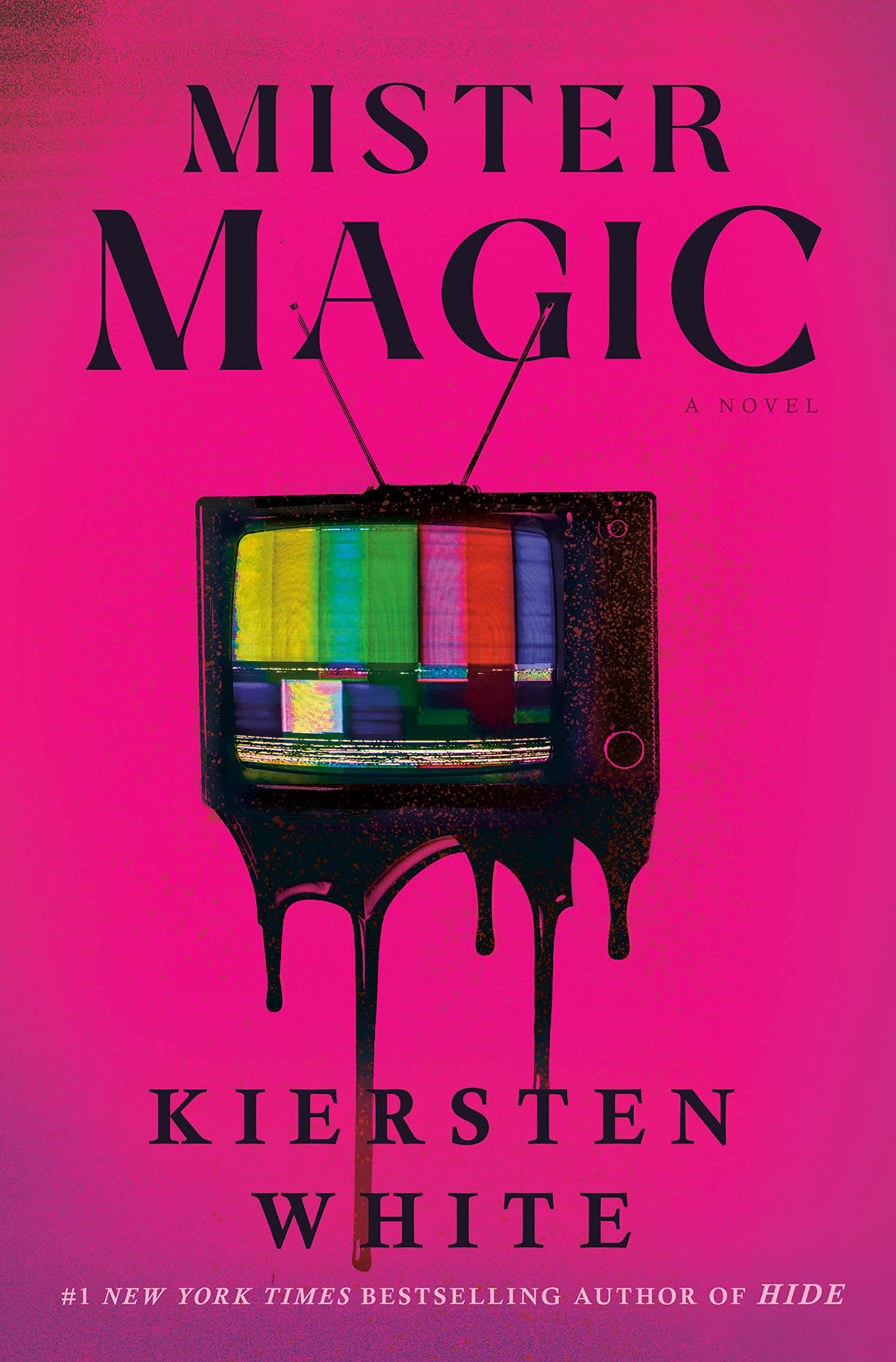
The novel opens with Val, an elder Millennial working on a horse ranch and caring for her invalid father. Things don’t quite add up, though; Val and her father never leave the ranch, nor do they post anything online. Are they hiding from someone? Or something? And then, Val’s father dies and the owner of the ranch puts out the funeral information on Facebook, which is the catalyst for Val meeting old friends, leaving the ranch, and trying to piece together her past.
The friends who find Val tell her she was part of a group of six children, who were stars on a beloved TV show called Mister Magic. The show ended when Val abruptly left. However, Val has no recollection of her time before the ranch, nor does she remember these friends (or is it “friends”?). The group heads to a remote location with a bizarre house: it has six identical floors, and not one single door inside. Behind the scenes someone is organizing a reunion of the Mister Magic cast to make a podcast, which will anticipate an announcement that Mister Magic will be back on the air after thirty years off.
Kiersten White explores the ways in which children are controlled and stifled throughout her novel. Each of the six had a stand-out feature: the leader, the do-gooder, the creative, the mischievous one, etc. However, when the child is “too” much of their main characteristic, the invisible father figure on the show, Mister Magic, presented as only a cape and top hat, is there to correct them. While the novel isn’t scary, it is spooky in places because we’ve got the unsolved mystery of why Val left the show as a child, why she doesn’t remember anything, and who — or what — Mister Magic really is.
I appreciate the way White thinks about the vulnerability of children, which lends itself to considering the complexity of how children are raised:
People think children’s lives are simple, easy, but it’s the opposite. Everything that happens around them affects them, and they don’t have the power to affect any of it back. But in there, with him, you had all the power. You got to affect everything around. You literally change it with your imaginations, with your dreams. You got exactly what you needed. All you had to do was summon Mister Magic, and then follow the rules.
White creates a world in which Val, at eight years old, takes back her agency. While the other five children obey Mister Magic and his rules, rules always explained in quirky little songs, Val sees what compliance does to her friends, whose personalities are quashed by conformity in detrimental ways. For example, one song suggests children should deny their emotions: “Clean hearts and clean minds, cleanliness at all times! Nothing dirty, nothing bad, always happy, never sad!”
I enjoyed Mister Magic because there is a mystery plot, something supernatural, not knowing who to trust, and a little bit of “no, don’t go in there!” There is no gore, violence, or other common features of a horror story, and yet White’s novel is billed as horror. Perhaps because TVs turn on by themselves and the podcast host seems ominous. If anything, Mister Magic has a vibe similar to It because you have the friends-forever gang, but without the monstrous creature.


I actually love the sound of this but I hated White’s Hide, so I’m hesitant. I also love that I am apparently *just* too young to be an ‘elder millennial’.
LikeLike
LOL, I used to hate making distinctions about generations, but our ages really inform us of how we think. I mean, I see a movie like Ginger Snaps and I feel like I’ve gone home to the land of thumb rings and kilts. I think people at least 10 years younger than I am are way more informed thanks to the internet than I ever was at their age, but they also don’t have the life experience to wisely apply what they’ve learned. I spent 27 years in education during which I did not have a smart phone. The way I get around is different, my anxiety toward being without being in contact is different, etc.
LikeLiked by 1 person
It’s interesting how different tech affects it as well. My family were fairly early adopters of the internet so I was using it at home by the age of eleven, but I didn’t have a mobile phone till I went to university, and a smartphone until 2016. So I’m very used to a world with the internet but also resonate with what you say about how weird it is that some people need to always be in contact/always have their phone on them etc.
LikeLiked by 1 person
I have a copy of this and am very keen to read it.
LikeLike
It’s an easy book to fall into, so I hope you enjoy it.
LikeLiked by 1 person
I feel like a weenie like me could read this one, ha ha!
LikeLike
Given the nostalgia Factor, you might really like this one.
LikeLiked by 1 person
This sounds spooky to me! But I can completely agree with that description of childhood. Sometimes I’m amazed by how overwhelming it must be to be a kid – so much is new and so little is in your control. I think I’ve mentioned before that we didn’t have a TV when I was young (though we got one before I started high school) and my media was very strictly monitored so there are several millennial references that I don’t entirely get even now.
LikeLike
[…] memorable horror novels I’ve come across in ages: This Wretched Valley by Jenny Kiefer and Mister Magic by Kiersten […]
LikeLike