
When I saw the charming scientist Jasmin Graham on CBS Morning news talking about her first book, Sharks Don’t Sink: Adventures as a Rogue Shark Scientist, I knew I had to read it. During the interview, she mentioned that her life path as a Black woman is similar to sharks, animals that never sink, e.g. go down or fail or stop moving forward. At the time, I had an audiobook about Black Lives Matters in my car, and I was not connecting to it. I felt like I was being shouted at with facts and emotionally charged language. I turned off that book and started Graham’s to get her perspective.
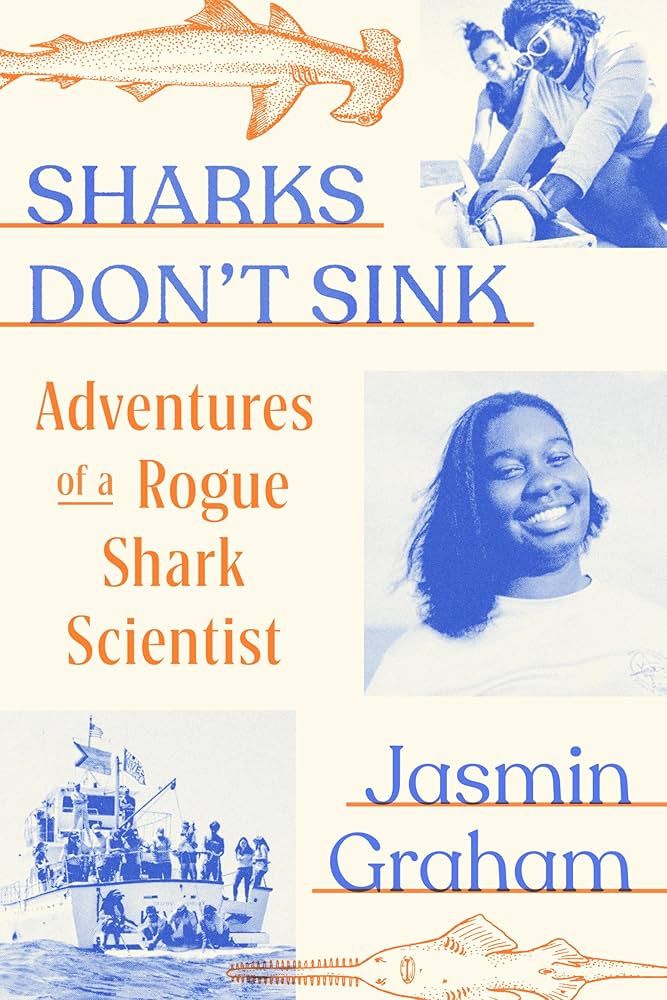
Sharks Don’t Sink is exactly what the title says: shark science, rogue scientist, adventure. And yet Graham weaves together her experiences in academia and as a Black girl learning to fish from her father into the book, making it informative on multiple levels. I’m going to say this is probably one of the best books I’ll read this year.
Firstly, Graham writes with her personality; not in an “academic” way prescribed by high education. Oddly, this is the second book I’ve picked up by an author who left academia because the institution of publishing academics fails to connect with everyone; imagine only a handful of specialists ever reading your work. She describes her animals of study — sawtooth fish and bonnethead sharks — as cute or goofs.
We meet Graham on a boat that a patron loaned her and three other Black women scientists. Together, the four start a group called MISS (Minorities in Shark Science). They take on students who are gender minorities of color for free to get them acclimated to what science on a boat really looks like: catching, measuring, inputting data, etc. Graham and her peers also warn the students about the perils of academia, namely that women aren’t really welcome in science, and Black and brown people will feel isolated and undermined. In fact, Graham explains why she left her PhD program before graduating, which involved an older white male stealing her data, about which he knew little, and publishing it himself:
“I had to go. Leave academia. Leave FSU. That I needed to remove myself from a world that could treat people the way it had treated me. I had given the best of myself to science, and the institutions within my field had allowed Minion to take my work, ignoring the impacts this would have on me, my work, and even the species they claimed to want to protect. Worse: they supported him.”
Graham explains that rarely are scientists unaffiliated with a college or organization, making what she and MISS do a rogue operation. Through her efforts to organize, she taught me about what it means to quit something. Examples I saw growing up were people doing something for as long as they could and then moving up. It didn’t seem like anyone ever just quit, but Graham has a point: “But I truly feel like the world would be a much better place if more people simply quit what did not serve them, leaving space for what did matter, even if it looked less prestigious or impressive to others.” This is what I mean by learning about more than just shark science; you may find yourself nodding, regardless of what it is you realize you need to quit.
While the first part of Sharks Don’t Sink largely focuses on day-to-day operations on the boat with the MISS students, the later half is when Graham describes how she left academia after her she received no support when the colleague was stealing her data. So although the book is about shark science, is also about being multiple minorities in a world that knows silene is a tool of manipulation. Graham realizes her voice is powerful:
“And when I flipped that switch in my brain from being worried about my career to not being worried, I realized that I did have power. Not only could I take myself out of a harmful situation, but I could hold people accountable, simply by letting them know I was not having it. Because if I was going to be ostracized and mistreated by the science community, regardless of whether or not I did what I was ‘supposed’ to do, I might as well make a frickin’ scene.”
I truly loved Sharks Don’t Sink, not only for the personal growth and insight into being a Black woman in marine science, but for learning about the actual science, too, and how scientists work together, and what the smallest thing can teach us about the world, such as the privatization of once-public shores.
 Grab the Lapels
This sounds pretty interesting! I’m a recovering academic myself, although I never left and made a scene (but I did get my poem Adjunct Exit Interview published).
LikeLike
I read Adjunct Exit Interview! As a former adjunct myself, I feel you. At one point, I was an adjunct teaching new, full-time faculty how to create assignments and develop a grading system. 🫠
Even though her work is in sharks, I think you would like this book because it IS commentary on academia and how it leaves people behind or forces them out.
LikeLiked by 1 person
Oh my sister has been a shark nut since we were kids and this sounds good on so many levels. I just might have to send her a present 🙂
LikeLike
I love that this book works on so many levels: feminist, anti-establishment, pro-science, Black Girl Magic, etc. Definitely send to your sister.
LikeLiked by 1 person
Wow, how cool is she? I’m adding this to my TBR.
LikeLiked by 1 person
I love this idea of learning to ‘quit’ something, and her radical idea of how much better the world would be if people quit things that weren’t serving them. It’s the exact opposite idea that we are often force fed; NEVER QUIT and yet, this idea she’s proposing makes so much sense!
LikeLike
I’ve definitely stuck with things for YEARS longer than I should have. I wish I had this message a long time ago.
LikeLiked by 1 person
This sounds like a book that would interest me. The point that she “writes with her personality; not in an “academic” way prescribed by high education” is really appealing. I can understand having to write in an academic style for your peers, and there’s probably some stuff that is only of interest to academics. But it rarely makes a readable book, so the work you do is never known by the public. There needs to be room for both, I think, but unfortunately there’s not much of the latter being published within academia I think. I can think of Aussie examples, in history and probably in science if I put my mind to it, that are published outside academia. The academic books are usually hugely expensive too – even if you wanted to read it.
But what I really like is her comment that she feels” “like the world would be a much better place if more people simply quit what did not serve them, leaving space for what did matter, even if it looked less prestigious or impressive to others.” Absolutely agree, and I love her sense of self and integrity that enabled he to do this.
LikeLike
I’m not sure what it’s like in Australia, but in the U.S., a lot of science is funded with public taxes; however, the results of that work are typically published in esoteric papers that go on academic databases behind a paywall. So, even though we pay for it, we can neither read it nor understand it if we pay the hundreds of dollars you need to access a database.
LikeLike
Pretty similar here too I think Melanie though there is some move to the open access principle.
LikeLike
In America, we just have hackers steal everything and release it on the web. At least, that’s what happened last time I looked into this.
LikeLike
We have hackers here too but probably not in these more esoteric areas. Our local university has just published the next edition of its humanities journal via its open access platform. So good to see particularly given almost all our universities are publicly funded. Interestingly private schools are very common here but not private universities.
LikeLike
Here, it doesn’t matter if the university is private or public. All the universities, at a cost of several hundreds of thousands of dollars, pay to access databases like JAMA, Ebscohost, etc. I’m growing more appreciative of Google Scholar and places that publish their work freely. Even the person who wrote the article and had it published through a database has to pay to read it. I think it’s all driven by that publish or perish mentality, but there are some rogue folks who avoid the egotism of being published in a fancy place.
LikeLiked by 1 person
Not enough of them eh? I can access some of these databases – or, the journals in them, through my National Library reader card.
LikeLiked by 1 person