
My first book by bell hooks, All About Love popped up in my library search when I was looking for more about self-esteem and loving yourself. However, hooks approaches love from thirteen angles, including justice, honesty, spirituality, and community. There was nothing particularly focused on self-love.
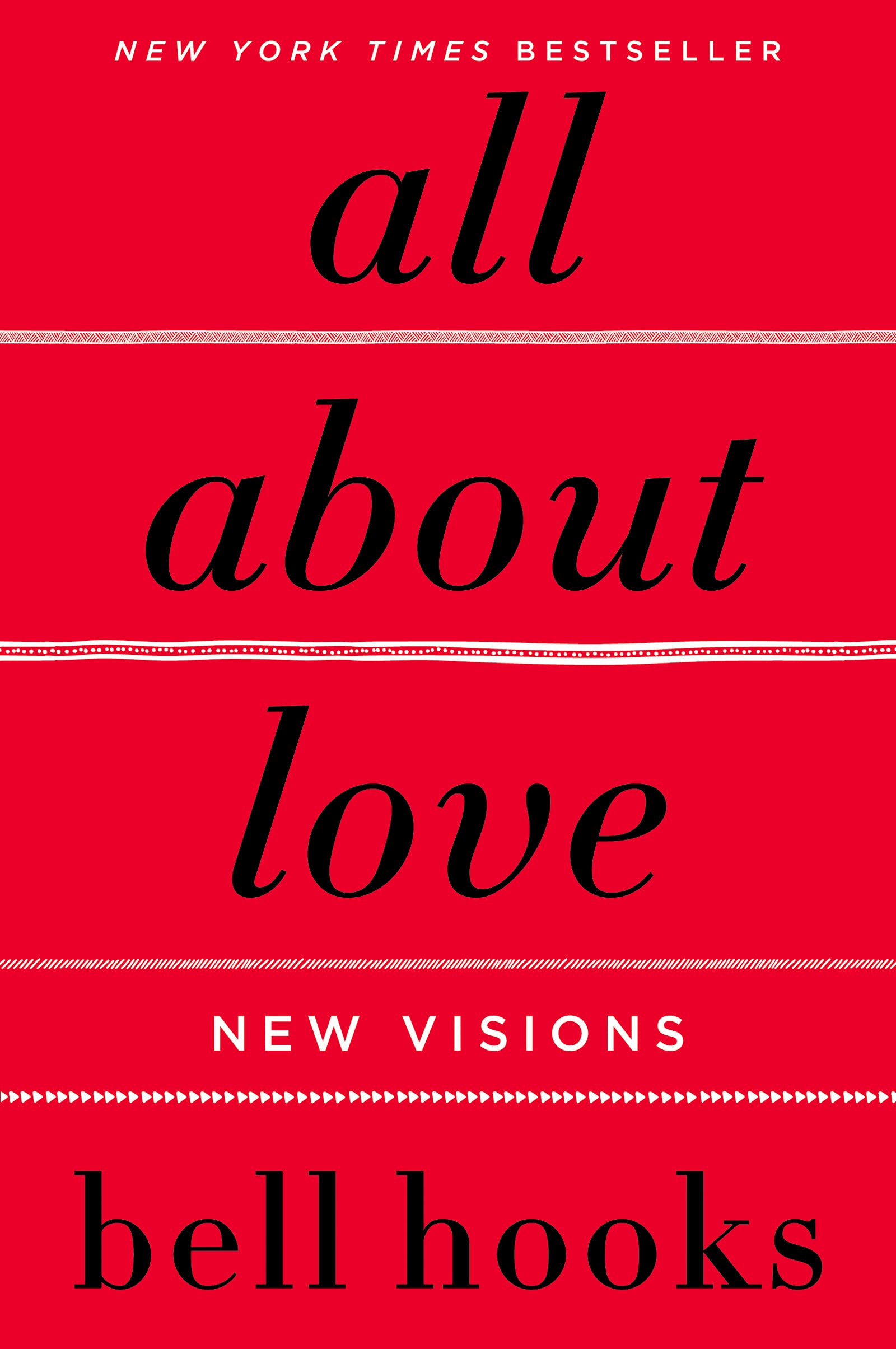
Published in 2001, All About Love feels terribly out of date. Hooks writes about women searching for a prince, and even when she acknowledges non-heterosexual relationships, she still places them in a hetero context, claiming that one partner will fall into the masculine role and the other into the feminine. We’ve come a long ways in our conversations about gender and relationships in 23 years since All About Love was published, so it had me feeling impatient.
One place where hooks caught my attention was her assertion that we accept just about any treatment and call it love because if we defined what love means to us, we’d discover that the people in our lives fall short:
Undoubtedly, many of us are more comfortable with the notion that love can mean anything to anybody precisely because when we define it with precision and clarity it brings us face to face with our lacks—with terrible alienation. The truth is, far too many people in our culture do not know what love is.
Therefore, if the people we think we love fall short of our definition of love, hooks implies we’ll be faced with the challenge of moving on to something better. While I don’t believe in changing another person, there doesn’t seem to be much discussion of how to address a lack in a relationship and how to mend it. If the mending process is not satisfactory to both parties, then you may need to move on.
Later, hooks discusses spirituality, what she calls “divine love.” Oddly, the spirituality chapter seems in direct contrast to the quote above. She appears unable to define spiritually, so what does it even mean? She mixes her Christian church attendance with Buddhist practice, and she calls community service spiritual. If the author cannot define “spirituality,” then it seems she is willing to call just about anything spiritual. I call community service satisfying, fulfilling, pleasurable; I don’t say “it feeds my soul” because I do not believe in souls. (I once had a student says whip creamed filled her soul). Hooks seems to be saying at times that all the little things that make you interesting to other people is your soul, but I would call that your personality. Therefore, once hooks got into spirituality, she started to lose me.
Occasionally, hooks made points that still seem relevant, though times are changing. For example, she discussed media depictions of sexual intimacy:
We see movies in which people are represented as being in love who never talk with one another, who fall into bed without ever discussing their bodies, their sexual needs, their likes and dislikes. Indeed, the message received from the mass media is that knowledge makes love less compelling; that it is ignorance that gives love it’s erotic and transgressive edge.
When I was in college, I took a class called adolescent development, which, funnily enough, included people our (traditional college students) age. The professor asked us to stand up. If we felt we would rather have spontaneous sex for the rest of our lives, stand on one side of the room. If we would rather have planned sex for the rest of our lives, stand on the other side. The professor and I stood on the “planned” side while everyone else was on “spontaneous.” #AWKWARD.
My point was that if you decide to be intimate beforehand, then you get all day long to think about intimacy and get your mental imagination going, which perks your whole day up because you basically have a fun secret. As the professor talked more about the unrealistic nature of spontaneous intimacy (yes, it happens, but what if you want to be spontaneous and your partner is tired or sweaty or stays late at work, so now you’re left hanging, etc.), many students came over to the “planned” side. So, I do see what hooks is saying about people thinking love just happens without discussion, and the media pushes that message.
However, the last third of the book is quite spiritual, making everything sound mushy and meaningless. If you are religious (I know have Christian readers) consider that hooks does not subscribe to one religious tradition but many, and she changes the definition of the soul to discuss love to fit whatever she doesn’t seem to have language for: personality, impulse, sexual attraction, mutual comfort in each other’s spaces, etc. I sped read those last 60 pages because many of the ideas were abstract-spiritual in a way that left me feeling like nothing was being said. For example, “After we have made the choice to be healed in love, faith that transformation will come gives us the peace of mind and heart that is necessary when the soul seeks revolution.” What??
 Grab the Lapels
I’ve made a start on listening to All About Love. Give me another week or so and I’ll finish it and respond to your post.
LikeLike
Wonderful, sounds great.
LikeLike
What? I think I’d say the same to that sentence.
As always, I have a few comments to throw in though whether I’ll remember all I thought about as I was reading your post is another thing.
The first one relates to books being dated. It’s interesting how some things written in the past can feel dated, while others can stay relevant. I’m thinking of Jane Austen, for example!! Her settings, her language, and the constrictions people lived under are not ours but she deals with human nature most of all, and that doesn’t change – people are still kind, boring, selfish, shy, greedy, loyal, short-tempered, fuddy-duddy, jealous, gossipy, and so on. I can’t really see her being dated, unless humans change.
I’m with you a bit on the spirituality business, but here’s what it means for me. It’s the things that inspire me, that lift me out of myself and my “worldly” worries into some sort of peace and joy. I don’t mean in a woo-woo sort of way, but in a way that, I guess calms me and makes me feel, for a moment at least, that all is OK. Here are examples: when I stand in a beautiful landscape, when I hear a beautiful piece of music, when I see a group of young children producing something lovely so unselfconsciously in the moment, when I go to a wonderful art exhibition … This is what spirituality means to me.
Your discussion of the planned vs spontaneous sex reminded me of a discussion I heard on the radio recently about anticipation. This person being interviewed talked about how she would always surprise her grandma with a visit, but how now she realises that the anticipation of a visit was probably an important part of the joy of their relationship and she’s sorry now. I think the visiting the grandmother as a surprise was also a bit selfish, because if she didn’t tell her grandmother she was coming she could change her mind.
Sorry, as usual, I’ve rambled too much but you will write posts that make me think!
LikeLike
I think the difference between Austen and hooks in this case is that Austen was writing about people, and hooks was writing about changes in people. If she’s writing about changes, then we’ll certainly continue to change and have changed 23 years later, thus if feels dated. In fact, I keep seeing articles about how women are choosing to remain single because they will not submit to the classic domestic wife + working wife model of the 1980s. I find that surprising because I thought Nick and I made a big change because he does about 50/50 on the chores and doesn’t view that as “helping” me because it’s OUR home. But now, the bar is even higher (stricter?). I even read that people aren’t dating in high school so much anymore, which I think is a good thing. While dating is exciting in high school (or so I thought), it leads to questions about how long-term should that relationship be, can they separate to go to different colleges, etc. When you have another person in your life, you have to make the pointed effort to grow with out without them, and in high school, it’s hard to make that judgment when everything feels new and special.
I like the story about the grandma visits. At first, I thought you were going to say the grandma loved being surprised, but you’re right; I’m with the grandma. I love having something to look forward to.
LikeLike
I love that about you and Nick Melanie, though this was also true of many baby boomers – in my circle at least. I haven’t stacked or unstacked the dishwasher, for example, probably since I retired. We still have some division of labour – because it is generally more efficient if people know their responsibilities – but it’s fair and seen as shared.
When we were all having kids we set up a babysitting club and our club, unlike most, agreed that men and women could babysit (unless the family being babysat for were not comfortable with men babysitting and this rarely happened). We were all very conscious of the “helping” issue and eschewed that. I’m thrilled to see that both our kids (your generation – aged 40 and 37) are in relationships where chores are shared. They share work on the basis of who has what skills, preferences, time which can vary over time, as it has with us.
I hadn’t heard about fewer high school students dating. If it means they are getting around together more as mixed groups of friends that would be great I think.
Oh, and your point about Austen and hooks makes sense. As you say, one approach is more likely to date than the other. Worth thinking a bit more about.
LikeLike
That is absolutely beautiful that you were part of a progressive group of people who respected each other as humans. I’m starting to believe there is some utopia in Australia of which I have been unaware until I met you.
LikeLike
Haha Melanie … I briefly thought we were moving towards a progressive future but now I think we were in a bubble. A beautiful bubble but one that hasn’t lasted. And it makes me a bit sad. I think my friends came out of the hippie-we-are-all-working-together-for-a-better-world era, but I feel it hadn’t lasted. So, much as I’d love you to think we have some sort of utopia here, I think I have to be honest and say we probably don’t!
LikeLiked by 1 person
Oh, I forgot to address spirituality. I think that we use the word “spirituality” because we’re not sure what else to use. I’ve been thinking a lot about language and inclusivity lately, and what I’m seeing is how often we choose a “good enough” word. For instance, where I’m from, everybody and their brother says, “Oh, my god!” when they’re surprised, upset, frustrated, happy — a whole host of emotions. Since I started at a school where I can get in trouble for saying that, I’ve tried to come up with other options, not only for their sake, but because I don’t want to say anything about a god I don’t believe in. In addition, I’ve been seeking fervently for a replacement for “I feel blessed.” I went to “fortunate” at first, but “fortunes” are also references to spirituality and religion. “Lucky” is superstitious. When someone says they’ve had a moving spiritual experience after listening to beautiful music and reveal themselves unconsciously, I would almost call that vulnerable, in a good way.
LikeLike
I agree with you about language. It’s one of the reasons I detest indiscriminate and/or constant swearing. It is so boring and meaningless.
Spirituality I think means more than religious feelings. It goes back to the spirit of which one meaning relates to, as one dictionary says “the soul or heart as the seat of feelings or sentiments”. That’s the meaning of spirit I use when I think about my spirituality. It’s what lifts my soul/heart/sense of wellbeing – and has nothing to do with spirits of any sort. I think “vulnerable” is not how I feel. I guess it “opens” me but I think I just feel lifted out of myself for a while or inspired to feel the world/life is just that bit better for a while. Hard to find the words – I think I need poetry for this! Maybe some of the great Romantic poets who looked to nature did it best.
Haha re OMG. I never say that either. Nor talk about being “blessed”. I think it’s hard to find perfect words. I like “fortunate” more than “lucky” but I hear you. Mr Gums rails constantly against the imprecision of language.
LikeLike
I think I would like Mr. Gums. Now you’ve got me looking at different dictionaries for “spirituality”:
–the quality of being concerned with the human spirit or soul as opposed to material or physical things.
–seeking a meaningful connection with something bigger than yourself
–a quality that goes beyond religious affiliation, that strives for inspiration, reverence, awe, meaning and purpose, even in those who do not believe in God.
And here is a huge discussion forum in which people explain what spirituality means to them.
LikeLike
What do you think about those definitions? Do any of them seem relevant to you? The third one in particular, I think, is closest to what I am talking about. I’ll check out that forum, though I don’t think I’m up for a HUGE discussion!
LikeLike
Well, I think that at its most basic, the spirit is something that is not real, so I don’t identify with any definition of spiritual or spirituality. I don’t feel like I need to have a vibe with something greater than myself because humans collectively are greater than one human. Us–we are the greater thing that I can serve and to which I can devote myself.
LikeLike
I don’t know how to explain this but I think your “us-we” is the sort of thing I would include. Us-we is not a concrete or in your sense a “real” thing you can touch? For me a sense of being part of a whole and of contributing to the betterment of the whole is a “feeling” and that feels spiritual to me because it gives me inspiration. It makes me feel good if I’ve been part of something that has been good?
LikeLiked by 1 person
I agree, some of the language is outdated but I don’t think she was saying we should accept any treatment and call it love. I think in each chapter she tries to carefully define what love is and is not. Ultimately love is not how we think of it in general because our everyday definition is far too narrow and fleeting especially when it comes to romantic love. I think she is aiming towards a foundational, world-changing sort of love like Martin Luther King’s use of agape https://www.themarginalian.org/2015/07/01/martin-luther-king-jr-an-experiment-in-love/ and all those other things we call love are misnamed.
I read the book last year so my memory is fuzzy on the details, but I thought she provided much to chew on. What made me sad though was how she was so certain we were on the verge of bringing that world-changing love into reality and all these years later we have clearly failed on that.
Your college class story made me laugh. Definitely an awkward moment!
LikeLike
Maybe I was overly distracted that she brought in spirituality so early and kept up with it. The entire last chapter is about a book of the Bible, which surprised me. I know some Black scholars have turned away from and condemned Christianity for the way in which it was introduced to slaves as a way of controlling them by making them fearful of sin and eager for reward in heaven after death.
LikeLike
Heh, maybe too many Bible classes at school? 😉 While hooks comes at love from a Christian lens, I didn’t get the impression that she was closing off other avenues, only using a route that a good many people would be most familiar with, if that makes sense.
LikeLike
It does make sense, and yes, too many Bible classes. It’s closing in on me like a hoard of slow walking zombies.
LikeLiked by 1 person
I love the word agape Stefanie … it’s a word used by an organisation called Kairos, for which a friend of mine volunteered for many years. They are Christian-driven but I understand the term to mean unselfish, unconditional love which all of us could aspire to?
LikeLiked by 2 people
Agape is a great word WG! Yes, many Christian focused groups use the word, but it’s a Greek concept that means exactly what you said and is generally considered the highest form of love. But I think having a love hierarchy defeats the point, so perhaps it’s the most expansive and inclusive form of love 🙂
LikeLiked by 2 people
Yes, good point about a hierarchy defeating the point!
LikeLiked by 2 people
That college story is excruciating. I would have bolted out of the classroom and never come back! You have much more resilience than me.
That final quote is just word salad. It reminds me a bit of Anne Lamott’s writing about spirituality in Bird by Bird, actually – that had a thin Christian veneer but was really just vibes without any substance, and it sounds like hook’s writing about spirituality is similar.
LikeLike
I think what the professor was asking was actually akin to that experiment they do with children when they say, “You can eat the cookie now, but if you wait 15 minutes, you can have two cookies.” Not that cookies and intimacy are the same thing, but perhaps a question about the importance of anticipation? Now I feel like I’m wrong…but that did pop into my brain. The professor could have asked us about anything–would you rather plan your birthday party or hope someone throws you a surprise party, for example.
Anne Lamott is THE worst about folk Christianity. That is a term I learned from the scholar Roger E. Olson, a fellow who won’t even stand for the pledge of allegiance because he does not worship false idols.
LikeLike
That college story is horrifying. As an 18 year old I would have frozen and probably just gone with the group. I think the prof could have just said, Think about what you would do without moving your bodies into groups. That just seems weird/sketchy.
I feel like I read this around the time it came out maybe, but I didn’t keep good records back then so I’m not sure. I understand it’s had a renaissance in the last few years and has been very popular.
LikeLike
It’s true that the professor could have had us think or write down our answers for ourselves, but then we would not have had a conversation. I thought it was an interesting sociology-type way of teaching. Maybe sociology is the wrong word….something where we had to collectively explain our mental organization and how society affects it? Anyway, I was grateful for that experience. I actually wrote to that professor, I think last year, because his class really stuck with me. It’s been 20 years ago now!
LikeLiked by 1 person
Well, I’m glad it wasn’t a bad memory for you!
LikeLiked by 1 person
Like Laila above, I’m a bit shocked by that exercise in class where you had to move to different sides of the room, but I’m not sure why, because ultimately, I think it was probably a very useful conversation and lecture? We should talk about these things in the open more, it makes up such a huge part of of our lives.
The abstract religious talk would have bored me as well. I’m not sure why, but whenever I reach any kind of philosophy talk my brain just shuts down LOL
LikeLike
I think we need to talk more about sex and sexuality as a group. Although this was circa 2005, I’ve read that the ubiquitous nature of pornography has cause some real problems in young people’s expectations about sex and bodies. Basically, they think pornography is real life and try to replicate it/expect it.
I’m with you on philosophy. I hate how philosophical arguments begin with a premise with which I do not agree. For instance, Descartes felt he had to prove that he existed before he could even get to his real argument, and I want to say, “Hold the phone, sir. Your criteria for proving you exist don’t jive with me.” There are just so many assumptions on the part of the philosopher and so little evidence.
LikeLiked by 1 person
Yes!!!! I totally agree. It feels like their starting argument is always flawed to begin with, so everything after that is just dumb ranting
LikeLiked by 1 person
Huh, this is not what I would have guessed this book to be like. I know people love hooks work and so I somehow imagined it to be more cohesive than what you’re describing here. This sort of undefined spirituality drives me crazy in non-fiction books.
LikeLike
I thought about it and realized I wouldn’t even recommend this to you or Lou (both Christians) because it does not take Christian doctrine seriously. I think Anne Lamott would love this book.
LikeLiked by 1 person
That’s good to know. Probably not a book for me then!
LikeLiked by 1 person
I got about half way through and gave up, too much God for me, I checked the last chapter to see what her conclusions were, but God, God, God.
As I said somewhere else, I think she argues round in circles, and yes, she does define love in each chapter, but those definitions often seem to clash.
At the beginning she says something like – if you want to know about love then read this book. A big claim, and not borne out by the following chapters.
LikeLike
I agree. I was really surprised. This is my first experience with hooks, who is touted as one of the key feminists of my lifetime, and yet she defers an awful lot to a patriarchal religion and is unable to build a conclusion as to what love is. Since she approached this in a philosophical way, I feel she needed to build off of and test her own definition, allowing it to change as she presented more challenges and answers.
LikeLike
[…] other books. So far, I’ve read/listened to seven books, four of which were on the list: All About Love by bell hooks, Razorblade Tears by S.A. Cosby, The Night Watchman by Louise Erdrich (review […]
LikeLike
[…] All About Love by bell hooks […]
LikeLike
[…] Recommendation: All About Love – bell […]
LikeLike