
It’s uncommon for me to read Young Adult fiction because I do not see my teen self in the characters. However, I’m willing to give books about fat teens, especially if they are by fat women, a chance. Amy Spalding wrote The Summer of Jordi Perez (And the Best Burger in Los Angeles), and right there on the cover is an endorsement by Julie Murphy. On the back flap is a picture of the fat author. Off to a good start!
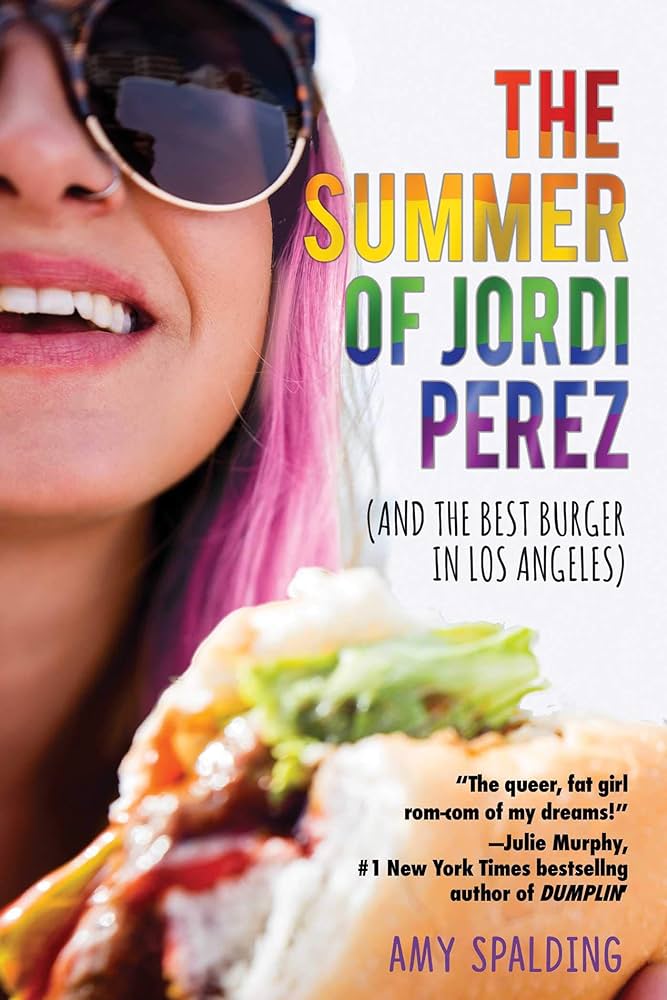
The story begins with Abby writing a letter to score an internship at a local boutique store. I did not realize there are still small stores with designer owners, but I’m also not from Los Angeles, where the novel is set. Abby gets the internship only to realize Jordi Perez got it, too. Since they are unpaid and the owner saw potential in both girls, they’re both brought on board.
This is a summer of transition. Abby’s best friend has a boyfriend. The boyfriend has a best friend named Jax, and both he and Abby are single, which means they both feel like third wheels (just go with me). You may see a set up coming, but Abby is an out lesbian. Instead, Jax, a total dude-bro, befriends Abby, a fat fashionista with a designer’s eye, through a project: eat and rate burgers in Los Angeles to find the best one. Jax’s dad is a tech-bro who wants to launch an app called Best Blank in which people can rate specific food groups. Jax and Abby are beta testing it with burgers, meaning burgers for free, riding in Jax’s sports car, and getting to know each other.
But the heart of the story lies with Jordi — her name is in the title — and how Abby has developed a crush on her. Fairly quickly, the girls realize the feelings are mutual, and they start dating. I found it interesting that everyone in the story tells Abby what she is like: cute, hot, stylish, loquacious, a good blogger, able to analyze social media for business reasons, and motivated. However, Abby can’t agree with the positive comments about her body, though she says nothing negative about it, either. Abby comes face-to-face with her ambivalence because Jordi, who was chosen for the internship because she is an aspiring photographer, takes loads of photos of Abby. However, Abby doesn’t want people to see the pictures, nor will she include photos of herself on her popular style blog. Even dude-bro Jax sees what’s going on:
“Man,” he says, “your self-esteem . . .” He mimes a plane with his hand and then makes the hand-plane crash.
“I’m just realistic,” I say. “Why do people treat realism as pessimism?”
“You’re fucking cute,” he says. “You know that. You wouldn’t wear all your weird fruity clothes if you didn’t think that.”
“It’s two separate things,” I say. Isn’t it? “Also, it’s just a weird coincidence you saw my lemon shorts and this pineapple shirt.”
“It’s not a weird coincidence you own all of it,” he says.
The hard thing is, I think I might be an Abby-type. I do not shame people for their weight, I do not believe I am a bad person because of my body, and yet I cannot understand where people are coming from when they say nice things about my appearance. In fact, I get mad that people care about appearances at all, while still hoping that someone will think I’m cute and it will be 100% objectively true.
Looking at the writing itself, at first, I was pretty irritated with the wording in Spalding’s book. Abby uses words like “bananas” and “wacky,” and has Spalding ever been in a public school?? Or were things just that different between 1999 – 2003 when I roamed the halls? Abby stands out as a little too “cute” with her language, especially when she blurts out stupid things, revealing the seams on an author’s carefully crafted awkward moment. For me, an awkward moment is when that senior in drama class was auditioning for a role in Dracula, but got too carried away with his hide-behind-the-cape-and-dash-out exit, just to run face first into a wall partition. Or getting the girl who said she was wearing a thong and got her period unexpectedly that day. I don’t find “tee hee” moments to be awkward enough to capture the teen experience. Perhaps that why I like a different YA novel, Fat Angie, so much. Being a teen is brutal, and I don’t think it’s fair to sugar coat that.
On the other hand, one moment of realism that stood out to me was when Abby realized that friendships will change with age. I’m not sure how boys experience it, but girls often develop one-on-one friendships that are so intimate and important they mimic romantic relationships. Ever wonder why two girl friends fighting is so devastating? When Abby needs her best friend, who is busy with a boyfriend, Abby realizes: “…she probably has no idea that I expected a best-friends-only day — that I felt like I needed one. I’m not even sure if a best-friends-only day is something I can expect at seventeen years old.”
Overall, there is a lot to like about The Summer of Jordi Perez, even with all the G-rated twee stuff, and I respect how complicated it is to move through the world as a fat person who struggles to apply their deepest beliefs about respect for fat people but cannot accept the same truths for themselves:
“It’s hard to think of myself as beautiful. . . . People HATE fat girls. The way people talk online. They way people will just STARE sometimes . . .”
“That doesn’t make you ugly,” Jordi says. “Fuck those people.”
“I wish it was that easy, “I say. “It’s not always that easy for me.”
 Grab the Lapels
It’s definitely not that easy to believe about your fat self what you believe and admire about other people.
LikeLike
I absolutely cannot figure out why, though. I think maybe there are other things inside ourselves that we know that other people don’t know that are fat-connected. Like, I have anxiety, so my blood pressure will go up pretty easily. However, I see my fat self and think, “Oh, I did this high blood pressure thing to myself through eating and sitting around,” and then that’s called self-hate.
LikeLiked by 1 person
It does sound a bit twee, but even kids need some fantasy relief from being teens sometimes because, as you say, it’s brutal. So maybe that was the author’s intent? Also, did they decide where the best burger place in LA is?
LikeLike
In-And-Out Burger! LOL. I was surprised. They went to all sorts of independent, creative restaurants, too. I wonder what a YA novel written by a teen would look like. When I Googled what’s out there, I got back Mary Shelley and Arthur Rimbaud, Miles Franklin and Anne Frank. You know, totally normal teens.
LikeLiked by 2 people
Ha ha, totally normal teens! 😀
Ok, so I lived in LA for about 4 years and I have to say the In-N-Out Burger in the Valley was really really good. At the time they made everything fresh on site from burgers to fries. And their shakes, soo good. Obviously this was pre-vegan days! LOL I have heard though since they hit the national fast food big time, the quality has greatly decreased. Still, kinda funny that In-N-Out still got the best burger vote.
LikeLike
I cannot, for the life of me, picture you eating a burger or a shake. Does now Stefanie miss those burgers, or just past Stefanie?
LikeLike
Now Stefanie does not miss them at all, and while past me really liked them, it turned out that she didn’t like them as much as she thought she did 🙂
LikeLiked by 1 person
This sounds cute – although the vocab choices do sound a bit anachronistic. Maybe it’s like an adult rom-com – escapism with a smidge of reality. Although with more reality than most rom-coms, with the fat and the queer rep.
LikeLike
I guess I wish bullies weren’t stereotypical, and that the people dating break up over one comment. I hate to say it, but in real life, sometimes the bullies get away with things, or they’re actually smart, and sometimes people are horrible to each other and keep dating, which becomes so toxic and pervasive to the people involved.
LikeLiked by 1 person
I hope this is not inappropriate but I have been a dead average size all my life. However, I have also eschewed the whole beauty and appearance culture. No hair colouring, no make-up, no nail colouring etc. And yet, even now, I will sometimes feel what you are saying. It’s my decision but I will still feel lesser at times. The pull is so strong in our culture. You have to be strong to be yourself …
I can’t comment on your critique of the novel in terms of its accuracy as I don’t know your era or this era well enough in terms of YA experience!
This – “Why do people treat realism as pessimism?” I often told my (wonderful) mother she was a pessimist but she would argue that she was a realist. I look like more of an optimist but I argue I’m a realist! I hope for the better but recognise the challenges to it. A bit tangential I’m sorry but that just caught my attention.
LikeLike
This is a great comment, Sue, and no need to apologize for taking up space in the comment section. I think it’s fascinating when people are the same size their entire lives. I always wonder if it’s genetics, a really steady diet and activity, if the activity is more fun because of the climate, etc. In the U.S., I’ve heard people talk about gaining a lot of weight in the winter because it’s too cold, but some people say they gain weight in the summer because it’s too hot. We’re constantly navigating the outdoors (and the last two years it’s been poor air quality from extreme pollen or forest fires). What we’re left with are gyms, which can be costly, too far away, or you feel like a hamster on the wheel.
Looking at media today, I believe there is a MUCH stronger pull now than when I was growing up to change yourself: hair color, make up, etc. Plastic surgery is HUGE here in the U.S., and not to be crude, but people call the current style of plastic surgery the blow-up doll look. I find it interesting that the look popular now also mimics the exaggerated, wonderful look that drag queens apply. I heard/read somewhere recently that a lot of makeup trendsetters are drag artists, so now you see straight-women who look like they’re doing drag with both plastic surgery and makeup, but because they’re straight cis-women, they’re labeled blow-up dolls instead of empowered, like drag queens. It’s all so fascinating.
Your conversation with your mom about realism is interesting because I feel like the two of you are discussing outlook. To have a realistic outlook that is positive or negative. I think what Abby is talking about in the book is what is perceives as real vs. her own outlook on things. She sees fat hate and knows it’s real, but where she is not, I would argue, is realistic is when she applies all fat hate to herself despite being surrounded by people who do not hate her for her fatness.
LikeLike
Darn it, I replied to this lovely response but it has clearly gone poof. That is so irritating. It seems to happen sometimes when I comment on my phone via the Jetpack app. I worry that it happens at times without my knowing.
I can’t remember all I said but I did say that I think for me it’s mostly genetics because I am not a highly active person, and what I do do, walking and yoga, I do all seasons. I will put on a little in winter because I’ll eat more “comfort” food but will usually lose it again in summer when I return to salads!
I think you have a point about outlook. Mum and I would see the same reality but think about it differently.
LikeLike
Sometimes it seems like my comment is still loading on Jetpacks, so I’ll copy it just in case, and then hit back. I paste and hit send, and most of the time, Jetpack tells me the comment already went through.
LikeLike
Yes I sometimes copy before I send if it’s feeling uncertain but not always.
LikeLiked by 1 person
On realism vs optimism vs pessimism, I recently heard the phrase “cheerful pessimist” and I feel like that’s a good description of me – I generally expect difficult things to happen more often than good things, but I also expect I will be able to deal with and learn from them as they come up. (I’m not always that philosophical about it when the bad things are actually happening, mind). Which is a sort of combination of optimism, realism, and pessimism all at once, I think!
LikeLiked by 1 person
Realism is tough because while I like the motto “facts don’t care about your feelings,” sometimes our “facts” actually are a product of our feelings, which we developed from our families and communities. If someone says, “that’s just the way it is,” we may think that is a fact. In this case, Abby is worried that everyone online will be awful to her if she shares a photo because online trolls are vile to fat people. This is true; in fact, I have had comments that I deleted when they were in queue because it was some random person who found my blog (all first-time comments going into the queue) and just wanted to say something nasty.
LikeLike
My teenagerhood was straight of a Boys Own book (except I went to a co-ed government school). Of course I was awkward, but we all were, except the really cool crowd. If I’m even aware of ‘brutal’ teenagerhoods, it’s only because my kids – your age, a little older – and my oldest granddaughter had periods where they were doing it tough. I listen to YA off and on and enjoy it if it’s not too goody goody.
LikeLike
Same here Bill … I had the usual girl angsty stuff, but it was my son really who had the more brutal time.
LikeLike
I was mostly fine in high school, but I remember lots of people being bullied. It really was middle school (ages 12-14) that was super awful, lonely, and friendless.
LikeLike
I do think things are changing. For example, I swear my niece might be a “mean girl,” but she also knows what she wants and won’t go with the flow just because someone wants her to. That can be a difficult personality to navigate, but she’s also not struggling to be seen, which many of us often felt we were. I was pretty brazen myself, once I realized that if I did not become myself, I would become no one. However, swinging from miserable and depressed to brash isn’t really where you want to be either. It made me closed-minded for a long time.
LikeLike
I know you see the unbelievability of having a fourth guy, rich, with a sports car, wanting to get burgers and be nice to you is somehow a problem (quite sure most teenage girls, straight or lesbian, would see the potential in this right away) but aside from that, this sounds like a fun read. Spalding…hmmm is that back now? Perhaps?
LikeLike
Actually, I had rich, straight, white, male friends who owned sports cars, and I totally rode in those cars, so….like, I didn’t have a problem with it then, and I’m not sure I’ve changed my mind much in the interim.
LikeLiked by 1 person
Thanks so much, Melanie. I put it down mostly to genetics and diet in terms of me. Anyhow, I will often put on a small amount of winter because I will eat more comfort food, and I’m not a particularly active person. It is what I eat and how much I eat that affects my weight and presumably genetics of my metabolism.
Regarding appearance that might be so, but there was big pressure in our time, and I was an outlier amongst my friends. Even my feminist friends coloured their hair when they started going grey. I felt very lonely for while, in fact. The difference now, though, might be social media, which I guess means that pressure is more in your face? And as you say, plastic surgery, though I think that sounds like a bigger pressure in the US than here. We hear about it, plus Botox etc, but not all the time. What you describe is interesting, particularly regarding straight women and drag queens.
I think you’re right about outlook. It’s a good way of describing the difference. We both saw what was happening in the world, but mum was more negative about it.
LikeLiked by 1 person
This sounds pretty good! I think many of us are far harder on ourselves than we ever are on anyone else. Especially as a teenager, I judged my own body with a harshness I would never cast on anyone else.
LikeLiked by 1 person
I find it interesting that being part of interpreting really lifts my self-confidence and self-esteem, but I still have body issues that just get out of control sometimes. I’m not sure why I need to control myself — that sounds harsh — but there has to be some kind of in between. Like, maybe my body lets other people down? Can that even be a thing?
LikeLiked by 1 person
I wonder if interpreting enables you to use your body in a new way and so lifts your confidence? I think I know what you mean by feeling like your body lets others down because I think I’ve felt that myself. At the same time, I’ve never actually felt let down by the bodies of others and so I try to remember to extend that same grace to myself.
LikeLike
I think I feel more confident because I’m making connections with people all the time, and the local Deaf community is so friendly and inclusive, so you start to feel like you’re part of something. I suppose that’s what most of us want: to be part of something.
LikeLiked by 1 person