
When you read Melissa Orlov’s bio on her website, there is no mention of degrees or teaching in psychology. Instead, we learn that Orlov’s own marriage almost collapsed in a fiery heap, but now she is one of the leading researchers on the topic. She runs a blog where people write in their experiences and find resources. While her ethos doesn’t bolster our trust in her the way some people with the alphabet soup at the end of their names will, her personal experience lets you know she’s been where you are.
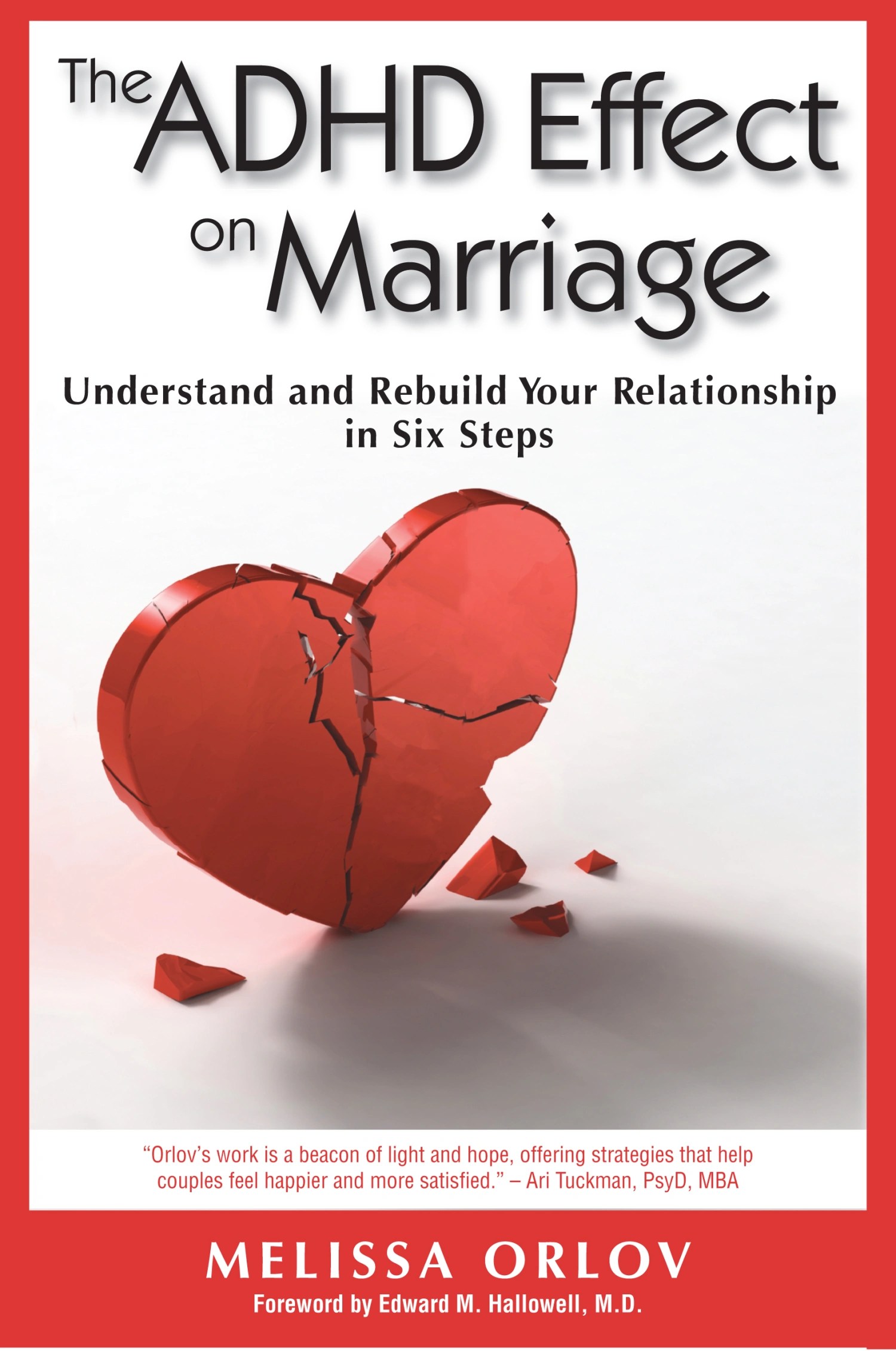
The ADHD Effect on Marriage: Understand and Rebuild Your Relationship in Six Steps is personable and readable. It’s broken down so you can take it one chapter at a time and discuss it with your partner or spouse, like my husband and I did. In our case, he has ADHD and I have anxiety, two mental health conditions that do not mix well. Oftentimes, ADHD causes a person to seem (or be) unreliable while anxiety makes people look for unreliable behaviors that suggest “danger” is ahead. Ha ha ha.
I do have Nick’s permission to write about this book, so I’ll share some of what I learned. People with ADHD and people who do not have ADHD are not alike. In fact, we can seem downright foreign to each other. We will not understand each other, nor will explaining help. We cannot imagine the other person’s experiences.
However, Orlov writes about ways to structure a conversation to avoid fights. One typical pattern is the person with ADHD does something unreliable, and the other person steps into “parent mode,” because the person with ADHD seems like a child: unable to care for himself. In fact, some of the most frustrated people who shared examples for Orlov’s book are women with children married to a man with ADHD.
While she does include a lot of personal information about her husband — and his girlfriend — Orlov adds many such excerpts from submissions people put on her website, a place where they are comfortable venting (the non-ADHD spouse) and frustrated or disrespected (the ADHD spouse). You start to see yourself in the pages through the anecdotes. Orlov does include data with the source material cited in footnotes, though that is not the crux of the book. The ADHD Effect on Marriage is more about synthesizing people’s experiences and solutions.
Besides understanding we won’t understand each other, the biggest take away is that neither spouse can control the other, so trying harder (and louder) won’t make a difference. We need to try differently and keep things creative. ADHD folks thrive on newness, Orlov explains, which is part of why they easily sweep a new romantic partner off her feet! He’s fun, creative, adventurous, and obsessed with her! All things that make a person’s knees weak. But once the relationship is “locked down,” he can mentally move on to whatever else is new, making his partner feel tricked. How do you get back to the novelty of the relationship? Orlov has ideas.
Orlov’s work has been approved by numerous psychologists and therapists, and she never denies the usefulness of therapy and medication. Generally, she uses the word “treatment” because both spouses will need it. For me, a year of therapy worked. For Nick, therapy was a disaster, but medication and learning about himself, my perspective, and our life is the right treatment as of now.
 Grab the Lapels
James has undiagnosed ADHD. He considered once getting the actual diagnosis for OSHA/disability rights reasons, but when presented with all the paperwork and questions he was asked to answer about his past life, etc, he couldn’t do it, had no patience for it and was frustrated by the entire process so never pursued it. However, we’ve done lots of reading and research and worked hard and continue to work hard, on our relationship and communication. He finds calm in having a regular routine/schedule and gets upset when unplanned things happen. But he also plays video games a lot (his need for the busy and new) and runs his kitchen like a mad scientist 😀 We get frustrated with one another sometimes, but we’ve been working together for over 32 years, so we must be doing something right 🙂 If you’ve not read Gabor Mate’s book Scattered Minds, I highly recommend it.
LikeLike
Thank you for recommending a book to me. I know that we are going to finish the two Melissa Orlov books and it will only be the beginning. If James is undiagnosed, I assume that means he does not have medication. I know when Nick got his medicine, it brought the “noise” down a bit. Yes, he still struggles, no he’s not “cured” (because, as you know, he can’t be), but that noise coming down made a world of difference, especially in the highs and lows of getting stuck in one spot and occasional depression.
LikeLiked by 1 person
Correct, James is not taking medication. Because he self-medicated as a teen into his early 20s with drugs and alcohol, he has no interest in taking medication because he is afraid it might affect his sobriety and his mental health in relation to it. We work on behavior modification, mindfulness, and plain old acceptance by embracing his neurodivergence and not trying to be “normal.” Not to say he/we have it all figured out, some days are better than others, only, this is the approach he prefers so we work with it 🙂
LikeLike
That makes so much sense. The book never talked about how a prescription for ADHD might interfere with the behaviors or brain chemistry of someone who self medicated in the past — and according to the book, there are so many forms of self medicating, from drugs, alcohol, and tobacco, to picking fights, having affairs, and driving dangerously fast.
LikeLiked by 1 person
Yup, self-medication takes many forms. When James is stressed out or extra tired is when he has the hardest time and that’s when he plays video games, a lot. Drives me wild sometimes, but I don’t say anything unless it interferes with other things. We all have things we do that help us cope, I mean, I spend hours on my bike every week not just commuting back and forth to work.
LikeLiked by 1 person
I’m glad that this book was helpful for you guys!
LikeLiked by 1 person
I’m going to read this book thanks for sharing
LikeLiked by 1 person
You’re welcome. There is a second book about thriving in a marriage when one or both partners have ADHD. I recommend reading it together with your spouse, otherwise you may feel like you’re explaining it to him/her, which does not have the same effect.
LikeLike
I’m glad this was helpful! Sometimes these kinds of books can draw too heavily on the author’s experiences and make the mistake of assuming those will be relevant for everyone, but it sounds like Orlov has the balance right.
LikeLike
Her personal examples were often embarrassing to her, and I think the point was that ADHD can make people feel like they’re losing themselves. Fortunately, having a website of her own allowed her to get in lots of different viewpoints.
LikeLike
Good on you both for allowing your own experience to be part of the review. In marriage especially I think it is important to take notice of how other people have dealt with the same situation. My own experience (no ADHD involved) was that talking in a formal situation – family therapy – enabled me to both talk and listen, which I had found impossible in unstructured situations.
LikeLike
One thing I find challenging is that after being married for 14 years, some of the stuff from back when we were in our early 20’s feels like different people, so it’s easy to forget about it. But it’s important to stop and really think about where we have come from because it IS such a long way. The more I learn about various mental conditions that affect a person, the more I realize that NOT understand the other person is totally normal and fine. We do not need to ask “Why?” all the time and expect an answer. Asking why is part of what makes anxiety worse, in fact.
LikeLike
I love how open and sharing you are.
I liked this “We cannot imagine the other person’s experiences.” because I think that’s true of a lot of us. It’s darned hard work imagining the experience of another, particularly if they view the world through different eyes. Mr Gums does not have ADHD, but he is easily stressed, impatient with inefficient behaviour, and is risk-averse. I can get stressed too but about different things usually to do with having to make decisions or do things that might upset others, but I’m patient and don’t see efficiency as the only criteria for how you do things. It’s a challenge coping with such different world views. I’d like a book on our differences!
LikeLike
Oh, wow, I sound more like your husband! Those are all facets of anxiety, especially when someone doesn’t do something in the way we think is the most efficient. What’s funny is ADHD people do things in terrible inefficient ways (or so it looks from the outside), but I often learn that Nick has done it better than I would despite it taking him an hour to do what I could in a few minutes.
The only book I can think of is Men are From Mars, Women are From Venus, but I never would encourage such a book that only looks at gender from a 1992 point of view!
LikeLike
That’s interesting Melanie… I think you might be right about my husband. I really feel for him as he lives with such stress, and I feel for me sometimes too as I also have to live with it!
LikeLiked by 1 person
Oh and I didn’t read that book when it was
all the rage for that reason.
LikeLiked by 1 person
I’m glad you’ve found things that work for the two of you and books can be such a great resource to learn how other people handle similar situations. A close friend was diagnosed with ADHD as an adult and although, as you say, I just can’t understand how their brain works, it helps to reframe what I once viewed as thoughtlessness or a lack of care.
LikeLike
There are many destructive ways a person with ADHD may soothe themselves, too, such as drinking, smoking, drug use, being argumentative, picking fights, speeding while driving, etc. I wonder if your friend is prone to any of those.
LikeLiked by 1 person
Fortunately, no. In my experience, it was more things like being chronically late or not following through with things they said they would do. Promising to show up somewhere important and then cancelling last minute. Stuff like that felt very hurtful to me (and still can, honestly) but having a different way to frame that behaviour and to understand that it’s actually really hard for them, helps me to not just see it as them not caring about me.
LikeLiked by 1 person
Thanks for your openness about this Melanie, and I think this book may be helpful for myself and my husband! I don’t believe he was ever formally diagnosed with ADHD (maybe in high school) but I’ve complained before about my husband’s unreliable tendencies, like being late to everything, which is something I’ve just come to accept, even though like you, I have anxiety, and his being late to everything makes my anxiety worse. So, perhaps I need to give this one a try?
LikeLike
ADHD and Anxiety certainly go together poorly. I had to do a lot of work on myself because, as the book says, you can only control what you do, which includes communicating your standards. If the spouse breaks your standards many times, it may be the relationship won’t work. Of course, those standards include things like being safe around your children (like not speeding in the car) or not having affairs, two things that are more common in people with ADHD.
LikeLiked by 1 person
Oh wow that’s really interesting. My husband does like to speed but his father is like that too LOL
LikeLike
If someone has ADHD, there is a 50% chance one of their kids has it, too, meaning A) your father-in-law could also have ADHD, and B) your kids have a 50% chance of having it.
LikeLiked by 1 person
which is why I think reading this book will be so helpful (it arrived!). It will help prepare me for my kids too as they grow older
LikeLike
Oh, good! If you want to talk about it, point something out, ask if I experience the same thing, or ask a question, shoot me an email. You have my address, I believe.
LikeLiked by 1 person
I will, thanks Melanie!
LikeLiked by 1 person
[…] you everyone for your thoughtful comments on my review of The ADHD Effect on Marriage by Melissa Orlov. It’s wild that I remember when Ritalin was first prescribed regularly to […]
LikeLike
That’s really interesting, and thank you both for sharing your marriage experiences too. While neither of us has ADHD, someone I work with in a volunteer role does and I do find myself stepping in and taking over – but presumably you’re not supposed to do that!
LikeLike
While not married to her, Moth has ADD and I do not (at least never tested, I feel I have a touch of it if that makes sense). We operate differently but complement each other, I feel. But I also think, being practically raised together, that we’ve adapted to each other and the way we each work differently. This leads me to say that I’ve never even considered that it could be a thing that causes so much trouble in relationships. It makes sense though now that I know it does. In my own experience, two people having anxiety in a relationship can definitely cause heads to butt. That could be a book on its own as well.
LikeLike
I’ve tried to read books about anxiety before, but they just gave me anxiety. What a terrible feeling. I didn’t know Moth has ADHD. What’s weird is I always thought it was ADD, but apparently that’s not even a psychology term anymore? The book we are reading now calls it something different, though I can’t remember now. I know the H stood for “hyperfocused” in her book instead of “hyperactivity.” I did used to picture kids with ADD running around, chasing squirrels, but it’s more like Nick is unable to sit still and when he starts a project, he deep dives like he’s ready to find the bottom of the ocean, hence the “hyperfocused.”
LikeLiked by 1 person
I knew one of the two abbreviations had changed but I couldn’t remember which one. That description of Nick is Moth to the T. 😛
LikeLike
I’m not sure if it legit changed or if that is just how people who have ADHD or are affected by it are now explaining it.
LikeLiked by 1 person
Orlov is NOT a researcher. She is a marketing strategist.
LikeLike
Reading her books, I’m getting the feeling she is a person with lived experience more than a researcher, so in that regard, I agree with you.
LikeLike