
If you’re paying attention, you’ll notice women’s horror writing tends to be softer, more romantic and paranormal (witches, vampires) than men’s horror writing (serial killers, creature features). When I saw Judith Hawkes’s book The Heart of a Witch at Goodwill, I knew it would be on the softer side based on the cover alone, but I cannot resist a spooky mass-market paperback. They just fit in your hands SO WELL.
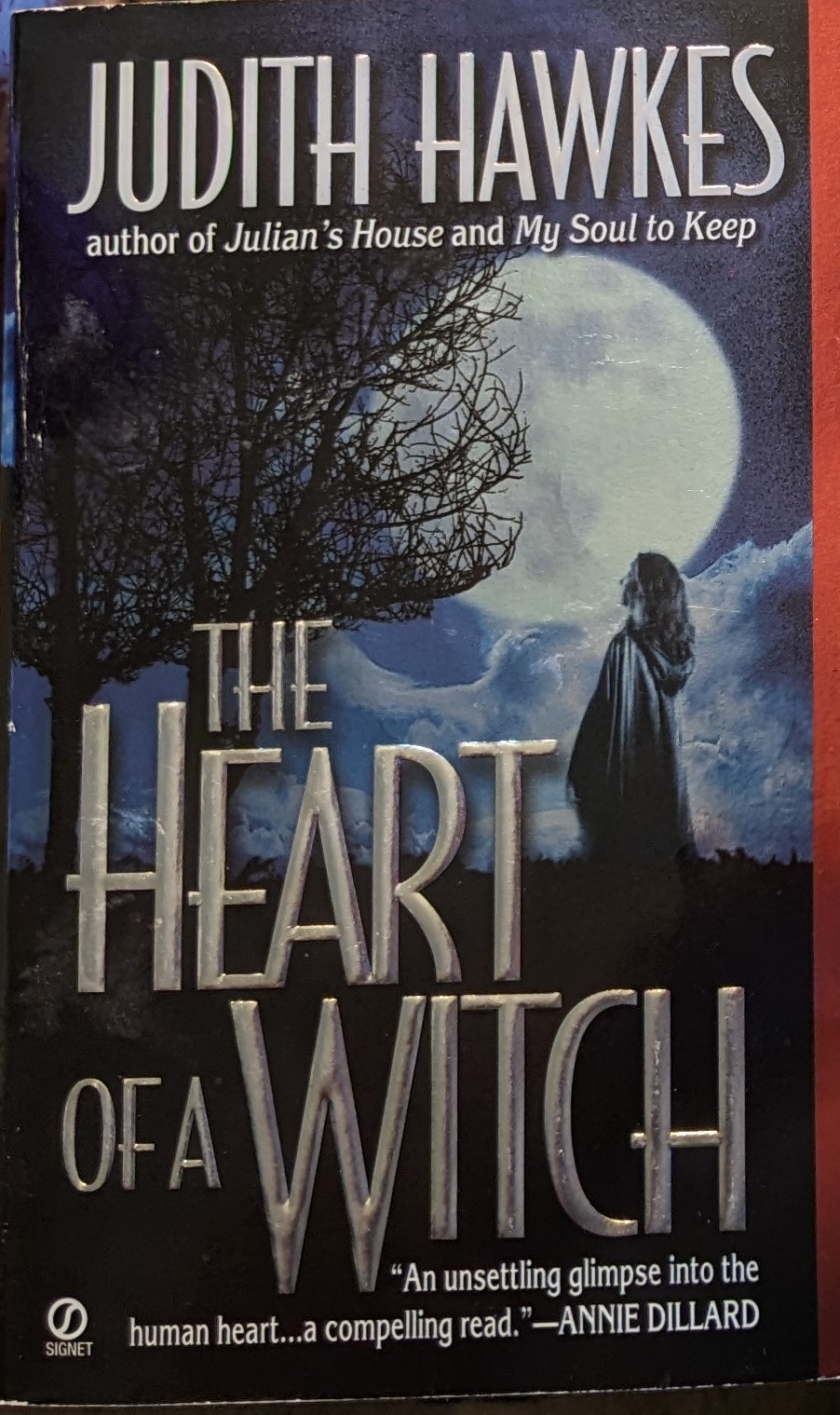
Look again at that cover. Do you see who endorsed it? Annie Dillard, famous for her essays, her nature writing, and winning the 1975 Pulitzer Prize in nonfiction. Huh. Truly, The Heart of a Witch is neither horror nor romance, so I was wrong on both accounts. It’s a coming-of-age tale about twins Shelley and Kip, named by their English teacher father after his favorite writers. Kip is the leader of the two, convincing his sister to do things she doesn’t want, like crossing the street without an adult, later trespassing, and finally joining a coven.
The coven meets at an inn across the street, an inn that is described like a Victorian bed and breakfast. It’s run by Snow, the leader of the coven, which currently has eleven members. If Kip and Shelley pass their trial year as apprentices, the coven will number thirteen and be more powerful.
Though Heart of a Witch was published in 1999, I believe it is set in the 1950’s. Everyone is buttoned up sexually and has sit-down family meals each night. So when the coven take off all their clothes and don robes to create a circle in which to worship, Shelley and Kip feel culturally off kilter. Sexual taboos are broken left and right: random sexual partners when they form a witches circle, nudity in group rituals, same-sex pairings for an evening, and even incest. The witches make convincing arguments for all the taboos broken.
On the other hand, the popular witch move loved by teen girls, The Craft, came out in 1996, so there was renewed interest in female empowerment through magic. In fact, the book has a scene in which Snow asks each coven member how he or she enters their circle, and I can almost hear The Craft word for word:
“For know it is better to fall on my blade and perish now, than to make the attempt with fear in your heart. How come you to this circle?”
“In perfect love and perfect trust.”
The narration switches between 3rd-person limited omniscient (following Shelley) and Shelley’s first-person point of view. The result is we sometimes watch Shelley from the outside and then later learn in-depth what she knew, chose, felt, or was surprised by. It flows smoothly, giving the reader both space from and intimacy with this teen girl who is hesitant about becoming a witch, though Snow sees potential in Shelley. It is Kip who is impulsive and wants to learn all the spells and rituals right now without the patience the coven attempts to bestow upon the twins. Each time Shelley fails a small task, she doubts herself. Snow encourages Shelley to see herself independent of her twin, with little progress.
In the background of the plot, someone is kidnapping children, which has police baffled, the community living in fear, and the coven suspicious that a dark witch is eating children to power his or her magic. Kip strains to get ahead in his training and help, while Shelley clings to her relationship with her twin as they mature into adults. And Snow, both a mother and lover figure, comes between the siblings by introducing sexual intimacy. In response, Shelley tries to find a moment of hypocrisy that she can throw in the faces of the coven members to convince Kip that they should go back to their “normal” lives.
An interesting, well-written read with a mystery, witch craft, and boundary-pushing ideas about how to be a person.
 Grab the Lapels
That “eating children” to “power magic” is often a necromancy trope, tied up in the attempt to live beyond a natural span.
LikeLiked by 1 person
Heck yeah, and you’re the perfect person to point that out with you amazing blog title. I love it, Jeanne 😀
LikeLiked by 1 person
Huh, not what I would have expected. Sounds pretty well done. I’m curious how it ends, but I don’t want you to spoil the ending for others so I will just keep my curiosity to myself 🙂
LikeLiked by 1 person
Bleakly, as many randomly-found mass-market paperbacks do. I swear it’s a whole thing. I even read books about mass-market paperbacks because I love them so much. Paperback Crush and Paperbacks from Hell, both from Quirk Books, come to mind.
LikeLiked by 1 person
That endorsement from Annie Dillard seems so random. The whole description of the book sounds very 90s to me. It does seem like there were a lot of witch-type books and movies around at that time.
LikeLiked by 1 person
I do wonder if The Craft kicked it all off, or what. We were all going goth in the late 90’s anyway.
LikeLiked by 1 person
Witches seem very popular at the moment. As you say, female empowerment. Sorry you didn’t get any horror this time. The 1950s stuff might have been a reference to Dennis Wheatley who wrote magic stuff with sex scenes, very popular with young men in the 1950s and 60s.
Kip and Shelley remind me of a time when my own kids, maybe 5,7 and 8, ran away from home but because they couldn’t cross the street kept going around the block until a neighbour brought them home.
LikeLiked by 1 person
…..what your kids really needed was one good friend who was a bad influence. Although, I must confess them going in circles is pretty funny. Did they ever say why they were running away from home?
LikeLike
Probably it was just an adventure. When the youngest was 15 or so she and a girlfriend disappeared for two days. When they finally reappeared it turns out they had been camping in the mountains, 300 km away, just to show they were independent. And in that case my daughter was the “bad influence”.
LikeLike
Welp…..someone has to be the bad influence, so why not your doubly-independent kid!
LikeLike
I too love a mass-market paperback (though of science fiction rather than horror or romance) – whenever I come across them in charity shops I’m tempted, even if I’ve never heard of them or they are midway through a series.
LikeLiked by 1 person
So true! Do you have any theories as to why they are so good? I swear they get away with some “dangerous” content that wouldn’t be “fit” for a really big-name company to put out. Like I mentioned in my review, this book talks about incest.
LikeLiked by 1 person
I feel like mass-market genre is focused on having a really gripping plot – that’s their selling point. Because people pick them up not expecting any particularly deep themes or analysis, I think they can get away with more interesting themes than stuff that’s marketed *on* its themes (if this makes sense!)
LikeLike
That completely makes sense and puts into words what I could not myself explain! And you’re right about the plot being the “big deal.” I spent so long in grad school reading books that were about abstract this and that, so now I’m drawn to plots.
LikeLike
Mass market paperbacks are the best! Although sometimes I find the font a bit small…
This sounds like a book that would have come out in the 70s, I’m surprised it’s only from 1999, that feels very recent to me!
LikeLiked by 1 person
It’s like they’re trying to save paper, or something, which, on the one hand, yay environment, but on the other hand, it takes me so long to get through one page. If I am organizing a book club and split the reading of a mass-market paperback, I always have to be mindful that 75 pages isn’t really 75 pages.
LikeLiked by 1 person
That Annie Dillard blurb is surprising. I wonder if she was a friend of the author?
LikeLike
No clue.
LikeLiked by 2 people
Mass market paperbacks always make me think of Lace and the like which did the rounds at school, and then a whole load by Anne Rivers Siddons I bought in the US. I also have some Larry McMurtry’s which are satisfyingly high page count which they need to be, don’t they, somehow?
LikeLiked by 1 person
I only recently learned of Anne Rivers Siddons because she has one horror novel that is supposed to be totally bangin’. Everything by her at my library looks kissy-kissy.
LikeLike
Of course, I am unlikely to read this, but as always I loved your post. I do have one bone to pick with you though about dating, re “Though Heart of a Witch was published in 1999, I believe it is set in the 1950’s. Everyone is buttoned up sexually and has sit-down family meals each night.” In 1999, my kids were 15 and 12, and we had sit-down family meals every night. (I don’t think we were buttoned-up sexually though!)
I enjoyed your opening comment about the cover, and then that, in fact it wasn’t quite what it seemed.
Also I like it when the 3rd person/1st person alternation is done well. It can add such perspective to a story.
LikeLiked by 1 person
In 1999 in the U.S. we were famously unable to sit down and have a family meal, and the kids were being corrupted by goths, sex, cable television, and violent video games. Oddly, on the other side was pop culture for teens that was a strange virgin-slut dynamic with a burst of boy bands and girl singers, like Britney Spears, the Spice Girls, and Christina Aguilera.
LikeLike
Fascinating Melanie… goths were around here, as were the Spice Girls. My kids were teens in 1999 (well my daughter was all but a teen). I THINK most of my friends did the family dinner thing, but we did (do) live in what’s called the “Canberra Bubble”, ie Canberrans are apparently out of step with the rest of the nation (as evidenced by the fact that ours was the only state/territory in Australian which voted YES in the recent referendum.) All this is to say that you should take what I saw about Australian life and behaviour with a grain of salt!!
LikeLike
I wonder what led to the Canberra Bubble. I know you’re in the capital, but I wonder if there is just something different that kept you from behaving like other rest of Australia, or even other cities.
LikeLike
[…] far as I can tell, I am done with witch books, like The Heart of a Witch by Judith Hawke, for now. I’m moving on to more nonfiction for my commute, which I find easier to listen to. […]
LikeLike
The Craft had such a profound impact on 90s kids. Dani and I were convinced by a friend to join her coven after that movie came out. We did it for fun but when she wanted to start pricking fingers and sharing blood, we bounced. As we recently discussed, I knew what HIV/AIDS was and I was not about to take that risk.
LikeLiked by 1 person
I was SO PARANOID about blood in the 90’s, and I don’t even remember someone telling me what AIDS was. Pervasive, that’s what it was.
LikeLiked by 2 people
Yeah, it was very much “DO NOT TOUCH ANYONE’S BLOOD” back then.
LikeLiked by 1 person
I remember watching My Girl and getting panicky when they did the blood brothers thing.
LikeLiked by 1 person