
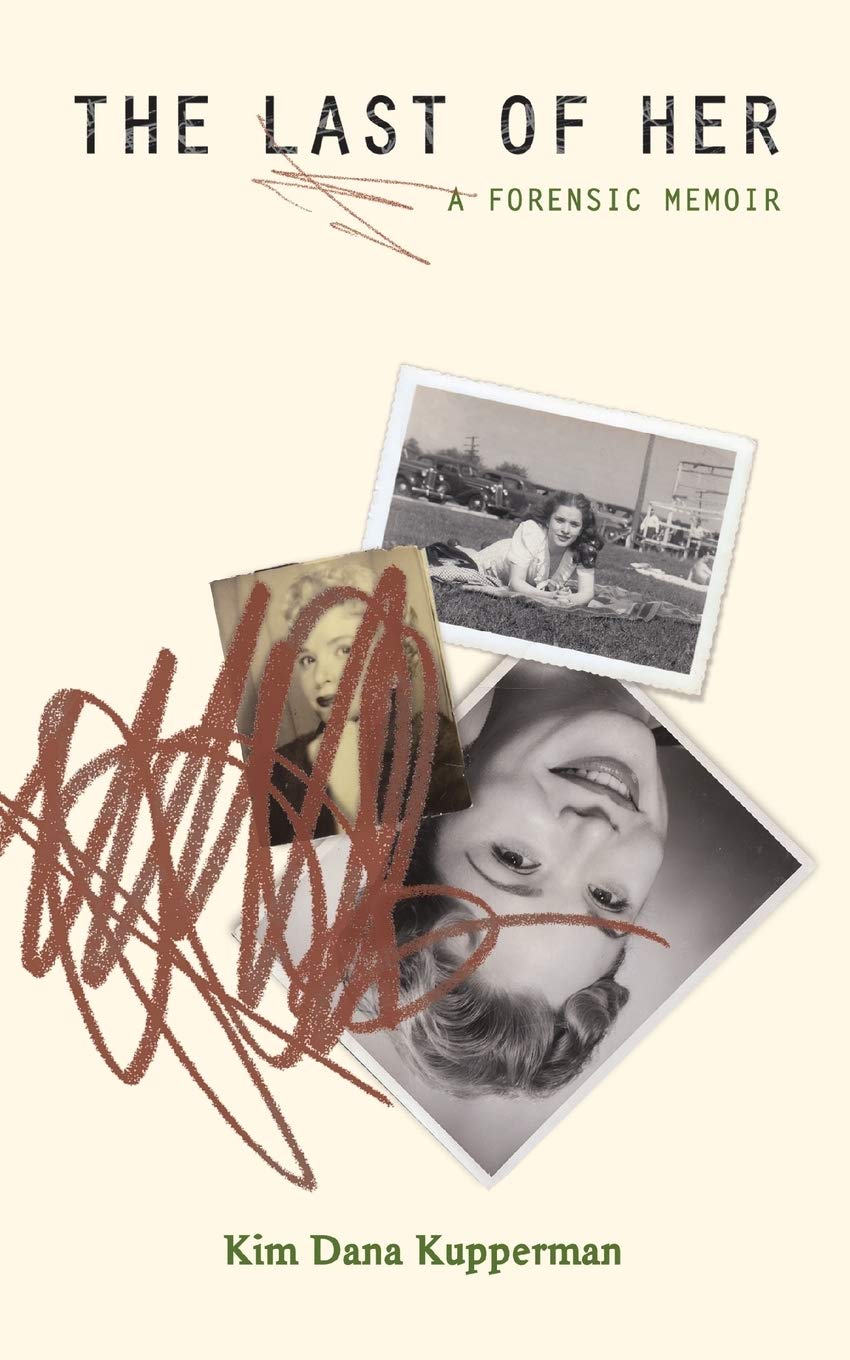
Advertised as a book about suicide and lies, The Last of Her: A Forensic Memoir by Kim Dana Kupperman has excellent shelf appeal. You pick it up, you read the synopsis, you see that cover with the beautiful woman scribbled out with brown crayon, and your eye catches that word — “forensic” — meaning “relating to or denoting the application of scientific methods and techniques to the investigation of crime” (Oxford Languages dictionary), and you’re intrigued.
Author Kim Dana Kupperman introduces readers to her mother, who had many names, and even more she used to get social security cards. Living only two miles apart in New York City in 1989, Kupperman has gone “no contact” with her mother for the last two months. Kupperman knew that her mother engaged in various kinds of fraud:
…my mother perpetrated fraud using the social security numbers of the unsuspecting, often vulnerable women who rented the back room of her apartment. Because she collected disability, my mother was eligible for subsidized home health care. On paper she transformed those young women into home health-care attendants she had “hired,” for whom she received money from a Medicare-funded agency … She even convinced them… to submit urine samples to be drug tested.
But now her mother has a twisted scheme to get out of insurance fraud. Kupperman is to tell police that they are sisters, that their mother is alive in Florida (she’s dead), and that a man is caring for their mother (oddly, she picks a former landlord who was a known child predator). Kupperman refuses, and her mother calls her dozens of times per day, at Kupperman’s home and work, which gets her in trouble with her boss.
But then the doorman from Kupperman’s mother’s building leaves an answering machine message. Her mother is dead. As Kupperman rides in the taxi over, she wonders how much her mom paid the doorman to lie. When she gets there, she sees a police car and wonders how her mom orchestrated police presence to bolster the lie. Everything Kupperman sees is evidence of an extravagant lie to her. But then there her mother is, in her bed, naked, dead of suicide.
These first 89 pages are intriguing. Kupperman weaves a narrative that makes readers doubt themselves. Yes, her mother is toxic and a criminal, but isn’t her mother the victim, too? Kupperman reveals a history of two deaf grandparents; the grandfather falls off the roof at 29 and dies. Their daughter is given up to an orphanage because a single deaf mother cannot afford her. The girl gets out of the orphanage and quietly makes her way in the world, marrying a con man and having a daughter, then dying alone and young, from multiple sclerosis. Her daughter — the author’s mother — entered the world with spina bifida that requires surgery. She’s in pain, she says, and we believe her. She uses heroin to self-medicate.
But the story builds; we learn Kupperman’s father was a gambler and womanizer, but when it came to her custody battle, Kupperman spent time with both parents. Then, Kupperman’s mother is held in contempt for failing to return Kupperman to her father and loses custody. Was the court against her because she was a single, disabled woman and the father had a new wife in a professional field? Kupperman thinks so, which is a surprising moment during which she agrees with her mother. She fights to get her daughter back.
But the more we learn, the more we doubt. The year before Kupperman was born her mom was charged with assault of a pregnant woman. And, the father Kupperman’s mother worshipped and loved was a con man who trained her. And then the lies pile up. Who is this woman, and is she abusing everyone — individuals and the government — by garnering pity for a disability? Did she even really have multiple surgeries?
I was totally engaged with this fascinating woman and Kupperman’s reactions to her, which ranged from mad and distant to confused and paranoid, because she couldn’t trust anything. Kupperman has some sympathy for her mother, describing her as a woman who “navigated the margins in so many ways that she had become not quite predatory, but opportunistic, much like the coyote who lives on the edges created by an encroaching urbanite landscape.”
But then we got to the “forensic” part of the book. Unfortunately, Kupperman uses scant evidence to reconstruct key moments in her mother’s life. By reconstruct, I mean use facts as a wobby framework to write fictional walls. Instead of Kupperman’s reactions, which I so enjoyed, we’re inside her mother’s head, and her grandmother’s head, etc., before Kupperman was born. This is where I grew seriously disappointed. Firstly, it’s a gross misuse of the word “forensic.” Secondly, if you’re going to invent 60% of the book, why not write fiction inspired by your family history? In the end, it was oddly like I was looking in a mirror with Kupperman on the other side: we were both suspicious about what was fact.


Interesting Melanie… These sorts of books are challenging. If she wanted to keep it as non-fiction she needed to make clear that she’d b inventing those bits she didn’t know and make clear where those bits were. Otherwise, as you say, going the fiction route would be best. Regardless, what a strange story.
LikeLiked by 1 person
I have read fictional memoirs in which authors are really clear about what they’ve done before you start reading, and throughout the work they acknowledge what is totally made up. Elizabeth Crane wrote a book about her deceased mother in which they “talk” to each other, Crane asking questions and her mother “answering” how Crane thinks she would — and this whole dance is made clear every step of the way. It becomes interesting in the sense that you wonder what kinds of conversations you would have with your loved ones who are gone.
LikeLike
Oh that sounds interesting Melanie … I wonder if I would find it painful. I still talk to my Mum quite a bit, particularly when big things are going on in my life, like my current downsize. She would have been so sympathetic and caring about it.
LikeLike
Do you talk aloud, or do you write it out, or do you talk in your head?
LikeLike
Talk in my head mostly … though I do sometimes if I’m alone talk out loud but that’s more just saying “I miss you”. If I tell her things it’s in my head. That’s interesting isn’t it?
LikeLike
I think it’s lovely.
LikeLike
The first part of the book sounds super interesting and compelling. I can’t imagine not knowing whether your mother was telling the truth about anything and then getting that call her mother was dead and not believing it! Wow! But the second part, yeah, not very forensic. It’s almost like she is taking a page from her mother’s book in a way.
LikeLiked by 1 person
Okay, Stefanie, I don’t always claim to be smart….but it never occured to me that the author was spinning tales just like her mom! Honestly, it the book were fiction I would feel totally differently about it. I can’t imagine that level of paranoia, thinking your mom set you up.
LikeLiked by 1 person
I agree, the first part sounds fascinating, but the invented parts sound frustrating.
LikeLiked by 1 person
It’s available in Australia, but $65! That’s me out. I can see why the author might want to reconstruct her mother’s life – I still have questions for my mother. Not that I’m brave enough to ask them.
But then, in a work of non-fiction, to imagine what people might have thought and said. I don’t know why writers do that.
LikeLike
Yes, I had questions for my mum that I never asked, and now I’m not sure why? Maybe because she would have asked me back and I might not want to have shared certain things either. Some things are just best kept to oneself!
LikeLiked by 1 person
I feel like my grandparents are almost unknowable. When I look at the markers of a decade, and what people were doing, politics, etc., they don’t seem to be affected by any of that. Perhaps it was more focus on survival, especially my maternal grandmother?
LikeLike
That’s an interesting point Melanie. I am now a grandparent and survival was not an issue for me, but you make me think that if we are still alive when our grandchildren are of an age to think about such things, we are probably likely to be unknowable because our formative world was so different to theirs. We can try to keep up with the changes but our points of reference are so different. When I hear my son … a year or so older than you … talk about my parents there is a sense that he adored them but didn’t know them. Hmm part of the reason he didn’t know them might have been because he adored them?
LikeLike
I’m not sure. I just know my grandparents never talked about big, historically important moments and how they shaped them.
LikeLike
There is another book I read called The History of Great Things by Elizabeth Crane. In it, Crane asked her dead mother questions and came up with responses was interesting, because she disagreed with her dead, imagined mother in some places, demonstrating that she knew she couldn’t totally reinvent her mother just to make herself happy.
LikeLike
Honestly the minute something seems to be a mix of fiction and non-fiction, I’m out (unless the author is very, very clear about where the lines are). Otherwise it gets suspiciously close to just being “lies”. What a shame this didn’t work – as you say, the opening premise is fascinating!
LikeLike
The History of Great Things by Elizabeth Crane does some interesting mix of fiction and nonfiction that she tells us about very clearly. She has imagined conversations with her deceased mother. I keep referencing this book in all the comments, so now I wish I had linked it in my review. Any time a memoir enters someone’s head who isn’t the writer, and they’re not upfront about why, I’m out.
LikeLike
[…] The Last of Her: A Forensic Memoir by Kim Dana Kupperman is definitely not the book anyone visiting this blog wants to read as it is written. Readers […]
LikeLike
Hmmm I see your point, a bit problematic to reconstruct a bunch of things based on your beliefs and the limited facts you know. Would this book be considered ‘creative non-fiction’ or do you think it stretches even that genre? Sounds like a fictional re-telling would have been much more effective, especially if she’s so good at writing reactions!
LikeLike
I think too much of the book is invented to even call it creative non-fiction. Typically, creative non-fiction is facts that have a bit more imagining, or focus more on imagery than a straight biography.
LikeLiked by 1 person
This sounds interesting but like the word forensic was just throwin in there as a buzzword. I’m reading a non-fiction book right now that delves into family habits and looks at the defense mechanisms we build because of who our parents are. Nobody becomes who they are in a vacuum and there are patterns in many people’s lives that are set in motion through their own parents and grandparents.
LikeLike
I think I adopted my dad’s clownishness and my mom’s fruit cakeiness, lol.
LikeLiked by 1 person
That’s lovely! They sound like a fun combo!
LikeLike
Awwwww, thank you. They are.
LikeLiked by 1 person