
Found in a Goodwill, the title of Janisse Ray’s memoir, Ecology of a Cracker Childhood, jumped out at me. It’s 50% about her childhood in Georgia. Her parents were Christians, the kind that didn’t believe in girls wearing pants or cutting their hair, or boys doing dishes or cooking, and they didn’t allow most forms of entertainment with the exception of National Geographic magazine. Ray snuck in library books. She writes, “To be raised in a dogmatic, fundamentalist, isolationist religion that eschews the ways of the world was confusing for a child.”
The book ahs personal information about the author’s relatives. Ray’s father had a few serious bouts of psychosis leading to him being institutionalized, as did his own father. While there is a triggering description of Ray’s father beating all four of his children with a belt because they let a teenager kill a turtle in front of them and did not stop it, she describes her parents as endlessly loving. Her father was empathetic toward animals and was creative with machinery, while her mother uncomplainingly carried the brunt “helpmate” side of the family and loved her husband. He owned a you-pick-it type of junkyard on their home property, and in the cover photo you can see how much stuff is laying all over.
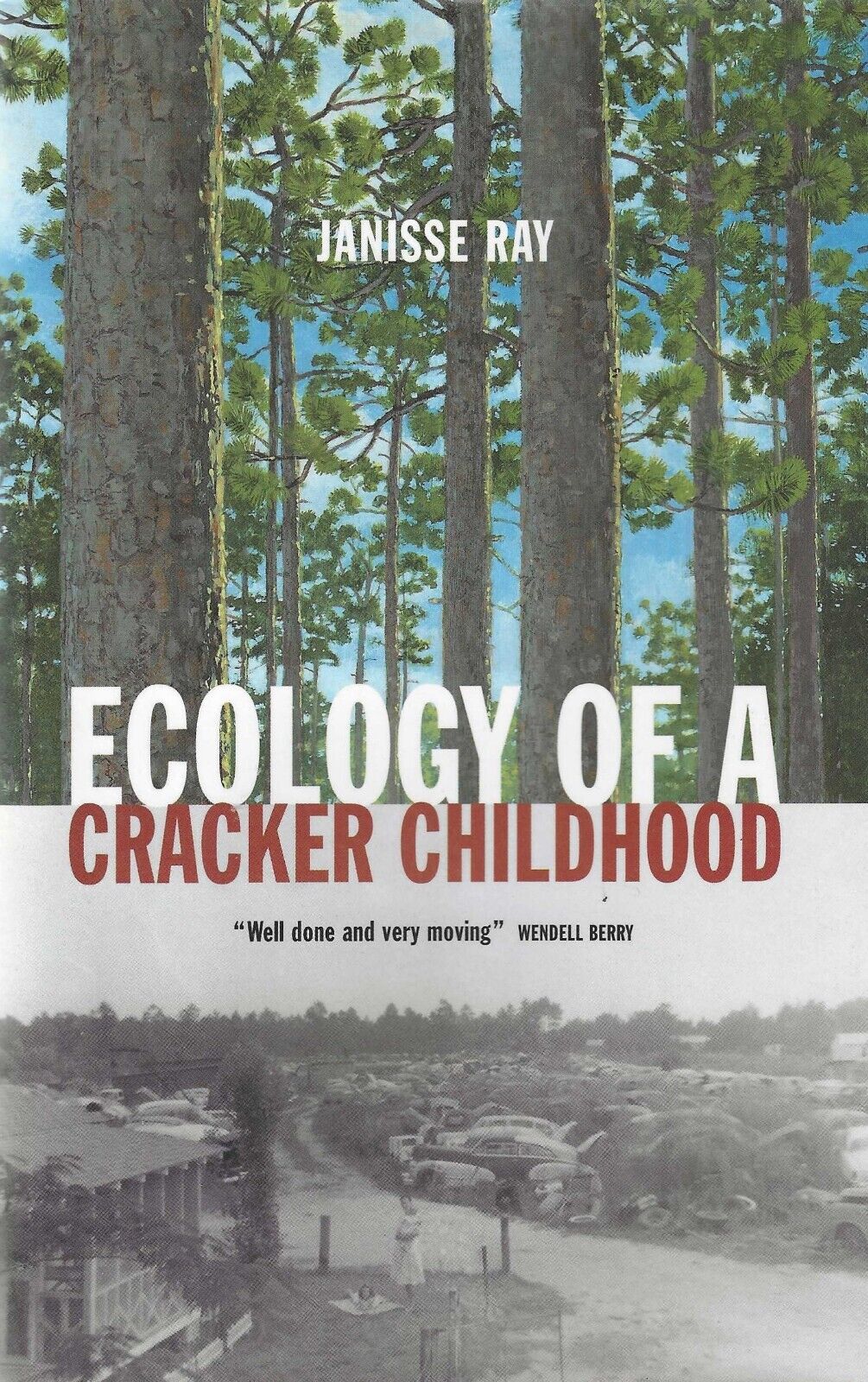
The other 50% of the book discusses some element of the Georgia ecology, be it birds, lizards, trees, whatever. Much like Lab Girl by Hope Jahren, the personal and nature chapters go back and forth, one then the other. These ecology chapters are harder to follow because this isn’t a science book, nor are there images like in a nature book. For instance, I read the following: “As orange-red efts, they live in upland sandhill, scrub, or pine flatwoods communities with a healthy herb understory.” I’m happy to believe other readers are much smarter than I. I have no clue what efts, upland sandhill, pine flatwoods, or herb understory look like. When I get so many plant and animal names without descriptions, my eyes unfocus. Plus, Ray is a creative writer, so sometimes she does describe the ecology using poetic words that didn’t create a clear picture for me: “In April and May, trumpet flowers are delicate yellow hands rising from wet ground.” Hands?
Early on, I truly enjoyed Ecology of a Cracker Childhood. Ray tells stories about her parents’ parents, such as the time they accused their grandfather of lying about having a girlfriend. They said if he’s telling the truth, he should call her up to prove it. The grandfather proceeds to call the woman, who can barely follow the conversation due to age-related hearing loss:
“Essie, you’re my girlfriend, ain’t you?”
“I’m sorry. What did you say?” This forced him to repeat his embarrassing question.
“No, I am not!” she exclaimed. “Charlie, have you lost your mind? Whatever, made you think that? I have as much need of a boyfriend as I do smallpox.” And she hung up the telephone into its cradle.
Devilishly we laughed at him, hooting and rolling against each other and the furniture in our hilarity, slapping high fives.
The stories of the Ray kids creating their own fun provide unique insight into a poor family that doesn’t allow their children to engage in secular delights. Instead, the kids sit in old cars in the junkyard and pretend to drive places. Frequently, they’re cut on glass or metal. However, the more I read, the more something sat wrong with me about Ecology of a Cracker Childhood. Then I realized what.
Ray says she never learned to name most any animal or bird from her area before she left home. In college, she combined creative writing and nature, as so many before her have. She starts writing about the ecological disaster of logging and clearing forests. The stories of her childhood during which she had no knowledge of nature don’t sit logically next to Ray’s somewhat dry and complicated chapters on plant diversity. In fact, never does she examine the damage caused by her father’s junkyard in which heavy metals, batteries, oil, antifreeze in refrigerators, etc. seep into the topsoil, and potentially the groundwater. She acknowledges that the topsoil would need to be removed, but that’s just one sentence.
In the end, I wondered if this is a memoir, a nature book, a plea for an end to irresponsible deforestation, or what? As a result, the parts didn’t go together for me, and my interest waned.
 Grab the Lapels
Interesting review. I can’t see trumpet flowers as hands, either – at best, they’re the frilly ends of sleeves or those frills you put on the end of lamb joints (we have a duvet cover / comforter with those on and that’s what they remind me of). Sounds like it misses what target it set up, really, which is a shame. Well done for getting through it.
LikeLike
My favourite wildflower is a grevillea that looks like a hand, a forest of hands waving above the road sometimes. I’ll make sure to include a photo if I ever include them in a post (which I have considered in the past). They should be out soon.
Wilderness conservation and junkyards don’t go together, though it’s better than leaving cars by the side of the road to be stripped and rust.
LikeLike
I Googled the grevillea, and it’s beautiful. It’s always known as the spider flower, and I can see why. Junkyards are horrible for things like ground water conservation, which is why landfills, although ugly and problematic in different ways, are important: they have a giant liner that protects the water system.
LikeLike
Spider-flower! I like that. There are lots of grevilleas, but their flowers are usually spidery. However, some are more like toothbrushes, like this one, grevillea-pteridifolia (Google it and you will see what I mean.) I’m with Bill, I love grevilleas.
LikeLike
Ha, they DO look like toothbrushes! Unfortunately for me, the grevillea is nowhere near my side of the globe.
LikeLike
Sounds kind of like a mess – I can see why your interest waned. Nature writing done well is so moving and it’s a shame that this didn’t hit the mark.
LikeLike
Jennifer Ackerman just came out with a new book, this time on owls. While she doesn’t include a lot of personal experience like Lee does, Ackerman does include her experiences learning about owls and ends up with a cohesive narrative.
LikeLiked by 1 person
I keep meaning to read her books but just haven’t yet!
LikeLike
Her audiobooks are the way to go because she makes bird noises (she reads her own books). Great for walking the dog and grocery shopping and whatnot.
LikeLiked by 1 person
Hmm lots going on in this book. It sounds like she’s got lots of unresolved (almost a naive?) view of her parents, although I suppose that’s better than hating them and resenting your childhood. The quotes you included about her nature writing were very confusing, I don’t think I would enjoy this one…
LikeLike
Yeah, the nature writing got poetic, which is not really what I want if someone is going for ecology. You’re right about her appreciating the life her parents could provide for her; I hadn’t thought of that, and it doesn’t sound like she resents them at all. Good catch, Anne!
LikeLiked by 1 person
It’s an interesting title … does it mean “cracker” as in slang for “really great”? If so, does she mean it in truth or ironically? If not, what does she mean?
I often like hybrid forms because it usually means the author has thought carefully about the forms and decided why they are drawing on multiple ones, but it sounds like this one hasn’t worked. And, nature writing is something I like too, but again you haven’t made this sound compelling.
Why did she write this? Did she have a particular intention?
LikeLike
Crack in the U.S. is a derogatory term for a poor, white, southerner. In stories set during slavery, a cracker was only one click above a slave because they were white, even though their living conditions were often no better.
I’m discovering the hybrid memoir-nature books often have the memoir for a chapter and then the nature, back and forth, and I’d rather see them come together. Perhaps they do not because there is more going on in the memoir than nature, and nature is not the true focus.
LikeLike
[…] the comments about Ecology of a Cracker Childhood by Janisse Ray made me realize that when an author mixes nature writing with a memoir whose focus is not nature, […]
LikeLike
Hmm regarding the trumpet flowers, there are lots of different flowers that go by that name so it’s hard to say what she is referring to unless she mentions their botanical name. But I am wondering if she might have been referring to the plant as it sprouts up from the ground in spring rather than the flowers?
Thanks for relieving my curiosity about this book. I liked her book on seed saving quite a lot so I think I will skip this one so as not to be disappointed.
LikeLike
I think Ecology was her first book, so maybe she grew as a writer, or someone (the editor) needed to see the big picture better. I hadn’t realized there are multiple kinds of trumpets, but I should have guessed just because there are multiple everything.
LikeLiked by 1 person
This sounds kind of interesting but I could see how the combo of semi-feral childhood vs more knowledgeable nature info would seem jarring, especially if she wouldn’t have known any of the nature stuff herself as a child. It’s reminding me a little bit of Tara Westover’s Educated, though that doesn’t have much nature in it.
LikeLike
I heard Educated was problematic because it seemed like any time she got her hands on money, she spent it on stupid stuff, which, frankly, is common when people are poor because money come/money go so easily.
LikeLiked by 1 person
I don’t remember that jumping out at me when I read Educated but that doesn’t surprise me. She was also so young when she started to gain independence. Combine that with someone who has never been taught any sort of financial responsibility and of course she’s going to spend money foolishly.
LikeLike
I think a memoirist’s choices frustrate me less than their attitude about it. I tried to read Girl in the Woods by Aspen Matis, and I kinda wish she never came out of the woods.
LikeLiked by 1 person
[…] Ecology of a Cracker Childhood by Janisse Ray ($0.79) […]
LikeLike
[…] Ecology of a Cracker Childhood by Janisse Ray ($0.79) […]
LikeLike
[…] Ecology of a Cracker Childhood by Janisse Ray — review here. […]
LikeLike
[…] Ecology of a Cracker Childhood by Janisse Ray ($0.79) […]
LikeLike