
I’m never happier than when I discover a book that feels punk, like the kind of book the author wants her teen readers to steal and then pass along to friends at school while they smoke behind the gymnasium. Manstealing for Fat Girls by Michelle Embree is one of those books.
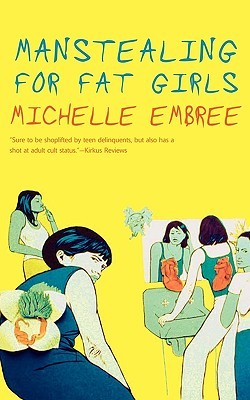
The narrator is Angie, the fat girl among her friends. We don’t know much about Angie’s size, but we do know that she both starves herself for days while taking diet pills and then binges until she’s sick. What’s different is that she does not have a mother who haranges her about her size. If anything, her mom wants to make sure Angie is eating (though she doesn’t know her daughter has an eating disorder). Set around St. Louis, Missouri, and populated by working class adults, Angie’s mom is a waitress who offers up frozen entrees and Hamburger Helper-type meals. Nothing healthy, no fresh produce. If anything, the focus on food tells the reader more about the social class and setting of the novel than teen feelings about weight.
Embree’s characters are anything but predictable, and none of them read like today’s YA novels. Although Angie battles her body, she’s also very horny. Readers are privy to her sexual thoughts and concerns about what her vagina looks and smells like as she navigates puberty and virginity. Her best friend is a lesbian who has recently started a physical relationship. Her other friends are Heather, known for only having “one tit” because the other never developed, who fights against her parents who want to schedule her for surgery to balance her breasts out. Then there is Inez, a drug addict and dealer, whom I found hard to like at first, but as I said, Embree’s characters are unpredictable. The ones you think you can’t rely on are the catalyst for supportive action.
There are also male characters. Angie’s mom is engaged to Rudy, and while he appears to be the stereotypical “man of the house” redneck, the one who pops a beer and watches TV when he’s not entering his future step-daughter’s room without knocking, Rudy is someone you can oddly like. He sees the truth when Angie’s mom doesn’t, and he’s got morals where you think he’s lacking. The teen boys are Mantis and Pike, both of whom have dropped out of school but provide companionship, support, and yes, sexual tension. I wasn’t sure what to expect of either of them until I was in the thick of a scene and saw it play out. Even their biting wit was a surprise when I expected apathy.
Then there is Robyn, the older girl. She’s Angie’s best friend’s big sister. She’s graduated from high school and basically taken on the role of mother hen to these wayward teens. She’s described like a woman from a Whitesnake music video, and based on Robyn’s style and a few other clues, I realized the novel is set in the 1980’s. Just when you think Robyn is a homophobic loser living in her parents’ basement with her worthless boyfriend who takes all her money, a fight breaks out at a party, and Robyn becomes a crusader for women’s justice.
Manstealing for Fat Girls is Michelle Embree’s only fiction work listed online, much to my disappointment. The novel came out with Soft Skull, which is a “big-little” press. Likely, you would need to get your hands on a used copy, because I don’t see it sold new anywhere. If you’ve ever described yourself as “punk,” or have a punk aesthetic (even if that aesthetic lives in your heart and not on your clothes), I would recommend Embree’s novel to you wholeheartedly.
A special interview with the author, Michelle Embree
If you could change places for a day with any one of your characters, who would it be, and why?
It’s hard to choose, of course! The main character, Angie, struggles against bullying in her home life and her school life and her interior life, but she narrows her focus to preserving her self-worth. She knows that as long as no one manages to take it from her, she will be able to pursue her own interests and be free.
This aspect of the character of Angie was important to capture because the worth of these teens (our worth) is consistently assailed, indirectly if not directly. It takes real grit to power through it, and Angie achieves that every day. I would want to live as her for a day so I could be aware of that power and revel in it, the unbreakableness of her.
In what ways has life outside of academia shaped your writing?
I went backwards. I wrote a few zines before signing a contract for Manstealing for Fat Girls, and it was after its publication that I returned to school for an MFA in writing.
I was always a big reader. Or, maybe I should say I was a desperate reader. I am dyslexic, so reading was something I was not expected to do particularly well, but I already liked stories and books so much, I had to figure it out, somehow, I think.
Books are the best teachers for a writer. You can make a lifelong curriculum for yourself and just keep growing your skills endlessly. It’s beautiful. I developed into a close reader early on as I worked to overcome certain obstacles in my perception. I had an ear for how Hollywood stories are organized so that they build to become exciting, too.
When I finally did take on formal training in the craft of writing, I was eager to learn techniques for structuring plots and how to artfully unfold the necessary details, the exposition. It was the dry stuff that felt like magic to me during that time.
What was the hardest part of writing Manstealing for Fat Girls?
There are two chapters, the midpoint climax of the book, that I knew would offer a specific technical challenge to write. The story is told by a first-person narrator, Angie, and I needed the reader privy to the tension happening in two separate places at once.
When it came time to write those chapters, I sketched out their basic outline and just kept writing the book knowing that by the time I got to the end of the story I would be able to write those two chapters with skill. Which is what I did and it worked.
I thought those chapters through over and over. I read books during that time with special attention on how high tension was evoked and carried out to a satisfying conclusion. I am still proud of those two chapters above the others.
Did you learn anything from writing Manstealing for Fat Girls?
The fictional party parents, Crystal and Wayne, drink and do drugs with the teenagers. They let the kids hang out and relate to the teens as if they are all on the same level. Their judgment is questionable in these ways, yet they consistently maintain an overriding desire to protect the kids. They are emotionally immature and suffering from a variety of addiction and trauma themselves, but they are not predatory.
When the kids go to a kiddie kegger, as Crystal will later call it, threatening adult men show up and start causing trouble. It is the party party parents who receive a phone call from the teens asking for help. Crystal and Wayne respond immediately, heading straight to the party. Crystal leads the confrontation against the unwanted men and, with Wayne backing her up, throws them out. Crystal and Wayne decide to hang around for a bit to make sure there is no further trouble.
Readers who relate to the plight of the teens in the story express feeling as if they knew Wayne and Crystal, but readers who did not relate to the teens found the adult characters completely unbelievable. This surprised me on the one hand and scared me on the other. These characters represent the real lives of teenagers then, and now. Often, their protectors are flawed adults with problems of their own and it’s not bad, actually.
All of the heroes in this story are flawed and traumatized women who suffer the relentless pain and confusion that poverty and misogyny grind down on them, but who also put their bodies on the line when sexual violations threaten the girls. They are my antiheroes and they taught me exactly how underrepresented their archetype is in literature and Hollywood. But who else could it be? Who else could know better than they do?
 Grab the Lapels
Really enjoyed the author interview! Did you ask her if she is working on another book?
LikeLike
It doesn’t sound like she is, so I’m bummed about that. Most of her work, based on what I see on her website, is in tarot card reading now. https://www.michelleembree.com/
LikeLiked by 1 person
This sounds like a good one – I’m glad you enjoyed it so much. I like that it sounds like the characters don’t behave stereotypically.
LikeLike
There were SO wild, Laila. I read this book aloud to my spouse, and we just had no clue what was going to happen — in the best way.
LikeLiked by 1 person
I should see if I can find this; I’m originally from a town a little south of St. Louis on the river.
LikeLike
I only see it sold used, though maybe it’s at your local library. I do wish it had one final edit — my copy had a lot of typoes, though that did not interfere with my enjoyment.
LikeLiked by 1 person
I always enjoy your author interviews! I find it so interesting to hear what the hardest (and most enjoyable) parts of writing are for different people, and how they have overcome them. The issue of how to share information with the reader without the point-of-view character knowing it is such a tricky one, but when it’s done well I’m always so impressed by it.
LikeLike
Thank you! I was surprised by the answer about the party parents, because I know people like that. I feel like Embree is spot on when she says that these kinds of parents can provide a safe space for teens to do what they are apt to do anyway, but in a place with people who can be in charge.
LikeLiked by 1 person
wow, powerful interview with the author! She brings up so many good points. Now that I work at a charity that supports vulnerable youth, I fully understand what she means when she refers to these adults like Crystal and Wayne. There are many parents like this in our world; parents who aren’t ready for parenting, but they’re getting through it best they can, and they care about their kids safety above all else. They may not always make good choices, but they have a special bond with their kids that shows (like when the kids can phone them for help over other parents)
LikeLike
Yes these are the kinds of parents you feel like won’t judge you because they have an odd grasp on the reality of teen life. But, when things get too grown up, they are the grown ups. On the other hand, I’m not sure I’d want parents like this because their overly-permissive attitudes don’t make for stability or guidance.
LikeLiked by 1 person
Yes, not ideal parenting, but I suppose in the end – what is? I find some parents my age are SOOOOO invested in their kids, they are just obsessed with them, and willing to ignore their own happiness just to help their kids succeed. It’s kind of sad. I want my kids to see me enjoying my life too, pursuing my own hobbies still, etc.
LikeLike
Yes, if your #1 descriptor in any bio is “Mom,” or even worse, “Mama Bear,” then your whole life is your kids. Which will make for a very sad state of affairs when they move away.
LikeLiked by 1 person
ugh yah, self-proclaimed Mama Bears usually scare me away haha
LikeLiked by 1 person
Great interview! It’s especially interesting to read the author’s thoughts directly in juxtaposition with what stood out to you in the novel.
As soon as you described the type of food the mother character offered, I had a feeling that the book was set in the 80s or 90s. It made me think about how our knowledge of health and nutrition seems to change quite a bit from one generation to the next.
LikeLike
I think you’re referring to when these boxed meals became popular to match the changing times of two working parents. Women would have a full-time job but still be required to be full-time caretaker. It always feels like they had to work out a deal with their spouse, like, “Don’t worry, honey! I won’t get behind on my house duties if I get this job!”
LikeLiked by 1 person
Yes, it’s that era of microwave meals! I ate so many pre-made chicken pot pies as a kid!
LikeLiked by 1 person
Oh this sounds exactly the kind of book I would have loved to read as a teen as well as now. I bet I will never find a copy over here, but you never know. Cool author interview. Did she ever write anything else?
LikeLike
It doesn’t sound like she wrote much else afterward. In fact, I remember a statistic about people who enter an MFA program and then basically quit writing. I wish I had known that before I entered an MFA program.
LikeLike
[…] for her interview! I’m glad you guys like the interviews, and I hope you seek out a copy of Manstealing for Fat Girls. There are used copies for sale […]
LikeLike
I had to look up Hamburger Helper. I ate a lot of spag bol as a student, so I guess I can see where it might be useful. Punk coming of ages are my favourite. You didn’t ask Embree to re-release Manstealing as an ebook?
LikeLike
No, I didn’t ask Embree to rerelease an ebook, though that would be cool. It came out with a publisher, so I don’t know what her rights are right now. i would assume she got the rights back after it went out of print? I emailed her about this post but haven’t heard back yet! I hope she’s okay.
Bill, I absolutely thought of you as I was reading this novel. If you’re able, I would also recommend Cruddy by Lynda Barry to you. I’ve read it three times now, but all pre-GTL. I should re-read it and get an review up for posterity. Nick would be giddy if I read it to him again.
LikeLike
[…] #3 Manstealing for Fat Girls by Michelle Embree (my review) […]
LikeLike