
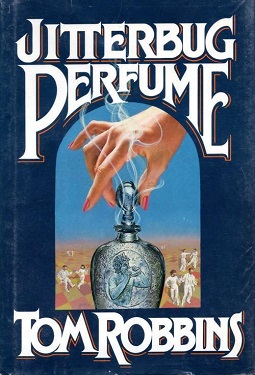
I don’t typically review the books that I read aloud to my spouse each night. Typically, reading time lasts about 30 minutes, or around 10 pages. It all depends. In fact, we started Jitterbug Perfume by Tom Robbins on December 19th and finished on March 22nd. That kind of timeline is not reviewer friendly.
However, Robbins’s work is so bizarre, but I feel like I have to say something. The novel begins by alternating with three characters in different locations: Priscilla, a waitress in Seattle who works on the perfect perfume at night in her apartment; the Le Fever family that owns a large perfume business in Paris; and Madame Devalier, Priscilla’s stepmother who owns a small perfume business in New Orleans. All three groups are trying to make the next big perfume, but none of them can seem to figure out what the bass note should be.
Robbins then takes us back into the past — Way before Christianity — to meet Alobar, a king who is not that old, but whose kingdom has the rule that once there is any sign of aging, including a single gray hair, the king must be killed so that an heir can take over. Alobar finagles away to pretend like he’s been killed so that he can escape, and throughout the novel, on his adventurous yet relaxing trek, he joins new societies, including one that teaches him a method for immortality.
You start to get the idea that the people who want to make the perfume in the present are looking for immortality. I think. I’m honestly not sure. Tom Robbins tends to be one of those authors who goes all over the place, and there’s sure to be a lot of sex involved, often with multiple partners at the same time. Robbins is pretty much the time captured on paper. Jitterbug Perfume was published in 1984, but it definitely has a ’70s vibe to it. If you’ve read Fear of Flying or Looking for Mr. Goodbar, the sexual scenes feel similarly graphic, freeing, and excessive. You start to get the feeling that all these characters want to do is have sex and see themselves as in tune with what their bodies want. In fact, I believe one whole section was two characters sitting in a hot tub, him waxing philosophical, her waxing his knob. I couldn’t help but feel like, at times, that I was staring at a monkey exhibit at the zoo.
What’s bizarre is that the entire novel is tied together by beets. Yes, the vegetable. At first, we have no clue what’s going on with beets, and why they keep showing up at the three locations mentioned above (Seattle, Paris, New Orleans). As the novel continues, Alobar meets his life mate, Kudra. A lot more sex ensues. Beets are mentioned throughout as a good food.
However, it was never clear to me exactly where this book was going, which can make it feel extremely long at 342 pages. The night on which I finished reading to Nick, we actually skimmed one section because it was yet another character who had left behind his philosophy on the types of brains that we have. It had very little to no relevance to the story, and we were fine with skimming.
Robbins is known for his sprawling casts, characters that don’t stay in one place, sexual content, and a trippy sort of psychedelic vibe. The sentences themselves are readable, but it may be the plot itself that trips you up if you don’t want to hang on. Anyway, when we finished, I was happy it was done.
what’s next?
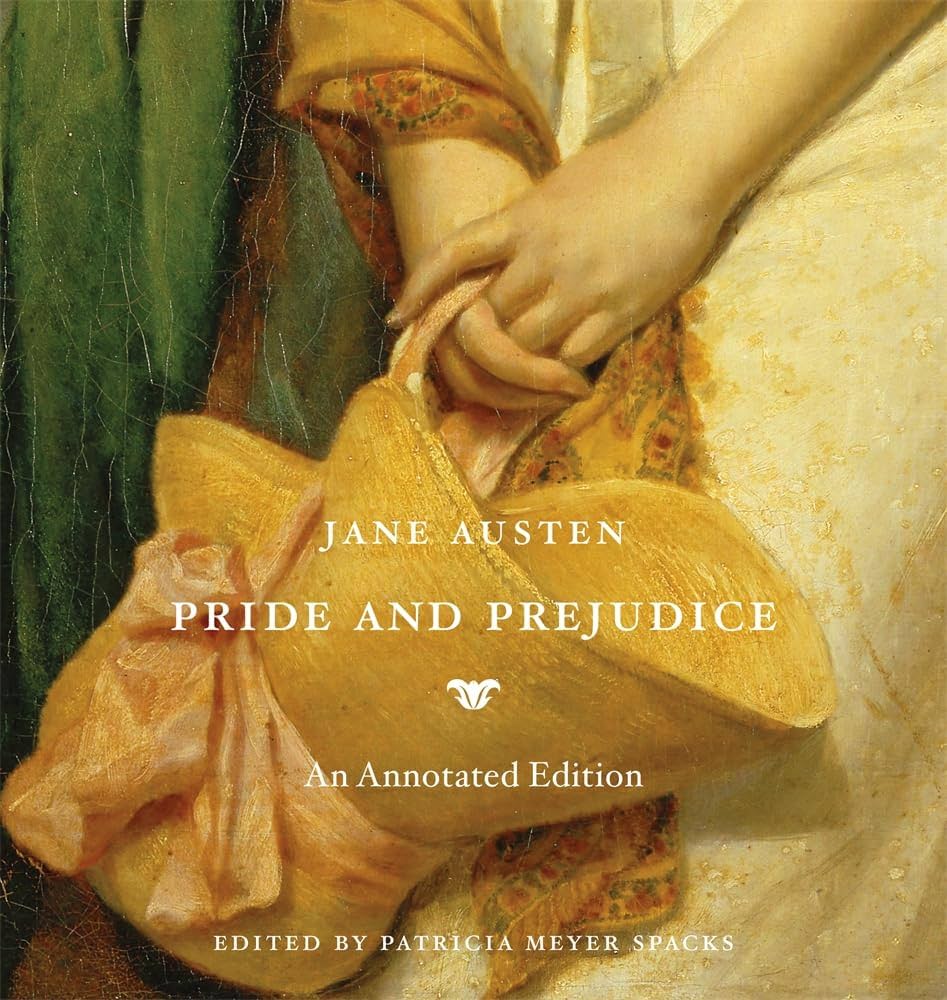
It’s finally happening! I’m going to read Jane Austen’s Pride and Prejudice cover to cover, out loud, to my spouse. Long-time readers know that I read to Nick nightly while he brushes my hair, so getting through a book is a slow process. Recently, I purchased a copy of Pride and Prejudice that is edited by Patricia Meyer Spacks, who includes side notes in her text, which include artwork to demonstrate what characters might own, ride in, etc., as well as money conversions and emphasis on why something that seems trivial to modern eyes was highly important. If you click HERE, you will find some images of the copy from which we will be reading.
 Grab the Lapels