
The Curse of Hester Gardens by Tamika Thompson was sent to me as an ARC, which does not affect my review.
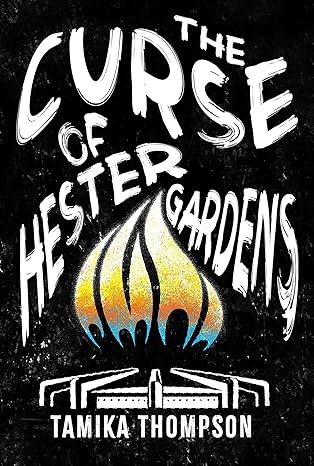
At its most basic, The Curse of Hester Gardens is a novel set in a housing project where gun violence haunts the residents — literally — who cannot escape their situation. But at 448 pages, of course Thompson’s novel isn’t just a simple story of grief.
Every author knows he/she/they must catch the reader immediately. Thompson excels with her first chapter, set in 2002. Nona is married to Vance, they live in the Hester Gardens housing projects but are saving up to move out, and they have small three boys. It’s Nona and Vance’s wedding anniversary, so a neighbor has agreed to watch the three boys while Nona buys Vance a gift and cooks him a special dinner. Thompson endears readers to Nona immediately when she has a hard time saying bye to her boys, even though it’s only for a few hours. Plus, the neighbor’s nephew is there, and Nona sucks him into her mom hug, too. She’s a lover, and we love her. But the Nona unexpectedly runs into Vance in the alley where he is threatening a young man’s life with a gun. What happens next changes their lives forever.
Thompson jumps ahead to 2016. Vance is in prison. Nona’s eldest son, Kendall, was shot and killed two years before. She and her other two sons, Marcus and Lance, still live in Hester Gardens, a place everyone wants to escape if they want to survive. At Hester Gardens, the city doesn’t follow up with the waste management company that is supposed to pick up the trash. A stench permeates the entire complex. The summer heat exacerbates things, and now Nona is starting to see a human-shaped black shadow in her peripheral vision. Is the shadow just stress or grief? Thompson writes in third-person point of view, creating an intimate relationship between the reader and Nona. She admits that Kendall was her favorite son. Marcus has been accepted to Brown, and all her energy is focused on getting him through the summer between high school graduation and the start of college. Lance, age fourteen, is barely on her radar. He reminds Nona too much of her imprisoned husband.
Readers have possibly read novels about the danger of being unable to leave housing projects notable for violence, drugs, roaches, mice, and garbage piling up. Although Thompson’s Hester Gardens, set in Medford, Michigan, is an invention, the characters compare the city to Flint and Detroit, both in Michigan and famous for their undrinkable water, trash, gun violence, and lack of basic city services, like dedicated policing and firefighters. The difference is Thompson turns the narrative on its head and adds a supernatural element. Something is haunting Hester Gardens, and multiple characters notice it. The teen boys from the Gardens gather and discuss a little boy who was killed in there and haunts the place. A blue ball appears rolls towards residents when they are outside with no owner around. A teen mom, whose twin was shot when they were children, sees her dead sister trying to steal her baby. And someone tries to kill a young man by shutting a window on his neck. A basketball bounces all night — but no one is there.
Nona is convinced she has to solve the curse threatening Hester Gardens because her ivy-league-bound son, Marcus, is starting to act odd: a shorter temper, poor decision making, and a glazed look in his eyes, as if something has possessed him. Because Marcus continues to behave more erratically, Thompson sends readers into a tizzy. He’s so close to escaping Hester Gardens, and now he’s screwing it up — unless it’s not really him in control. Marcus’s cousin made it out and became a reporter, so the cousin serves as an example of what Marcus can do. Despite leaving, the cousin is still tied to the cycle of violence: “I’m hoping to tie it into a larger multi-part feature about gun violence as a public health crisis like how cigarettes and car accidents were tackled in the past, but shit ain’t changing.” Thompson suggests no one can truly escape housing projects.
Meanwhile, Nona’s youngest, Lance, is largely forgotten. He’s actually getting into trouble himself, but Thompson wisely reminds readers often of how young he is — fourteen — and how much trauma he’s experienced. Beyond his father’s incarceration and oldest brother’s murder, Lance is used to gun violence: “A crowd of shell-shocked neighbors huddled together, whispering to one another, staring into their phones. Usually, his mother made him stay inside after a shooting. This was the first time he’d been outside in the aftermath, and he didn’t like the eerie silence that hung over Hester Gardens. The place was never this quiet.” Although the majority of The Curse of Hester Gardens follows Nona’s point of view, when Thompson switches into Lance’s point of view, we see his vulnerability and hopelessness, endearing us to a kid who, from the outside, seems like another statistic terrorizing people.
The Curse of Hester Gardens is largely a single-setting story. Hester Gardens is a housing project, meaning different buildings are centered in one area. Nona visits neighbors, whom we get to know easily. Select details solidify each person in the reader’s mind: Vega sitting on her porch all day with a white coffee cup, Mable and her gun bulging under her clothes, Mother and her health issues that keep her from seeing her nephew terrorizing the other residents. Thompson does take readers to Nona’s church, Medford’s “Deadford” hospital, and the high school, but the lens is zoomed in on Hester Gardens, making the novel feel like a tight, single-setting theatre production — and is totally immersive as a result.
Tamika Thompson’s novel The Curse of Hester Gardens goes on sale March 31st, 2026, which you can purchase directly from Kensington Publishing Corp. or wherever you buy your books.
 Grab the Lapels