
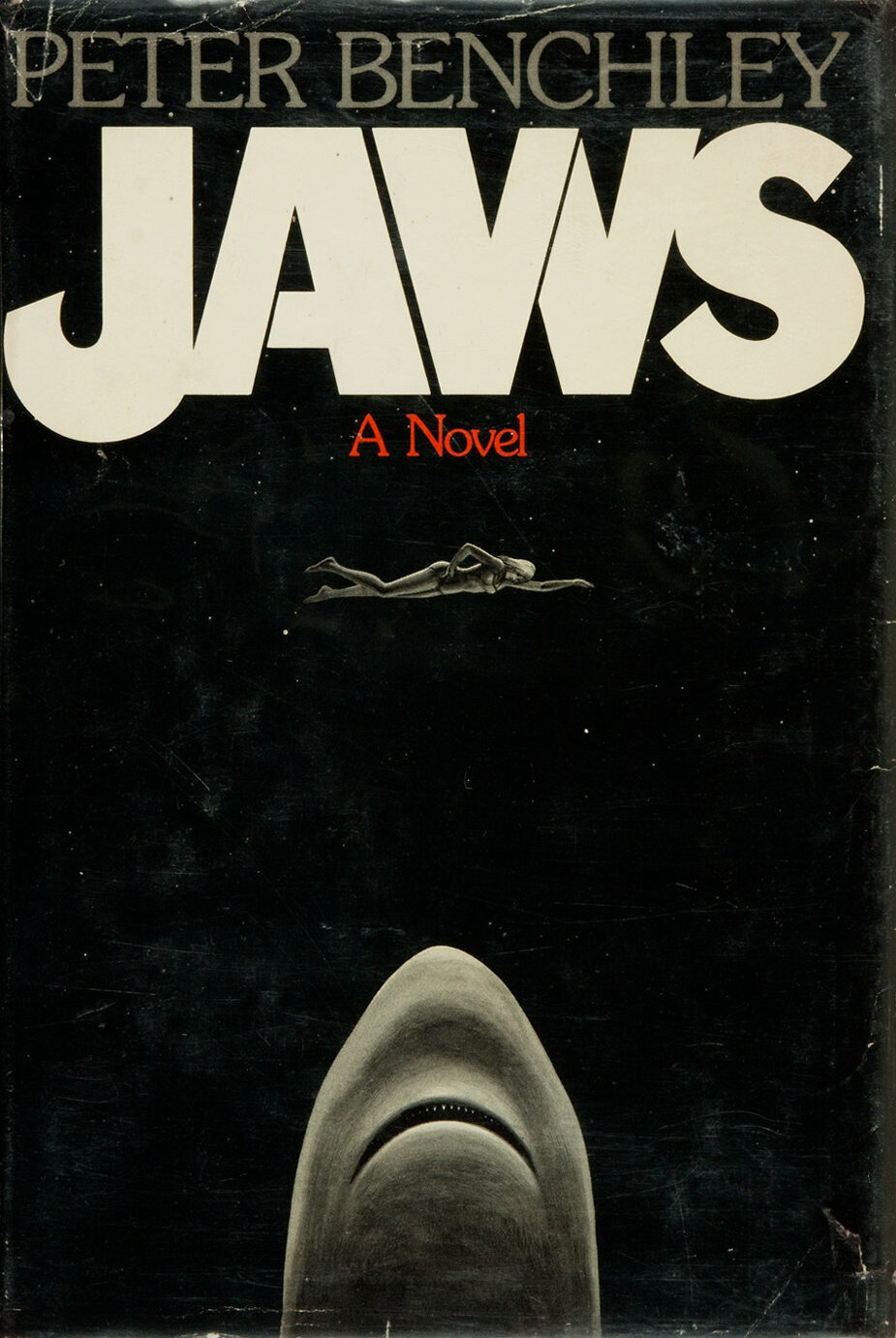
We’ve all heard it: Peter Benchley’s Jaws is one of those rare occasions when the movie is better than the book. Yes, Steve Spielberg’s 1975 adaptation of Benchley’s novel was a smash success, basically defining what a summer blockbuster even is. However, I wouldn’t be so quick to dismiss the novel. Readers complain of the “romance” and “mafia” stuff, leading me to think Jaws would focus intently on, you know, romance and mafia stuff. I had a picture in my head of a love triangle with a dose of The Godfather. Fortunately, I was wrong, and I’m glad I gave Benchley’s Jaws a chance, because it stuck with me and drew me in much like James Dickey’s Deliverance did.
I once read in It Came from the Closet: Queer Reflections on Horror, edited by Joe Vallese, that the film Jaws is about three men on a boat, and what’s gayer than that? Although funny, there is also something boring about reading about three men on a boat. If you’ve been on a boat all day or read about actual fishermen and their work, you know there is a lot of sitting, waiting, and sun frying your skin. Thank goodness Benchley chose to make Jaws a multi-layered triumph. In the beach town on the fictional Amity island, we have the “winter people” that live there year round and the “summer people,” wealthy New Englanders who rent property for three months of rest, relaxation, and swimming. Chief of police Martin Brody is a winter person; his wife, Ellen, was a summer person. Benchley cleverly creates tension that comes from “inside the house,” so to speak, showing the class differences in this one small town.
The divide is exacerbated between poor islanders and wealthy vacationers when a great white shark eats a girl late one night who went for a drunken swim. Her bust is found along the beach and quickly covered up by Amity’s mayor and lead newspaperman. If it should get out that a shark killed someone, the summer people won’t come to Amity; they will easily pick a different beach town. Naturally, when a beach town loses out on the summer economic boom, they end up on welfare over the winter, or lose their homes. This does not concern the wealthy. Benchley writes how the teen-age vacationers spend their summers: “Nothing touched them — not race riots in places like Trenton, New Jersey, or Gary, Indiana; not the fact that parts of the Missouri River were so foul that the water sometimes caught fire spontaneously; not police corruption in New York or the rising number of murders in San Francisco or revelations that hot dogs contain insect filth and hexachlorphine caused brain damage. They were inured even to the economic spasms that wracked the rest of America.”
Chief Brody, who wants to close the beaches for safety, is pressured into keeping his mouth shut about the first death. Maybe the shark will go away? Benchley creates a contrast: rich vs poor, thrivers and survivors, the informed and the uninformed. When the early vacationers start showing up, naturally they go to the beach, which is where the shark eats a child and an elderly man. There is no way the news can stay under wraps; a wealthy person’s kid was eaten, and word gets out to newspapermen in New York. Now, vacationers are showing up because they want to see a shark, creating a callous rubber-necker scene that emphasizes what Benchley has established about the elite vacationers.
Amity is still in financial dire straits. The mayor continues to push for the beaches to remain open as the July 4th holiday approaches, and this is where we get the mafia. No long, drawn-out mafia “goodfellas” stuff, just the mayor borrowing money (the story explains for what and why) and it’s time to pay up. I thought this was clever because Benchley gives the mayor a motive for being unreasonable. He’s not just dumb or stubborn; he’s in trouble.
Now that word is out about the great white shark, Matt Hooper, a ichthyologist, visits Amity because this is a big opportunity. Jaws was published in 1974 when not much was known about sharks. Hooper gives readers basic information that shark specialists had at the time, such as the water temperature sharks prefer, whether they stick to one area, etc., though he also claims that sharks like to eat people, so the information is dated. Hooper himself is a “summer person,” a rich college “boy” who used to visit Amity in the summers with his family. In fact, Hooper’s older brother used to date Chief Brody’s wife, Ellen. Here comes the “romance” — Ellen feels out of place because she grew up wealthy and now lives on a police chief’s salary. They have three lovely boys, but Ellen doesn’t feel like herself. Hooper represents her old life when she was “someone,” and you can probably see where this is going.
I loved what Benchley did with Ellen and Hooper. Their interactions do not read as subplot, just plot. The point is the wealthy do what they want without fear of consequences, and the working class people who live on the island year round deal with hard stuff, like shark attacks, public image, and bureaucratic bullshit. While we’re following Ellen and Hooper’s storyline, we can forget about the shark for a moment because what else can the characters do? It’s not like the shark is swimming circles on the beach with that ominous triangle sticking out of the water. Some time has to pass, so why not pass it by highlighting the class issue?
Jaws does reflect the US in the 1970s to a larger degree, so Benchley has captured the feel and uncertainty of the 1960s Civil Rights Movement, free love, drugs, hitchhiking, women’s liberation, etc. After the first victim of the shark is found, the police learn she had no one — she’s just some “girl” with no family or kids or home (a hitchhiking hippy, most likely). Therefore, the mayor feels justified in covering up her death because she’s a no one (likely meaning a feminist). Islanders are convinced that a Black man raped seven white women on the island not long ago (we’re never told if this was true, nor is it relevant to the plot). As the economy gets worse, a local deli considers what to do. The owner was supposed to hire two men to help with the summer rush, but now he can only afford one: either the black man or the white man. He settles on the black man, and the section reads as if the owner does it for appearances, because he thinks how glad he is the white guy isn’t Jewish; that would have made the decision impossible.
Finally, the famous fisherman Quint is hired by the city at a whopping $400 per day to slay the great white that has since attacked another person. Quint needs a guy who knows boats, so Hooper is brought on board, as is Chief Brody, who doesn’t know boats and hates the water:
Brody felt a shimmy of fear skitter up his back. He was a very poor swimmer, and the prospect of being on top of — let alone in — water above his head gave him what his mother used to call the wimwams: sweaty palms, a persistent need to swallow, and an ache in his stomach — essentially the sensation some people feel about flying.
Much as I feared, there is a lot of sitting and waiting on the water — while interesting in the movie because we can see what’s going on, in the novel, descriptions laced with nautical jargon isn’t fun to read. Thankfully, the time is filled with an ecological debate. Hooper wants to protect endangered sea life while Quint makes a living killing it. Several times Quint catches small sharks, reels them in, and slices them open just for the fun of watching other smaller sharks chew up their friend. Originally, he goes through the process to show Chief Brody what the people who charter Quint like to see: a feeding frenzy. Why he keeps doing it, I don’t know. Maybe to irritate Hooper, but the argument continues. Quint argues with new laws protecting sea life applying to big Japanese companies and not individuals like him. Benchley even touches on the nonchalance about trash in the ocean. A big push in the late 80s and early 90s about protecting the planet helped create an awareness of how much trash goes in the ocean, but it seems like nothing to Quint in this 70s-set novel.
Overall, I found Jaws an engaging, thoughtful read about class issues, ecology, and ethics. Yes, for the horror fans out there, we do get descriptions of the shark eating people, which are more graphic than the movie because words are typed and movies have to be convincingly shot. As for the comment about three men on a boat being gay, I wouldn’t even call Jaws a book about being a man, interestingly enough, for the way Benchley focuses on bigger, worldly issues.
books of winter ❄️🎄⛄
- Savage Inequalities: Children in America’s Schools by Jonathan Kozol
- Monster: A Fan’s Dilemma by Claire Deder (DNF)
- This is Not a Book about Benedict Cumberbatch by Tabitha Carvan
- Crafting for Sinners by Jenny Kiefer
- Uncomfortable Conversations with a Black Man by Emmanuel Acho
- Suggs Black Backtracks by Martha Ann Spencer (DNF)
- Paradise Rot by Jenny Hval (DNF)
- The Lost Girls by Allison Brennan (#11)
- Deliverance by James Dickey
- How to Save a Misfit by Ellen Cassidy
- The Road to Helltown by S.M. Reine (Preternatural Affairs series #9) (finished — special review forthcoming at a later date)
- The Man Who Shot Out My Eye is Dead by Chanelle Benz (DNF)
- At Wit’s End by Erma Bombeck (DNF)
- Touched by Kim Kelly (paused)
- After Life by Andrew Neiderman
- The New York trilogy by Paul Auster
- Awakened by Laura Elliott
- Devil’s Call by J. Danielle Dorn
- Minding the Store: Great Literature About Business from Tolstoy to Now edited by Robert Coles and Albert LaFarge
- All of Me by Venise Berry
- Jaws by Peter Benchley
 Grab the Lapels
well this was a surprise. I never imagined the book would be more than a basic horror plot
LikeLike
I was surprised there was so much social commentary. It’s really the shark attacks that bring all the tension between the summer and winter people to the forefront. I talked with my book club, asking if the summer/winter people part of the novel is plot or subplot to the shark.
LikeLike
What Karen said. I had no idea. I’ve never seen the film. Am still not sure I want to read graphic stuff about sharks eating or terrifying people but I love that this book had so much social analysis – for want of a better word – in it. Why do people say the film is better?
LikeLike
I think people feel the film is better simply because they watched it first and loved it. Benchley was aware; in his 30th anniversary introduction to the novel, he mentions the readers who complain about the “romance” and “mafia stuff” are those who saw/loved the movie first, and he’s basically asking to give the book a chance.
LikeLike
Oh that makes sense Melanie. It must be frustrating for an author … though I guess he must have made good money from the movie which could soften the blow?
LikeLiked by 1 person
I’ve seen the film (on TV), didn’t even know there was a book. I liked your analysis of class.
I took your advice and read (listened to) Deliverance last week. It was very good, but Jaws I might give a miss.
LikeLike
Ah ha, I knew Deliverance would be a book you liked. Jaws has the same vibe (another book club member mentioned this, too), so if you find yourself looking for another audio edition, some book clubbers also said the audio was very good.
LikeLike
I haven’t seen the movie, which is probably hard to believe. Just never wanted to and was never made to, LOL. But I enjoyed your review – the book seems like it contains a lot of substance and nuance.
LikeLike
I think “substance” and “nuance” are two excellent words to describe the novel of Jaws. I wish I had thought of them! The movie totally focuses on the shark, of course, and there is an interesting bit about 2/3 through during which Quint explains he was on the Indianapolis that is a beautiful, moving monologue, but other than that, I think the movie would be too much for you.
LikeLiked by 1 person
This sounds much more interesting than I would have expected. My own town depends a lot on summer tourism and part-time inhabitants who feel a lot of ownership over our community but don’t actually live here. There’s naturally a lot of tension. I’ll admit, I feel almost no tension over the presence of a shark. It’s so easy to avoid sharks. Don’t go in the water. A shark won’t come to your house. Bears are much scarier.
LikeLike
Given where you live, you might like Jaws by Peter Benchley. I wonder if any of it would sound familiar or strike a chord. Also, yes! Every time you write about Peter hiking and bears, I get all wound up.
LikeLiked by 1 person
The movie launched my sister’s shark obsession when we were kids! She went on to read the book, of course, and everything else she could get her hands on about sharks. Ask her a shark question of any kind and she had an answer. Her obsession has cooled, but she still keeps up with all things shark. She was going to be a marine biologist, but had to abandon that goal because she gets bad sea sickness. I never did read the book, but it is interesting to think about the movie and how much they simplified if from the issues the book brings up.
LikeLike
Absolutely, I always thought the movie was a complex look at three types of masculinity, but I like the environmental and class issues of the book better. The movie is still great for shark scares, though!
LikeLiked by 1 person
Hmmm I haven’t read the book or watched the movie, so I’m shocked the book delves into this many issues – very cool! I also love the saying ‘the wimwams’, because this is how I feel about heights, and it’s such a descriptive word
LikeLike
I giggled because I had never heard that word before. I do appreciate how older generations would deny that they have anxiety, but they take their “heebie jeebie pills.” It reminds me of that.
LikeLike