
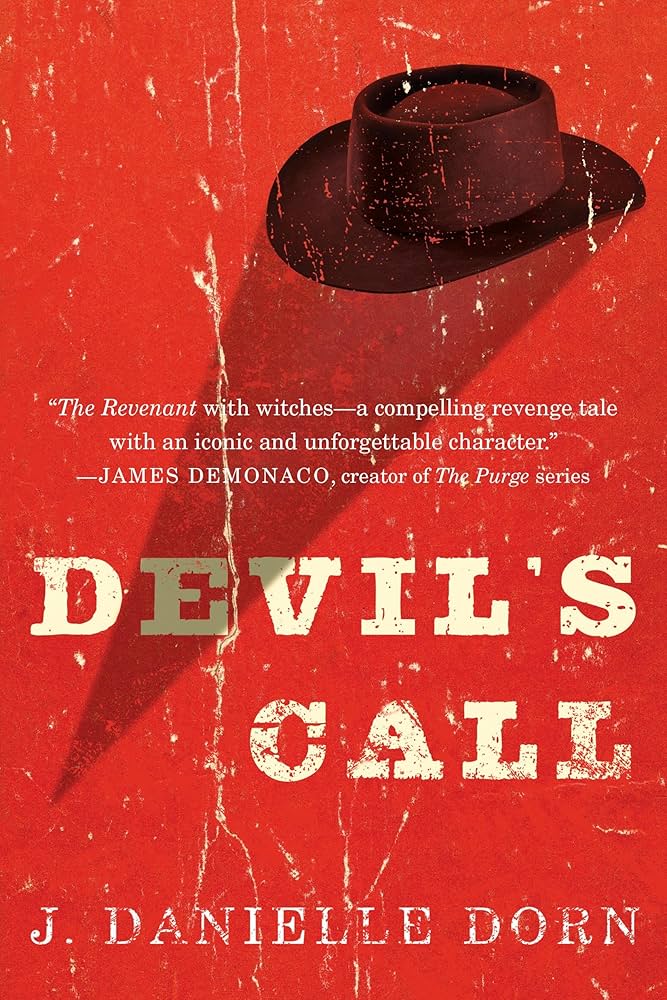
Devil’s Call by J. Danielle Dorn is a mix of genres: western, revenge, witchcraft, a small dose of horror, humor, and historical fiction (set around the Mexican-American War in the 1840s). The novel begins clearly in the narrator’s intentions: this is a letter to her child explaining why the child’s mother and father are not in its life. Readers immediately wonder: is our narrator already dead? Did the baby’s father run off? What’s going on?
The narrator is Li Lian, a girl raised among women in St. Louis, Missouri, who have owned a roadhouse for generations. Through descriptions of her facial features, we realize Li Lian is half-something. Maybe Chinese, Japanese, Korean, etc. Although being not obviously white, Li Lian stands out for other reasons: she’s a witch, as are all her female kin. Explaining her origins to her child, Li Lian writes about the time her cousin was haranguing her at school, so she used witchcraft against him, which kept him out of school with an illness. Here, readers learn that witchcraft “costs” the witch something; Li Lian herself becomes ill with diarrhea and can’t go to school, though she feels it was worth it to intimidate her cousin into leaving her alone. Through these memories, Dorn explains to the reader what kind of witches they have imagined without an obvious info dump or worldbuilding.
In her late teens, Li Lian meets Matthew, a medical man who can go toe-to-toe with her forward thinking. Later, when Matthew is called to the Mexican-American war to serve as a doctor in the field, they write each other letters, and when he comes home, they marry. Throughout all this, Matthew is guided by his friendship with a soldier named Ness, and it is Ness who suggests Li Lian and Matthew leave the city in which they live for the Nebraska Territory. Ness could become the only sheriff in an untamed land, and Matthew would be the only doctor. Li Lian is thrilled, not being one for claustrophobic city life, and stops taking herbs to prevent pregnancy. Now, the couple are expecting their first child, the one to whom the letter is written. Dorn creates just enough characters to give the story movement and a closeness with the people without overwhelming readers with too many names.
All of the events I’ve described happen in the first couple of chapters; we’re not even to the main plot line, which begins when two strangers, one Irish and one Mexican, show up in need of a doctor. Deciding the injured man needs a leg amputation, Matthew sends Li Lian to their neighbor, the drunken Mr. Hawking, to assist. When Li Lian and Hawking return, she sees a third person, a man in black, who wasn’t there before, unload his gun in Matthew’s chest. Dorn amazingly endears us to their characters in a short couple of chapters, meaning Matthew’s death sucks. But, it is the catalyst that sends Li Lian on her revenge plot with Hawking as her drunken sidekick. The only issue? The man in black has left no trace of himself, meaning when Sherrif Ness shows up, he believes Li Lian killed Matthew (Ness has never liked this “half-breed” witch), and puts her in jail.
Li Lian and Hawking’s relationship develops as they travel, following the man in black using magic, and Dorn includes pockets of humor, typically related to technology. When Li Lian struggles to summon her mother in a mirror, Hawking asks why she doesn’t just send a telegram. Confused by faucets in a hotel bathtub, Hawking scoffs, asking why she doesn’t just question the bear she sees in her visions on which tap is the hot water.
Horror fans will want more horror, wester fans will delight, and anyone who likes a compelling story will enjoy Devil’s Call. By mashing up so many different genres, Dorn creates something wholly new. We’re not burning witches at the stake. We’re not fighting “banditos.” We’re not reading a buddy-“cop” comedy in the style of Shanghai Noon (the western-karate film starring Jackie Chan and Owen Wilson). The historical fiction isn’t about reimagining the time period; instead, we get distrust—Li Lian’s features are obviously Asian, and the Mexican man who arrived for medical help argues that Matthew’s involvement with the U.S. military in Mexico contributed to the death of his family there. The horror derives from the bodies the man in black leaves in his wake, and throughout most of the book, we don’t know who he is or why he’s luring Li Lian across the central U.S. states. Dorn’s only novel is a compelling read, one which nearly killed them in the writing process.
books of winter 🎄❄️⛄
- Savage Inequalities: Children in America’s Schools by Jonathan Kozol
- Monster: A Fan’s Dilemma by Claire Deder (DNF)
- This is Not a Book about Benedict Cumberbatch by Tabitha Carvan
- Crafting for Sinners by Jenny Kiefer
- Uncomfortable Conversations with a Black Man by Emmanuel Acho
- Suggs Black Backtracks by Martha Ann Spencer (DNF)
- Paradise Rot by Jenny Hval (DNF)
- The Lost Girls by Allison Brennan (#11)
- Deliverance by James Dickey
- How to Save a Misfit by Ellen Cassidy
- The Road to Helltown by S.M. Reine (Preternatural Affairs series #9) (finished — special review forthcoming at a later date)
- The Man Who Shot Out My Eye is Dead by Chanelle Benz (DNF)
- At Wit’s End by Erma Bombeck (DNF)
- Touched by Kim Kelly (paused)
- After Life by Andrew Neiderman
- The New York trilogy by Paul Auster
- Awakened by Laura Elliott
- Minding the Store: Great Literature About Business from Tolstoy to Now edited by Robert Coles and Albert LaFarge
- Devil’s Call by J. Danielle Dorn
- All of Me by Venise Berry
- Jaws by Peter Benchley
 Grab the Lapels
I like the genre-mixing of this. Horror and western seem to me like they would blend nicely, maybe because the atmosphere of westerns is generally so bleak and sort of filthy.
LikeLike
You’re so right about Westerns feeling oddly dreary but also very bright and sunny (because they typically take place in the desert). You might enjoy this one especially with the motherhood theme.
LikeLike
I’m sure it’s a fun story. My only questions concern the 1840s. Did they have roadhouses back then? I suppose they had roadside inns. Did you have Chinese in the US in the 1840s? In Australia they mostly arrived with the gold rushes of the 1850s (The San Francisco gold rush was a little earlier, I think). Telegrams! The first demonstration electric telegraph in the US was between Washington DC and Baltimore in 1844. And did you even have mid western states back then? My impression, and I’m not going to look it up, is that settlement west of the Mississippi only began around 1850.
LikeLike
Bill, did you just suck all the fun out of the room?
I looked it up and St. Louis, Missouri, was founded in 1764. The book is set during the Mexican-American war in early chapters and then takes places a few years after that, so 1848 for the early chapters and then the 1850s afterward.
LikeLike
People often say that about me, I just like arguing. Sorry!
LikeLike
🤣 You bring your own fun, so it balances out
LikeLike
That does sound oddly compelling.
LikeLiked by 1 person
I agree with Laila, this does sound oddly compelling in spite of the possible anachronisms Bill puts questions to.
LikeLike
I think I forgot to CC you on the email that Bill sucks all the fun out of the room. I am 100% kidding, but some of the things that he pointed out aren’t correct 🤣
LikeLiked by 1 person
Sounds like this mash-up of genres works, which is never easy to do. Especially getting us to care about characters so early on in the novel – sign of a good writer for sure!
LikeLike
I love genre mash-up novels, but I have to imagine they are hard to sell. To whom do you market such books? Where do you put them on the shelf in the bookstore?
LikeLiked by 1 person
I’ve heard of authors going into bookstores, curious of where their novels are slotted just because they cross over so many genres
LikeLike
Oh, that’s a hoot. I’ve also heard of some authors going into stores and signing their own books on the down low. Interestingly, some books sell for less if they’re autographed, depending on the author, lol.
LikeLike