

Firstly, a comment about that cover. It is gorgeous, a work by Art Spiegelman, best known as the creator of the graphic memoir Maus. I love the meta nature of the cover; the three book covers of the New York trilogy on the cover as a cover, and the cover is also one of the book covers.
The New York trilogy by Paul Auster contains three novels birthed at the end of postmodernism (1960s-1980s), meaning we get some of those (now) annoying quirks of the era: people who don’t have actual names, people lost in ennui, people removing themselves from society and pondering inward only to lose themselves, etc. I mean, it was interesting at the time. I’m sure it was brilliant at the time, but now, much of postmodernism feels more like a dry “ha ha, aren’t you clever.”
city of glass
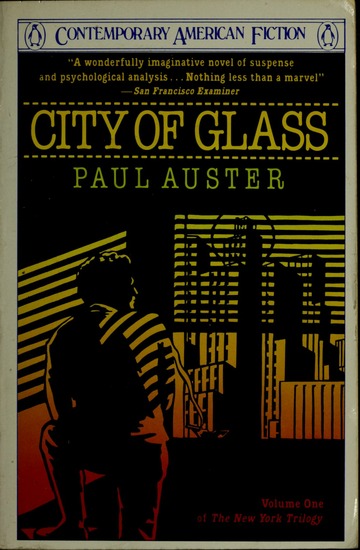
The first novella, City of Glass, is about a writer in New York City named Daniel Quinn. Suddenly, Quinn repeatedly receives phone calls asking for Paul Auster, the detective. Quinn writes a popular detective series, so finally, Quinn gives in, says he’s Auster, and meets the client, Peter. The novella follows Quinn following his target, a odd man who picks up junk off the streets and walks in bizarre patterns. In the end, Quinn loses himself, living on the streets, sitting naked in an apartment writing in a red notebook obsessively.
There are sections that seem to encourage skimming. For instance, when Quinn meets Peter, Peter goes on and on for ages in a rambling fashion, and if you skim and catch key words, it doesn’t matter what he says. Same thing for later when Quinn is walking around the city, and the author describes every street and right turn and left turn. If you don’t know the area, it means nothing to you. They’re just street names. Why do this?
City of Glass has a plot but the whole point is to think and dig into basic philosophy, the stuff grass students eat up in seminar papers. For the average reader, City of Glass would benefit from a book club or buddy read. The writing is clear and easy to read, though you may want to stop and analyze every little thing:
At last Stillman turned to him. In a surprisingly gentle tenor voice he said, “I’m sorry, but it won’t be possible for me to talk to you.”
“I haven’t said anything,” said Quinn
“That’s true,” said Stillman. “But you must understand that I’m not in the habit of talking to strangers.”
“I repeat,” said Quinn, “that I haven’t said anything.”
“Yes, I heard you the first time. But aren’t you interested in knowing why?”
“I’m afraid not.”
“Well put. I can see you’re a man of sense.”
ghosts
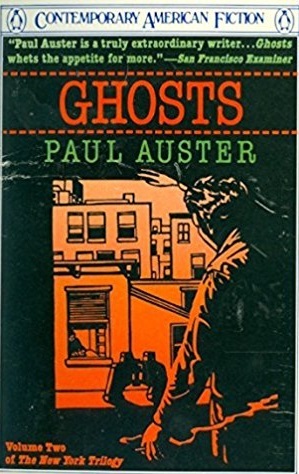
The synopsis of Ghosts reads, “Blue, a student of Brown, has been hired by White to spy on Black.” Having everyone’s name be a color just feels like postmodernism trying to be cute. If the point is that our names are not our identities, I would suggest that people read Immobility by Brian Evanson instead. Or, check out Steve Tomasula’s book In & Oz, in which all the people are named after their jobs, suggesting that we are slaves to our jobs and that they identify us, that is, until the characters start doing the opposite of their jobs when they’re working.
Oddly, Auster seems to contradict himself in Ghosts. Blue, our detective, is someone who never thought much about anything until he is sitting in a room staring our the window at Black:
He has never given much thought to the world inside him, and though he always knew it was there, it has remained an unknown quantity, unexplored and therefore dark, even to himself. He has moved rapidly along the surface of things for as long as he can remember, fixing his attention on these surfaces only in order to perceive them, sizing up one and then passing on to the next, and he has always taken pleasure in the world as such, asking no more of things than that they be there.
While it seems like City of Glass was about a guy who knew who he was and slowly lost himself by focusing on following another person, Ghosts seems more like a guy who never really thought about who he was until he started following someone else. Weirdly, the author writes a sentence that says Blue is losing himself because he only thinks about Black. Ghosts failed to keep my interest because it was yet another novella about one man following another and ending up sitting in a room alone. Auster certainly makes a certain kind of man seem…pathetic.
the locked room
So far, the most relatable thing that I’ve read in the whole New York trilogy is this quote:
We smiled at each other again, and then I wrapped her up in a big bear hug, gave her a brief kiss on the lips, and got down the stairs as fast as I could.
I went straight home, realized that bed was out of the question, then spent two hours in front of the television, watching a movie about Marco Polo. I finally conked out at around four, in the middle of a Twilight Zone rerun.
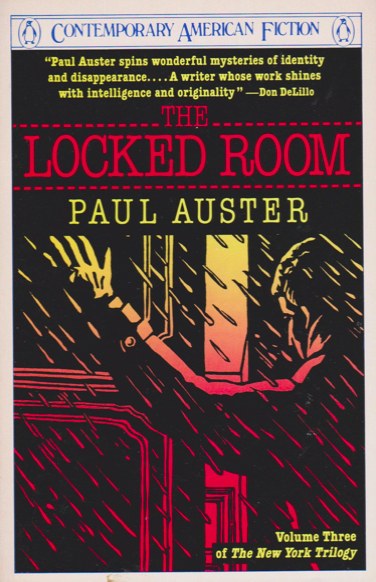
Although The Locked Room is also about a person doing detective work, it had a whole plot running through it that made the more philosophical and postmodern elements more interesting, as if they were running on all cylinders. Two boys grow up together, best friends, until they grow apart in young adulthood. Our unnamed narrator receives a note saying his old buddy, Fanshawe, has disappeared, and can help help the wife and baby left behind? The narrator easily slides into Fanshawe’s old life, replacing the missing man. The crux is that the wife wants Fanshawe to be dead, even if he isn’t dead, because the remains of her lost husband, as the years go by, create rift in her family. Meanwhile, our narrator has been tasked with publishing the literature Fanshawe left behind, which is bought and sells well. They cannot be rid of Fanshawe, even as his royalty checks keep the family afloat. As the childhood best friend, the narrator is pushed into writing a biography of Fanshawe, and as he does, the secret of what happened to our missing writer digs a wound in the narrator’s soul that keeps him from an honest relationship with is wife.
Again, Auster pushes the postmodernism, to the detriment of the story. Randomly, the narrator acknowledges two books that exist in this trilogy, which adds nothing to The Locked Room:
The entire story comes down to what happened at the end, and without that end inside me now, I could not have started this book. The same holds for the two books that come before it, City of Glass and Ghosts. These three stories are finally the same story, but each one represents a different stage in my awareness of what it is about.
And though our narrator is Fanshawe’s best friend, sometimes we get this other narrator, one who sounds like Auster? It doesn’t make sense or add anything. Sadly, The Locked Room contains quite a bit of the narrator feeding his sexual needs that are dreamlike, from his perspective, when his wife isn’t around and making implied excuses, such as the lingering presence of Fanshawe drove him to it.
Overall, these novellas felt more like that vibe you get in “important literature” in which the male professor is sleeping with his students, which Auster didn’t need to do to make his point about the identity of man. In fact, James Dickey did it better, and without throwing women under the bus, in Deliverance.
books of winter ⛄❄️🎄
- Savage Inequalities: Children in America’s Schools by Jonathan Kozol
- Monster: A Fan’s Dilemma by Claire Deder (DNF)
- This is Not a Book about Benedict Cumberbatch by Tabitha Carvan
- Crafting for Sinners by Jenny Kiefer
- Uncomfortable Conversations with a Black Man by Emmanuel Acho
- Suggs Black Backtracks by Martha Ann Spencer (DNF)
- Paradise Rot by Jenny Hval (DNF)
- The Lost Girls by Allison Brennan (#11)
- Deliverance by James Dickey
- How to Save a Misfit by Ellen Cassidy
- The Road to Helltown by S.M. Reine (Preternatural Affairs series #9) (finished — special review forthcoming at a later date)
- The Man Who Shot Out My Eye is Dead by Chanelle Benz (DNF)
- At Wit’s End by Erma Bombeck (DNF)
- Touched by Kim Kelly (paused)
- After Life by Andrew Neiderman
- The New York trilogy by Paul Auster
- Devil’s Call by J. Danielle Dorn
- Jaws by Peter Benchley
- All of Me by Venise Berry
- Minding the Store: Great Literature About Business from Tolstoy to Now edited by Robert Coles and Albert LaFarge
- Awakened by Laura Elliott
 Grab the Lapels
These books had been vaguely on my radar for years, so I am pleased you reviewed them, as I can now decide not to read them. However, that cover really is gorgeous. I have a gallery wall of book-related art in my spare room (it is also the room with all my bookshelves) and it has some book covers art on it – if I ever come across a print of this in the wild, I will be quite tempted to pick it up, despite the fact that the book itself is not for me!
LikeLiked by 1 person
Which part in particular turned you off from reading the trilogy? I can see how the sections from The Locked Room with the husband sleeping around would bother someone, but other people are giddy over metafiction, creative introspection, and fiction as a vehicle for philosophy.
LikeLike
I think all the colour names as characters, postmodernism etc. I like metafiction and I’m not even opposed to philosophy being integrated into novels. But I think “creative introspection” tips over into “the author is more interested in his own clever thoughts than in telling a good story” quite easily, and it sounds like that might have happened here.
LikeLike
Oooooh, yeah, I think you nailed it. It does feel like the author thinks he’s so clever, and maybe he was at the time — or, at least, he had the most exposure and there were lots of other authors doing it better, in my opinion. I have an anthology of stories that have loads of examples what other people were doing at that time called The Scribner Anthology of Contemporary Short Fiction: 50 North American Stories Since 1970, edited by Lex Williford.
LikeLike
Was there anything you ended up liking about the books besides the really cool cover? You stuck it out to the end so there must have been some allure?
I see you DNFed Paradise Rot! I’ve read that one and it is freaking bizarre but not bad after I just went with it.
LikeLike
I think I stuck with it because the writing is so clean. If a book has ideas that make me roll my eyes AND it’s difficult to read, I’m not playing with that. But yeah, his style is clean and sometimes he did touch on some ideas that were interesting here and there, so I kept with it.
Paradise Rot was a lot of walking around and pee, so I was done. I’ll share a post soon of books I didn’t finish from my Winter Reading List.
LikeLike
Firstly, love that cover.
Secondly, I haven’t read Auster – my bad I know – but this does intrigue me, partly because I want to see if I can answer your questions or if they bother me too. For example I wanted to find some metaphorical meaning for those colour names but that probably undermines their whole point! I don’t mind some aspects of postmodernism, but it can make my brain want to find meanings that aren’t there, or are they!! Haha.
Thirdly, “Auster certainly makes a certain kind of man seem…pathetic”. Is this part of his point?
I greatly enjoyed this post.
LikeLike
I think using colors as names was just something people were trying out at the time. He’s not the only one to do it, though I can’t confirm if he was the first. Some aspects of postmodernism just starts to feel “cute” rather than meaningful.
Maybe the point IS to show a certain kind of man is pathetic, though I felt more like he was asking for understanding for the kind of man who may end up sitting in a room, alone, naked, just writing down everything he sees. I guess I don’t see the genius in that that maybe I’m supposed to.
Altogether, the trilogy is like 250 pages, so if you do read it, it’s not a huge time commitment.
LikeLike
Thanks … Melanie … 250 pages is tempting.
Your answers make sense – I wonder if many artistic experiments feel “cute” later rather than meaningful?
I’m thinking for example of writers trying magical realism – thinking it might help them express some idea better – when it’s not part of their culture’s thinking so doesn’t in fact work. I don’t have an example because I think these writers realised quickly that it didn’t work for them.
LikeLike
I love the magical realism in Like Water for Chocolate by Laura Esquivel, a Mexican author, but you’re right about culture being a factor. I think another one that seemed mind blowing at the time that now seems “cute” is metafiction. “Oh, look! The author is in his own story! HAHAHA.”
LikeLiked by 1 person
I love that book too Melanie. And am heartbroken that I never got back my gorgeous hardback copy that I bought in the US. I asked for it back a couple of times but the second time the borrower just looked blank!
LikeLike
That person sucks! Oh, man! I also just realized there is a companion book that’s supposed to look like Tita made a scrapbook. Then, there is a third book from 2020 in which another character further down the bloodline gets her hands on a copy of Tita’s scrapbook.
LikeLike
Some years ago I read a book by Paul Auster that wasn’t one of these but had a lot of connections to these books. I read it without knowing that and felt kind of lost the whole time. I guess it didn’t make me that curious because I’ve never been tempted to read more from Auster. Reading your review I can imagine that there are readers who would find it satisfying to dive into his world and writing but I don’t think that’s me!
LikeLiked by 1 person
I think he was hot shit when he came out, but it doesn’t seem like people are really interested in this sort of work anymore. In fact, I’ve heard younger writers kind of scoff at how similar a lot of postmodern literature was, and they all thought it was brilliant at the time.
LikeLiked by 1 person
I remember him being more sought after when I first started working in a bookstore (back in 2006) but it’s been a long time since anyone asked me for a book by Paul Auster. Interesting to think about the trends literature goes through.
LikeLike
Absolutely. I think he had one of those weird little followings like Jack Kerouac had when he came out with On the Road (basically, edgy dudes in college).
LikeLiked by 1 person
Working at a used bookstore in a university town, we had a lot of those weird little followings! I feel like Auster’s crowd tended a little older than Kerouac’s or Bukowski’s and then eventually faded off. But, yes, definitely edgy college dudes who wanted you to know what they were reading!
LikeLike
I saw a meme once that said something to the effect that college dudes will read On the Road, Lord of the Rings, or The God Delusion and make it their personality for the rest of their lives, lol.
LikeLiked by 1 person
Hahaha, I have heard something similar! I don’t think my husband was any of those dudes when I met him but I think I really liked that I got to introduce so many books to him!
LikeLiked by 1 person
I think I would tire of these books. I of course had heard of Paul Auster, but had no idea what his books were about, until now! Glad I can skip these and not feel bad about it LOL
LikeLike
I believe it was the middle book that was under 100 pages, so if you’re interested in knowing more about writing from this time period/style, it’s not a big bite. Sometimes I try to find Victorian novellas, or Regency novellas (me Googling “What is Jane Austen’s shortest book??”).
LikeLiked by 2 people