
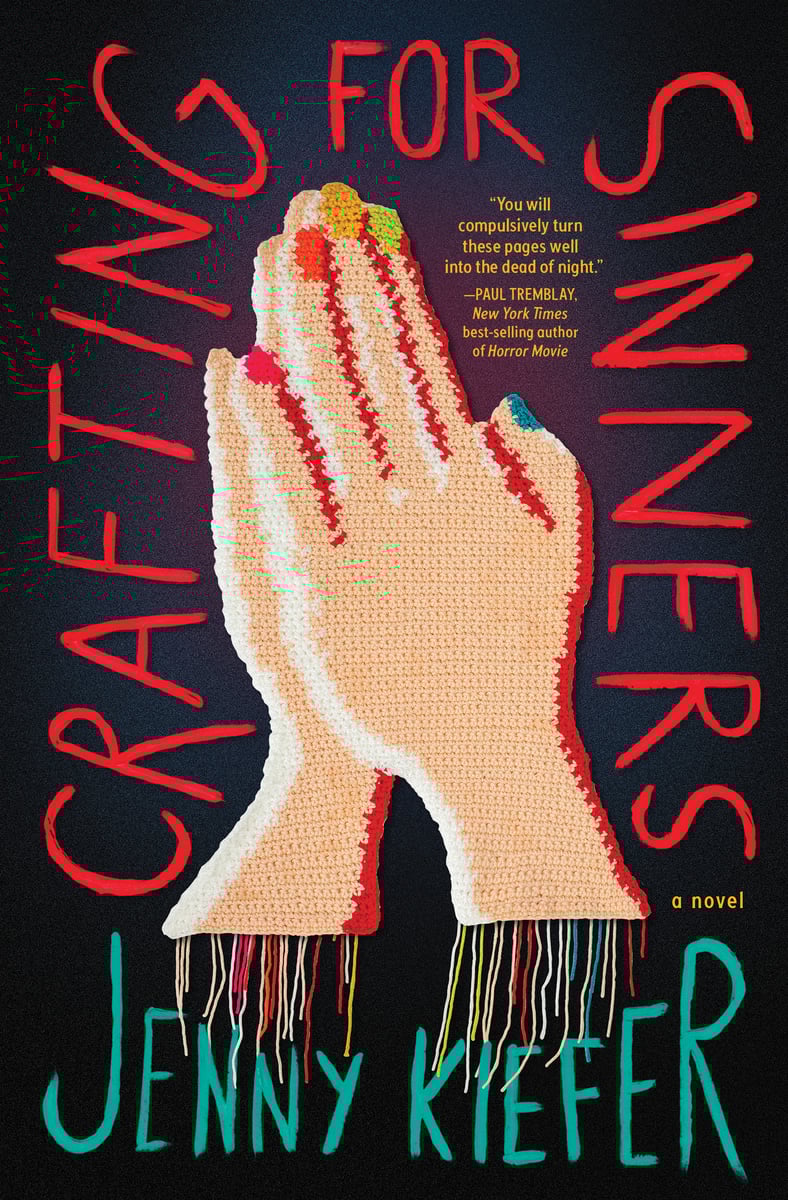
This Wretched Valley by Jenny Kiefer was one of my favorite horror books of the last several years, with its engaging plot, challenging characters, and detailed setting that proved Kiefer was a native to the Kentucky landscape in which her story took place. Of course, I was thrilled to learn that Crafting for Sinners would be published in 2025. But there is always an issue with a follow-up book by a beloved author (Sarai Walker, why did you do it to me?!)—it can be a letdown. My main concerns were repetition of specific phrases, describing everything with horrific language unnecessarily, and a lack of pathos for characters early in the novel.
The story opens with Ruth and Abigail, girlfriends living in Kill Devil, Kentucky. Ruth is a diabetic, which cuts into their finances, and that’s important because Abigail wants to leave this small, religious community. In fact, Abigail is paranoid that the town will learn Ruth and Abigail are lesbians. She keeps the curtains shut, the door bolted, and she’s suspicious of the bird watcher hanging around in the woods—especially since they live at the end of a road, miles from anywhere. Abigail’s mother was also a paranoid person, so Ruth chalks it up to a learned paranoia rather than one based on evidence.
On our first evening with the characters, Ruth is frantically knitting a baby blanket, a custom order (her first ever, I believe). She gets a text from the buyer asking if the blanket could be bigger and be finished by tomorrow morning. It’s a good amount of money, so Ruth heads to the local craft store for more yarn. The problem is she used to work at the craft store, which is owned by the New Creationists, a church that cropped up a few years ago. Ruth was fired when her manager found out Ruth is gay. Although there is nowhere else to buy yarn but from these bigots, Ruth gets them back by stealing her supplies. This time, the employees try to detain her, and it is for something much more serious than petty theft…
Firstly, I was astounded that Kiefer kept using the same phrases: “boiling rage” seems the only way to describe Ruth’s anger. She constantly has to bite her lip to hold in a scream; by page 159, Ruth has held in a scream over a dozen times. If you’re trying to hide out in a dark craft store so a religious cult doesn’t kidnap you, I would think you’d be able to keep your screams to yourself without having to bite your lip and draw blood. What other ways might Ruth have expressed anger? Or, what other emotions might she have felt?
One thing Kiefer wisely repeats, because it’s important and adds real urgency to the story, is how Ruth’s blood sugar is. Remember, she’s diabetic. If she gets injured and bleeds, it affects her blood sugar. Running around and fighting with the bad guys affects her blood sugar. She has no food on her. She scavenges cake and brownies from the break room throughout the novel, and I wondered about how long diabetics can continue without sliding into a coma. I wish she could actually test her sugar levels throughout.
There was also the issue of describing regular things in an unnecessarily horrific way, making the description land flat because it’s so unbelievable. Regular human beings who are trying to capture Ruth two times have saliva dripping down their teeth, as if they were animals. Speaking of animals, one scene involves rats, which should have been terrifying. You know, rats climbing up you while you have to stand there silently, lest the murderous cult members find you? But this is how Kiefer describes he scene: “Their claws and teeth peeled away the fibers of her shoes, digging down to her skin, trying to burrow to freedom.” How in the world would rats chew through an entire shoe in seconds? Even more baffling was the way Kiefer described a mere light: “At The top corner of the number pad shone a tiny red light, a little pimple Ruth wished she could pop, could slice and slash and gut, watch the pus squirt out.” If a simple light turns into a disgusting pustule to be maimed, anything that needs to be horrific pales in comparison. Like, you can’t sprint the whole race, you know?
I wish the author had established the depth of the relationship between Ruth and Abigail earlier and more clearly. Ruth’s nervousness about Abigail possibly leaving her made me feel like they were a relatively new couple, but we find out much later that they’ve known each other since they were kids. This is a fundamental relationship, even if they were to stop dating, though Abigail has given no indication she would. Really making me care about that relationship earlier, perhaps with more flashbacks, would have added heart to the novel. Ruth wants to survive for Abigail, but we barely know Abigail’s personality.
books of winter
- Savage Inequalities: Children in America’s Schools by Jonathan Kozol
- Monster: A Fan’s Dilemma by Claire Deder (DNF)
- This is Not a Book about Benedict Cumberbatch by Tabitha Carvan
- Crafting for Sinners by Jenny Kiefer
- Uncomfortable Conversations with a Black Man by Emmanuel Acho
- Deliverance by James Dickey
- Devil’s Call by J. Danielle Dorn
- Jaws by Peter Benchley
- The Lost Girls by Allison Brennan (#11)
- The New York trilogy by Paul Auster
- The Man Who Shot Out My Eye is Dead by Chanelle Benz
- All of Me by Venise Berry
- At Wit’s End by Erma Bombeck
- Minding the Store: Great Literature About Business from Tolstoy to Now edited by Robert Coles and Albert LaFarge
- Touched by Kim Kelly
- Awakened by Laura Elliott
- The Road to Helltown by S.M. Reine (Preternatural Affairs series #9)
- After Life by Andrew Neiderman
- Paradise Rot by Jenny Hval
- How to Save a Misfit by Ellen Cassidy
- Suggs Black Backtracks by Martha Ann Spencer
 Grab the Lapels
This is a great description of why the book didn’t work for you Melanie. If only her first readers and editor hadn’t done this work for her. The set up sounds promising (though of course not necessarily for me!)
LikeLike
It could have been so cool, such a neat blend of crafting and satanism. It doesn’t help that I just watched 28 Years Later: Bone Temple in cinema on Sunday, and it was an amazing film with Satanists. Doesn’t that just irk you when you get two things (accidentally) put side-by-side and now you have to compare them whether you want to?
LikeLike
Haha … yes it does.
LikeLiked by 1 person
Yeah, I was so disappointed, the book had such potential! Sometimes I wondered whether it was supposed to be funny or horrific. And then it just got saggy and boring for a lot of pages before finally getting interesting again at the end. Oh well. I did enjoy some of the creative use of craft supplies though.
LikeLike
If you’re into nature horror, I recommend her novel This Wretched Valley. Super spooky, sometimes scary, pretty intense. Lost in the wilderness is one of my favorite things. I love horror that I can’t see — like we’re just hearing things or we can’t get out of the woods or something. I love it. I think of it as sensory horror.
LikeLike
Once you notice those repeat actions in a story, it’s so hard to move past! I read a book where characters kept clasping their hands over their hearts and it drove me crazy! This sounds like it could have used some heavier editing.
LikeLike
So, it was basically the literary version of Sarah Jessica Parker?
LikeLiked by 1 person
Hahaha!
LikeLiked by 1 person
Comparing a small red light to a pimple about to pop is a real…choice. It’s a choice. Repetition really bothers me in writing too, I totally get that. It feels like it hasn’t been edited properly, which annoys me.
However, I love this cover.
LikeLiked by 1 person
I love the cover as well. I believe the cross-stitch was an actual piece someone made. I never noticed repetition was bothersome until a dude named Henry pointed it out in an English class in 2004. Weird that I remember that.
LikeLiked by 1 person
weird you remembered his name was Henry too haha
LikeLiked by 1 person