
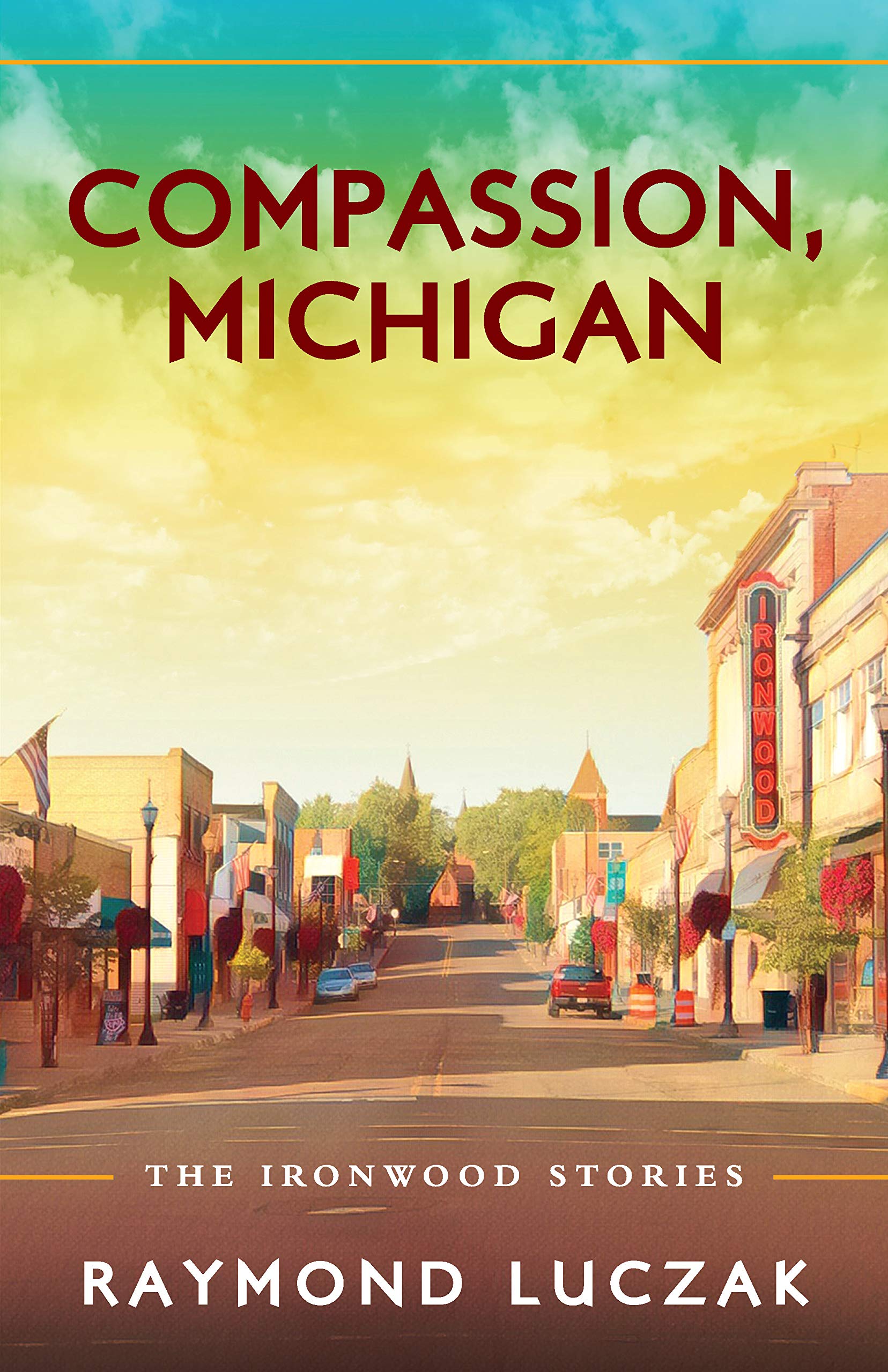
Compassion, Michigan is a short-story collection by Raymond Luczak. Known for writing collections of poetry, personal essays, and fiction; editing anthologies; and writing plays and novels, he’s also an advocate for better accessibility for the Deaf community. Since so many of his books focus on the experiences of gay men (check out some of his book covers), I was surprised to finish Compassion, Michigan and realize every story’s protagonist was a young women with the exception of a story about a transman and one about a person who believes they do not experience gender—they’re just who they are.
Luczak’s collection takes place in Ironwood, Michigan, where the author was born and raised, writing stories covering quite a bit of history, from the days when the iron ore mines attracted thousands of immigrants to work there to the city’s recession, of course tied to the lack of mining jobs and people leaving. Ironwood is in Michigan’s upper peninsula, a rather isolated part of my home state. In fact, in one story set in the 1980s about a deaf girl living in Ironwood, we learn she must travel three hours yearly to reach the only audiologist in the upper peninsula.
Another interesting factor that surprised me aside from the female protagonists were the lack of D/deaf characters. Not that a Deaf author must write Deaf characters, of course, but this is my first fiction collection by Luczak—thus my surprise. In fact, the first book I read by him was an edited work of another Deaf person called When I Am Dead: The Writings of George M. Teegarden, which was about a teacher. It was a fascinating look at Deaf education during a time when most places had banned sign language, instead forcing children to try speaking and reading lips only, which can lead to language deprivation.
I do wish Compassion, Michigan had been structed somewhat differently, perhaps with the stories rotating in main characters as secondary characters—perhaps neighbors or bosses or love interests—instead of each story being disconnected. As a result, the plots and characters started to blur together: women who are unexpectedly pregnant, women escaping husbands, women who realize they are attracted to other women. In a sense, Luczak recognizes this: “Each generation recycles the past. In between they create and weave stories filled with the same old plots that never feel that way to any of them.”
I did enjoy how “The Traitor’s Wife” gave me a good sense of setting. I felt like I knew where and when I was based on the historical references and the way the small-town people behaved once they found out that the main character’s husband was a traitor to the U.S., not a soldier fighting in the Korean War, as he said he was. While he’s gone (good riddance!) but before he’s caught, the wife starts buying up loads of plants, and I loved all the plant descriptions. Plant parents, unite!
I’m eager to go back and read Luczak’s nonfiction about his life as a gay Deaf man in an isolated area, who didn’t learn to sign until he left for Washington, D.C. where Gallaudet University is located. It’s the only university in the world for Deaf students. His life sounds interesting.
Books of Fall 🍁🎃🍵
- Feeding Ghosts by Tessa Hulls
- Rebecca by Daphne du Maurier
- Just Desserts by G.A. McKevett
- Slewfoot by Brom
- She Throws Herself Forward to Stop the Fall by Dave Newman
- Submerged by Hillel Levin
- The Unmothers by Leslie J. Anderson
- Homing by Sherrie Flick (DNF)
- The Bloody Chamber and Other Stories by Angela Carter (DNF)
- Ask Elizabeth: Real Answers to Everything You Secretly Wanted to Ask about Love, Friends, Your Body — and Life in General by Elizabeth Berkley (DNF)
- No Good Deed by Allison Brennan (#10)
- Fat!So? by Marilyn Wann
- The West Passage by Jared Pechaček (DNF)
- Quest for the Unknown: Bizarre Phenomena by Reader’s Digest (DNF)
- Icebreaker by Hannah Grace (DNF)
- Notes on an Execution by Danya Kukafka
- Queer Little Nightmares, edited by David Ly and Daniel Zomparelli
- Player Piano by Kurt Vonnegut, Jr.
- Compassion, Michigan by Raymond Luczak
- Bitter Thirst by S.M. Reine (Preternatural Affairs #8)
- Syd Arthur by Ellen Frankel
- Deaf Eyes on Interpreting, edited by Thomas H. Holcomb and David H. Smith
- A Life in Letters by Zora Neale Hurston
 Grab the Lapels
As always I enjoyed your review Melanie, and I loved this quote you shared: “Each generation recycles the past. In between they create and weave stories filled with the same old plots that never feel that way to any of them.”
This is true of stories too isn’t it, if it’s true of generations. So, what makes these recycled stories interesting to readers? For me it’s the writing – writing that makes old stories feel fresh. It’s also the characters, that is making them individual so interesting to readers about but universal so readable. And I guess it can also be the writer’s angle, as in why do they choose to tell this particular recycled story?
LikeLike
Those are all great reasons for why we keep reading stories. I love this video on YouTube of Kurt Vonnegut explaining how people love the boy meets girl story. He plots out the whole thing on a pad of paper, and the whole bit is funny. His point is explaining what it means to write, and basically, all those touchstone moments have to be colored in, and we will all use our creative powers to color them in differently. If you Google Kurt Vonnegut on the Shapes of Stories, you will find it. It’s lovely.
LikeLiked by 1 person
Oh thanks Melanie… I will try to find it later when I have a free moment.
LikeLiked by 1 person
I got home today from a trip up north – to Australian iron ore country. My aircon failed in 40 deg (about 110F) heat and I’m a bit tired. (I’ll update my work blog tomorrow).
I can see why writers write short stories, they get to practice descriptions of events and people, I just don’t get why people read them. I expect real writers to be able to string lots of events and people to make a coherent whole.
I’ll make a note to myself to Google Kurt Vonnegut on the Shapes of Stories.
LikeLike
I don’t agree that short story writers are just practicing nor that they are not “real” writers.
Sounds like your trip up north was rather miserable, and I’m sorry to hear that.
LikeLike
I don’t mind a varied short story collection – I’d much rather read one that had stories I didn’t like and stories I did like, vs collections that all feel the same to me. In my mind, ups and downs are preferred to medicore all the way, if that makes sense…
LikeLike
That does make sense. I remember there was a short story collection just eating up the praise several years ago, and my mom and I read it together. Every story felt like Mario had died and needed to start the level all over again. This one isn’t quite like that, and I will say my mom got more out of it than I did, but I do wish there was more variety. It’s also possible an editor pushed the author to gather similar stories, so the author had a theme to the collection.
LikeLiked by 1 person