
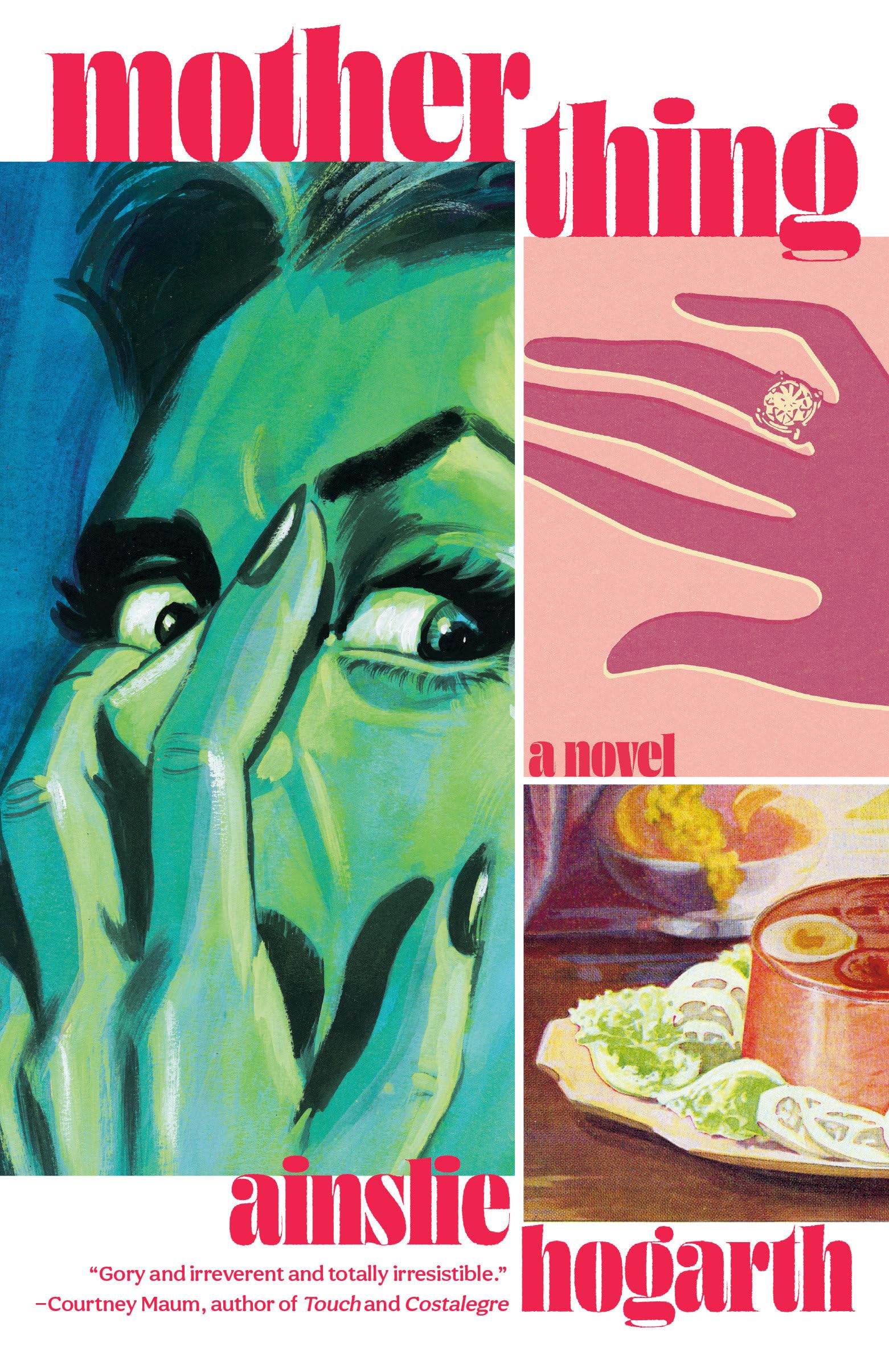
Although I had intended to just review MotherThing by Ainslie Hogarth, I found my thoughts drawn more toward how novels are marketed, and so that is the direction I’m going to start. On the cover of Hogarth’s novel, we see a blurb that states, “Gory and irreverent and totally irresistible.” However, on the back, another review refers to MotherThing as a “dark domestic drama….” So, which is it? Gory or a drama? Because in my head, those are not the same things.
One trend in the horror fiction genre I find a bit frustrating is how books by women are typically domestic set. It’s almost as if they’ve been limited by their gender roles. Readers get novels set in a house with ghosts or demons, but the real problem is childhood trauma or a spouse/partner who isn’t equally committed to the marriage. See novels like The September House by Carissa Orlando, It Will Just Be Us by Jo Kaplan, and Suburban Hell by Maureen Kilmer. Of course, I’m generalizing, so take this how you will.
Male authors in the horror fiction field, on the other hand, write about any and everything that would scare the crap out of you. Yes, they can write domestic horror, but they’re also giving us zombies, the devil, pandemics, a clown in a cornfield. If men write in the domestic setting, it’s not about the domestic setting and family trauma. That’s just where people live, and the horror has shown up on their doorstep.
In MotherThing, we meet Abby. She’s married to Ralph, whom she really, really loves. But Ralph has been manipulated by his mother over the years, and when she claims she can’t live alone, Ralph and Abby move in. Because Abby’s estranged from her own mother, she hopes she can develop a loving, mother-daughter relationship with her mother-in-law. This is what readers are told on the back cover of the book, by the way.
In reality, the novel opens with Ralph’s mom dead by suicide. Ralph becomes deeply depressed while Abby feels frantic. She stole her mother-in-law’s beloved opal ring before paramedics came after the 911 call. There’s a whole subplot around the search for the ring and whether Abby should confess to Ralph. Also, Abby wants to leave her mother-in-law’s house now that they don’t need to be there, but Ralph is inconsolable, sleeping in her mother’s bed instead of with his wife. Time passes. Abby considers lying, saying she’s pregnant. She doesn’t. Ralph stays in the house. Abby goes to work at a adult care facility where she has grown too attached to one resident, calling the older woman “my baby.” Through Abby’s first-person point of view, we know she’s decided she will have a baby and name it Cal, so much of what Abby does in the novel is for Cal or thinking about Cal.
Is this a novel about baby fever? Abby sees babies and mothers everywhere, ignoring the husband who is sinking into depression, unable to go to work, and . . . talking to himself in the basement? Here is where the publisher gets to claim MotherThing is horror; Ralph says he’s talking to his mother’s ghost. He convinces Abby to stand in the basement with the lights off and invite his mother’s spirit to her. Abby tries, and in the pitch black she hears something moving, but we never see evidence of a ghost.
Thus, I would ask, what kind of novel is this? There is a moment near the end readers might call surprising or icky, but it doesn’t register with me as horror at all. And so, is it possible publishers are calling any dark, irreverent, domestic-set novel “horror,” especially if there is trauma in the family? Because my expectations were toward one genre and I got something unique, — dare I say a work obviously from an MFA program — I wasn’t as satisfied with MotherThing as I would have been had it been advertised accordingly. On the other hand, I’m aware that my readers likely wouldn’t pick up MotherThing due to its untrue synopsis when some of the parents who read my blog might actually like Hogarth’s novel.
 Grab the Lapels
Seems like the book was trying to be too many things and the marketing intern didn’t know what to do with it. 😀
LikeLike
🤣 The marketing intern. Who probably isn’t paid! I do find that books that come from folks who graduated from MFA programs tend to be marketed incorrectly. My issue isn’t with the writing that comes out of MFA programs but the way publishers don’t seem to know what to do with books that have stories that feel both familiar and completely odd. The result is that readers go in with one expectation and are disappointed when they don’t get what was on the back of the book or in the blurbs.
LikeLiked by 1 person
Huh. You make such a good point of the domestic-ness of horror about women. They also often seem to involve children. My first instinctive reaction when reading this review is that I hate when a female character’s desire for a child seems to be the thing that drives them “crazy”. You never see a male character motivated to do crazy things because he wants to become a father.
LikeLike
I find the back covers of books really frustrating – often saying both too much and too little. Choosing books at the library I have no choice but to read them, but if I’m buying books I will generally buy on the basis of reviews or of the author’s name and not read the back cover at all.
And no, this doesn’t sound like horror, nor even a psychological thriller, just another general fiction drama ( was it really necessary to the plot for the wife to steal her MIL’s ring).
LikeLike
I thought the narrator stealing the ring would lead to something, but not much happened with it. The author truly could have had the MIL haunt them because the narrator stole the ring, but even that did not happen.
That’s interesting to know you don’t read the back of books. Currently, I’m reading A Tale of Two Cities with Lou and Biscuit, and I have to keep reading the back of the book to remind myself what the plot is about. I get that sense that Dickens wrote a serialized novel because each chapter feels like a short story, so I end up asking myself, “What is the point of this book again?” I do know some people who refuse to watch trailers at the cinema because some show way too much.
LikeLike
How frustrating! This seems like a very different book than the copy would lead one to believe.
LikeLike
Indeed.
LikeLiked by 1 person
I actually have this book on my shelf, the publisher must have sent it to me awhile ago, because I think it’s been there for awhile! I’ve read / heard of quite a few books lately that deal with the horror of being a mother / not having a mother / wanting to be a mother. It’s all wrapped up in this idea of female hysteria as well, which the cover sort of reflects I think
LikeLike
Huh, I did not connect this specific subgenre of mother-related horror to hysteria, but you are spot on. However, I can’t tell if the authors are criticizing the history of hysteria or unintentionally adding to it. Oddly, the most empowering novel I’ve read about motherhood in horror was by Nat Cassidy–a man.
LikeLiked by 1 person
haha good on him!
LikeLiked by 1 person