
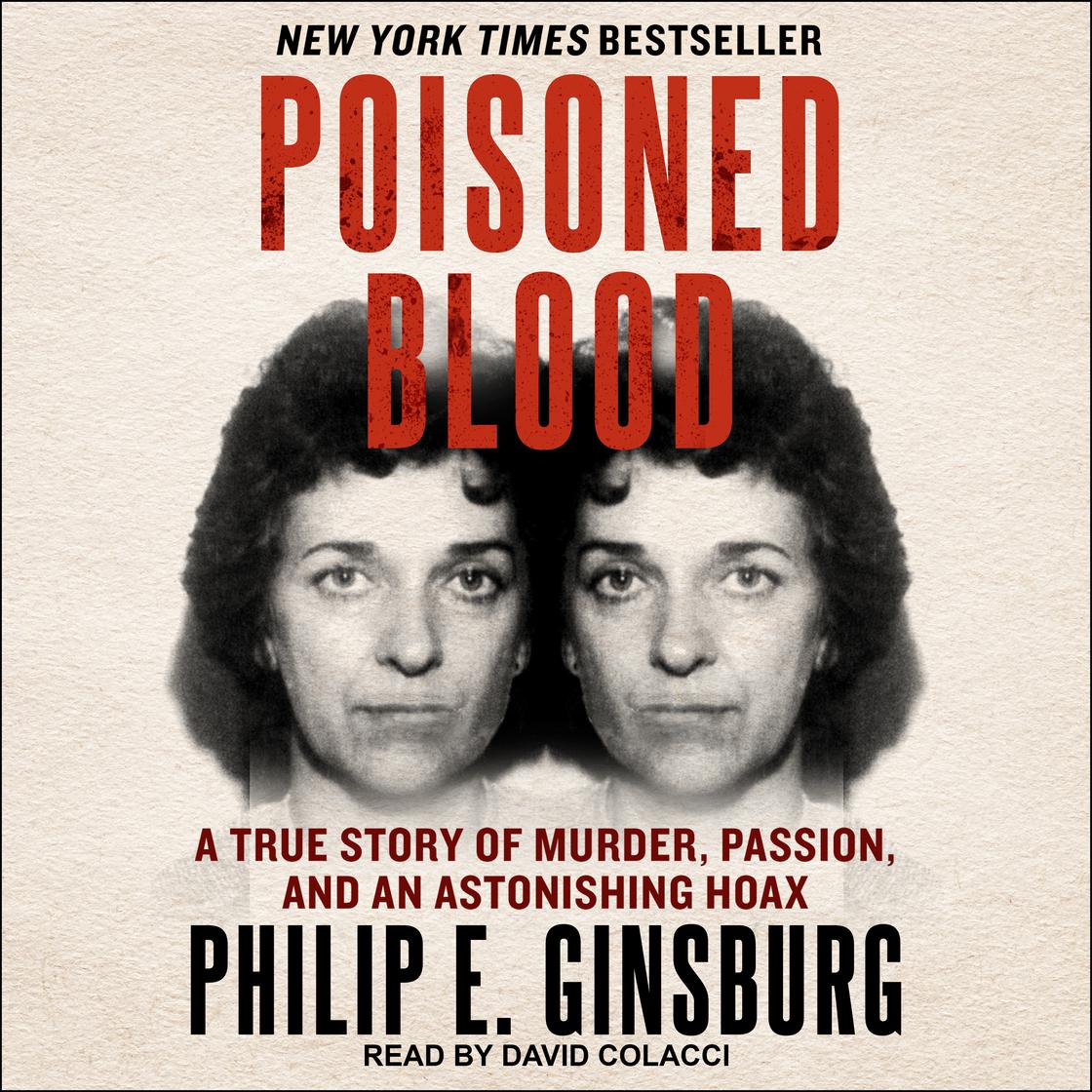
Philip E. Ginsburg’s book was one that caught my eye in a Goodwill. I don’t read much true crime, but we Americans (maybe other countries, too?) are endlessly fascinated by the female killer in particular. The full title is Poisoned Blood: A True Story of Murder, Passion, and an Astonishing Hoax. What in the world could this plain-looking woman on the cover have been up to with that whole subtitle?
Audrey Marie Hilley was born and raised in a small town in Alabama where she married Frank and had two children, Mike and Carol. Hilley had massive spending issues that became apparent when Frank got calls from collectors claiming he had unpaid loans. After Frank suffered from a debilitating illness that affected his stomach — and catching his wife sleeping with her boss — he died in 1975.
Later, Mike and his wife experienced similar symptoms whenever his mother came to visit, and then Carol followed the same trajectory as her father. Meanwhile, Audrey Marie Hilley, the dutiful mother, took Carol (age 19) to the hospital where they could not figure out what ailed the teen. Eventually, she lost some function in her limbs before relatives on Frank’s side of the family, still unsettled by his death four years before, suspected Hilley of foul play.
Doctors, now knowing to look for the inconspicuous causes of Carol’s illness, quickly realized she was suffering from arsenic poisoning. Frank’s body was exhumed; he was loaded with arsenic. Hilley was arrested but her intelligence and kind manners fooled authorities, allowing her to slip away after posting bail. While FBI searched for Hilley for three years, she made up a new personality, got married, worked, claimed she has a twin sister in another state, faked her own death, and came back as the twin.
If you’re thinking, wow, that escalated quickly, you are only partially right. Hilley spent four years slowly poisoning Carol, likely for the life insurance policy Hilley made payments on above all other debts. Interestingly, author Ginsburg leads us to believe Hilley is killing people for insurance money. If that’s the case, why create a persona, fake her own death, and then go back to her new husband pretending to be the identical twin sister? There is no mention of money issues in the three years Hilley lives a lie. Even weirder, her new husband claimed she would sometimes revert to acting like a one-year old child despite her ability to type quickly, fit into office culture, and win over bosses. She was a valued employee.
Poisoned Blood is read by David Colacci. His voice is easy on the ears, and he speaks clearly. However, he does that unforgiveable stunt of most male audiobook narrators: he gives women a high, dainty voice that had me cringing. Otherwise, he does a fine job. Ginsburg keeps the book going at a steady clip, only slowing down in one chapter during which he gives a full backstory on Hilley’s new husband. It was unclear why his childhood and adolescence mattered when his role in Poisoned Blood was fairly smally by comparison. Ginsburg does avoid slowing things down during the trial, which most books with a trial in them cannot claim. The ending — what happened to Audrey Marie Hilley — absolutely surprised me.
 Grab the Lapels
Wow! I looked her up on Wikipedia, no word about why she killed her husband and tried to kill her daughter. And I can hardly believe her second husband after everything stayed married to her and even moved near the prison so he could see her. What a story.
LikeLike
The author implies that she killed her husband for his life insurance policy, and then she took out life insurance policies on herself, her daughter, and her son. Therefore, it suggested that she was trying to kill the daughter for money, too. Whenever she went to visit her son, who had moved away and gotten married, both he and his wife would get sick. It’s like she was just giving everybody a happy little dose of poisoning. There were even reports of the police coming to visit her after she claimed somebody kept calling her and harassing her, and she would offer the police coffee, and then they would get sick.
LikeLiked by 1 person
This sounds like a wild story! I recently read a news story about a woman who killed her husband then changed her name and moved to a new place and started a new life. She lived for years in her new community and seemed like any other little old lady, playing bridge and going to church. After she died it turned out she was this wanted murderer. This story sounds more complex though and maybe more motivated by money?
LikeLike
Some of the complex stuff in this true crime book seem off the charts wild. For instance, her second husband claimed that at times she would revert to the behavior of a 1- to 2-year-old child. Why do that? She had a history of overspending, so when she killed her husband, the motive made sense. And she took out an insurance policy on her daughter, so slowly poisoning her made sense. But then getting a new identity etc, just doesn’t add up. It is wild.
LikeLiked by 1 person
It does seem like money is a prime motivation for murder in so many cases. The new identity thing does sound confusing. And obviously it didn’t work out for her!
LikeLiked by 1 person
Now that I’ve started to listen to audiobooks, I know EXACTLY what you mean when you say male narrators imitating a female voice going annoyingly high. In fact, I thought it was just a few books that I had listened to, and this wasn’t the norm. It’s awful!!! I laughed out loud the first time I heard it because I though it was a joke haha
LikeLike
There was one book I listened to in which the chapters alternated between husband and wife and have a male and female narrator to read them. In the husband’s chapter, later in the book, he gets letters from the wife, so the MALE narrator reads the wife’s letters, and it feels like ages of him reading in his “woman voice.”
LikeLiked by 1 person