
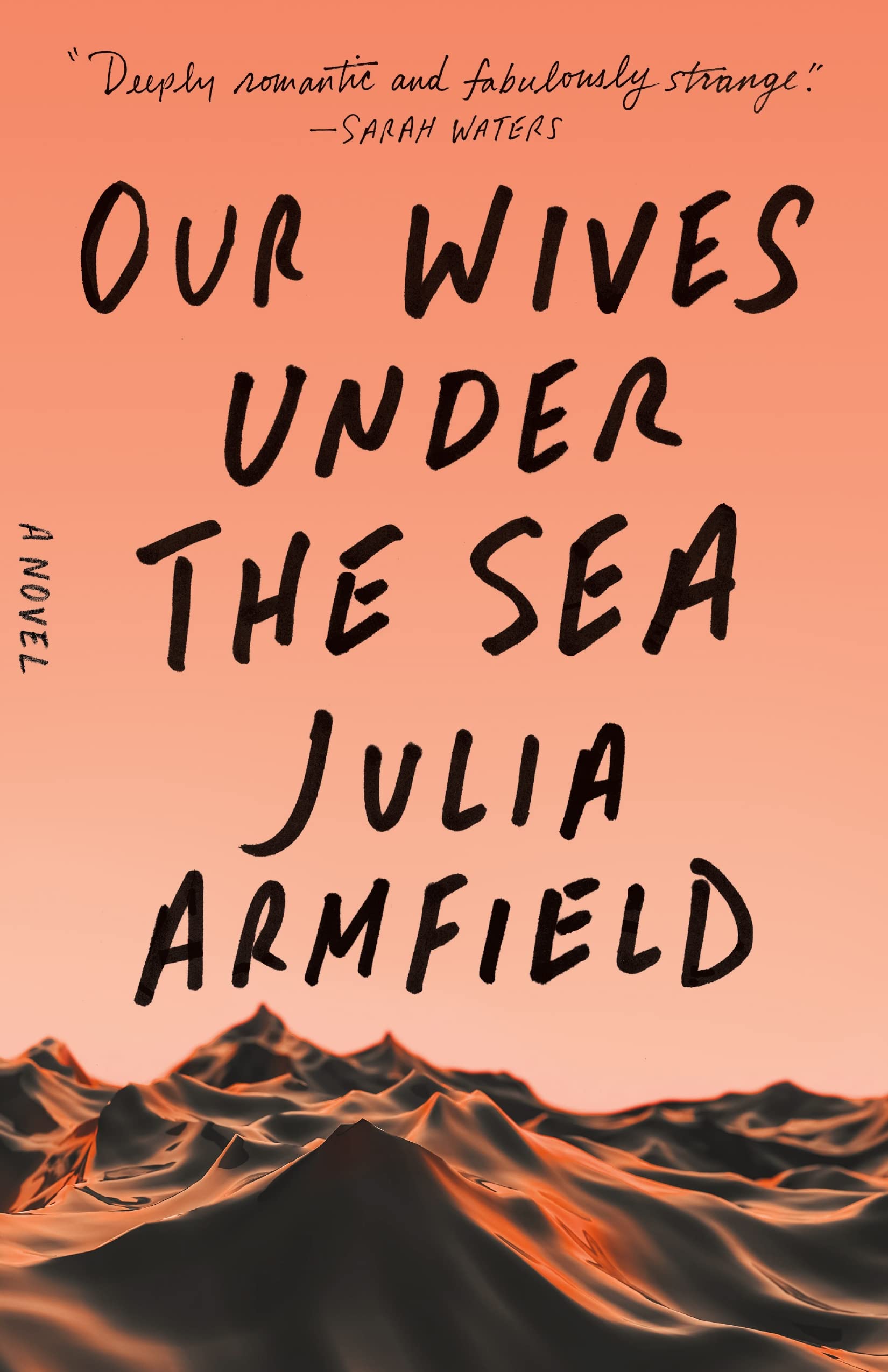
Based on what I’ve read across the internet, Julia Armfield’s Our Wives Under the Sea is polarizing. If you look at the back cover, this book was a “best of” for many distinguished reviewers, such as NPR and The Washington Post. While the lush language definitely draws you in, I found the story bloated into a novel when it really wanted to be a short story all along.
Miri and Leah are wives who were separated for six months when Leah went aboard an oceanic research vessel with two other researchers. What was supposed to be three weeks submerged went haywire after the lights, communication, and mobile abilities in the sub are suddenly, inexplicably, turned off. The crew sinks until they hit bottom, not knowing if they went to the ocean floor, an even deeper crevasse, or what. How do they survive six months? We’re told the company that hired them packed months worth of food, the water that comes out of the shower is purified from the ocean, and the oxygen system never turned off. Although Miri assumed Leah was dead, Leah reappears: “Deus ex machina — the missing loved one thrown back down to earth.”
For starters, the novel feels like an exploration of losing someone and ocean science. The science did not work for me. Author Julia Armstrong had Leah spout random ocean facts without context, and the description of the research vessel is unbelievable. I’ve read nonfiction about deep sea exploration, and the only vessels that can take scientists as deep as Leah and her two coworkers purportedly go are small — there are no showers or stores of food. In fact, divers must go to the bathroom before they launch and not expect to go again until they resurface. If this is a massive submarine Leah and the crew are on, there would be more than three of them to staff it, and it wouldn’t go as deep as “miles” below the surface.
As for a discussion of loss, Armfield connects Miri losing her mother, a unlikable, rigid person who died in hospice care, to Leah’s return and degradation. While the description suggests something ominous — that it isn’t Leah at all who came back — what we get is Leah spending all her time in the bathtub filled with salt water. I half expected to learn she’d become a mermaid, but she’s basically dissolving into a clear bag of water.
Our sense of time is fuzzy, but it seems months have passed with Miri wondering why her wife won’t act normal and Leah sitting in the bathtub. Miri doesn’t ask for help, nor does she seem to work and earn money. When her mother died, Miri inherited the house, yet they rent an apartment with upstairs neighbors who leave the TV on high volume 24/7. The plot is conveniently inconvenient, moving ahead at a snail’s pace and never reaching the finishing line. Miri sits on the couch most days; Leah sits in the salty bathtub. We get snippets of their relationship, of meeting, but it’s all ordinary.
If you like flowery prose, you’ll get heaps of it. For example, “Most nights we don’t talk — silence like a spine through the new shape our relationship has taken.” In fact, despite chapters switch from Miri’s to Leah’s points of view, both are written in the same purple prose, which occasionally made me forget about whom I was reading. Had Armfield written a long short story of Miri and Leah, I would have enjoyed this immensely. At 240 pages, it felt forever long, especially for how little anything moves forward, including whether Leah is actually Leah or something else dredged from the ocean’s depths.
 Grab the Lapels
I misread the title as “Our Lives Under the Sea” and assumed this would be about people setting up an underwater habitat! I don’t always need my science fiction to be believable, but if there is a lot of effort made to communicate the supposedly underpinning science, I do want it to seem plausible. It sounds like this doesn’t get the balance right there, which is a shame – it’s an interesting premise.
LikeLike
It leaned so heavily toward lovely language, making each sentence so completely quotable, that the story gets lost in the author taking those opportunities. Some have claimed this novel seems obviously produced in an MFA setting; I don’t know if it was, but I understand what they mean.
LikeLike
I love how you express yourself Melanie … “ I found the story bloated into a novel when it really wanted to be a short story all along”. That made me laugh. But that example of writing you gave at the end didn’t. I agree either way you. If most of the writing is like that it sounds a bit trying-too-hard-to-be/writerly to me.
Interesting premise though, as loulou says.
LikeLike
Thanks, Sue. When I chose the word “bloated,” it was intentional, my hopes being that you picture a body waterlogged from the ocean. I would have loved the writing if the plot had kept up. On the other hand, some of the sentences didn’t make sense. I recall one about the sun peeling back like wallpaper.
LikeLike
I recall being totally engrossed in this book, for a few reasons – the bits about being underwater reminded me of when I learnt to scuba dive (exhilarating and terrifying at the same time), but I also thought that the way Armfield explored the theme of ambiguous grief was very well done. Enjoying it as much as I did was a bit of a surprise to me because I’m not usually one for magic realism at all.
LikeLike
While I would sometimes be interested in how this is told, your description of it makes me weary right now.
LikeLiked by 1 person
Depends on how much poetry you want in your life, and I know you love poetry. Which part makes you weary?
LikeLike
the part where the plot is “moving ahead at a snail’s pace and never reaching the finishing line.” I feel that in too many areas right now and have always been impatient with it in fiction.
LikeLike
Oh! Wow, your comment made me realize maybe that’s why I like the Lucy Kincaid books. I’m enjoying my internship, but I’m also in a hurry to get home and “start life.” The Kincaid books are NOT slow. They deliver.
LikeLiked by 1 person
In a moment of synchronicity, my daughter told me today that she’s been listening to this on audio and enjoying the way it’s written!
LikeLike
I’ll bet the audio version just lulls you into a happy place. It’s highly quotable, so as long as you don’t think too hard about what each line means, it’s got a lovely rhythm.
LikeLiked by 1 person
The premise sounds interesting, too bad the execution didn’t quite match
LikeLiked by 1 person
Every time I hear about this book, it sounds like a potentially interesting premise that goes nowhere. I could probably look over the science behind their time under the sea but it sounds like it lacks tension after her return and that would be too disappointing.
LikeLike
The themes just don’t come together and the timeline is so obscure as to push disbelief, which is impressive given that the one wife was trapped at the bottom of the ocean for six months and now refuses to leave the bathtub. Like, if you’re going to add in magical realism, really go for it.
LikeLiked by 1 person
Yeah, I could imagine the under the sea part as being like Captain Nemo’s submarine but if the author isn’t going to fully dive in, magic realism doesn’t work.
LikeLiked by 1 person
I had never heard of this book before so I’m glad you reviewed it, and I can ignore it now LOL
Like you, I have a surface level of deep sea submersibles, but I also know for a fact they aren’t big, so already this book is leaving me skeptical. What I would like to read, is the story of what they did while they were down there for those six months – what it was like, the emotions they ran through, etc. Now that would be an interesting story!
LikeLike
Another books I can miss! Hooray! I’ve got more than enough to read, LOL. I get annoyed when characters don’t do anything to make their lives/relationships just a smidge better. Like the chronicling of malaise is not very interesting long-term.
LikeLike
My big beef with books about twenty-somethings is they often spend the novel wandering around wondering who they are and why they can’t just sit around writing a novel on a typewriter or painting in a loft in a big city. This book had a similar vibe despite the characters being neither artists nor twenty-somethings. I guess I would say, “Your malaise is not my fancy.”
LikeLiked by 1 person