
Content warning: child abuse, incest
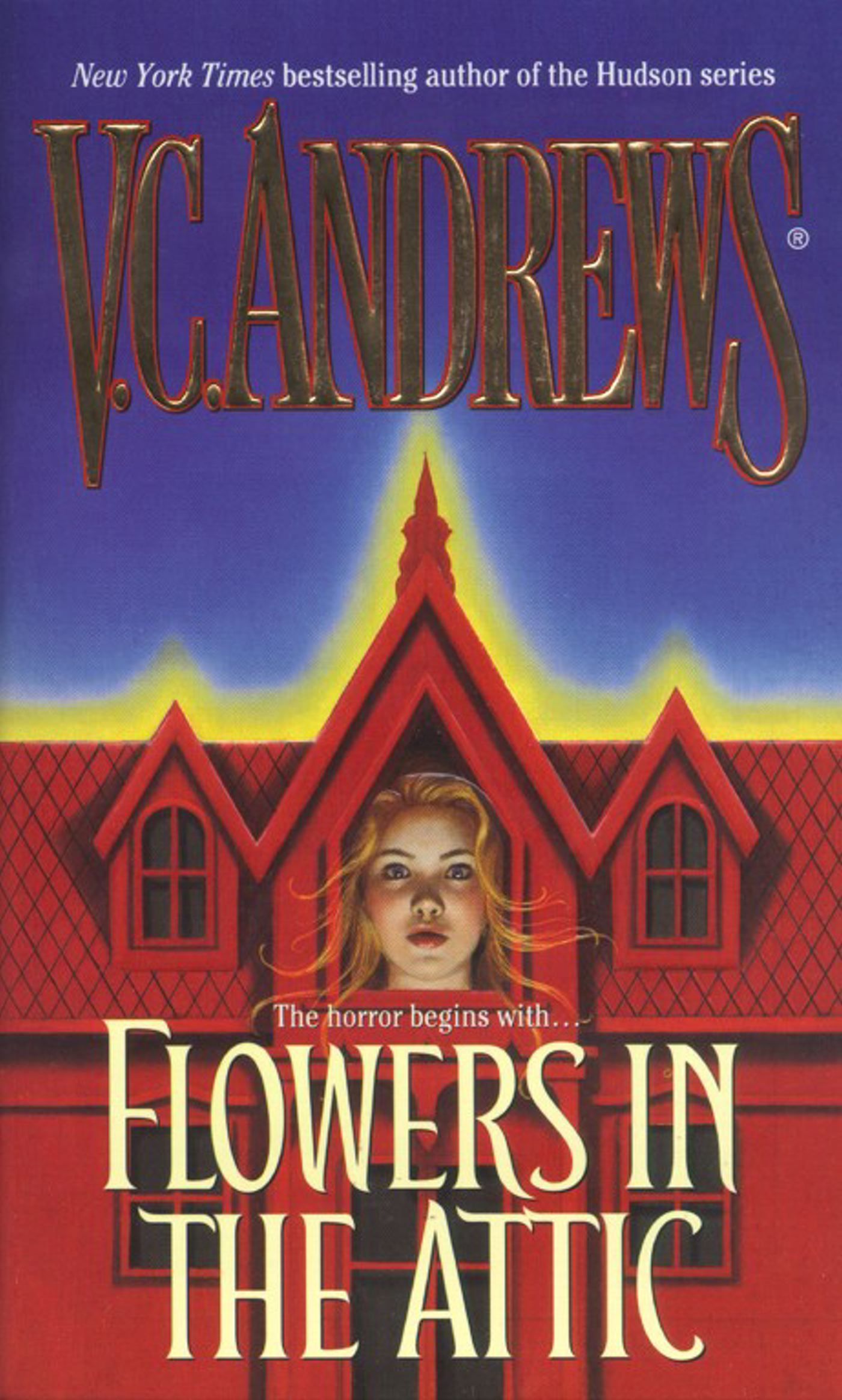
Published in 1979, Flowers in the Attic by V.C. Andrews is a classic. Many people have told me to read this novel, including a lady probably close to 90, who delightedly said it had “sex stuff,” when I was working at a library. I’ve read that it was common for tween girls in the 80’s to eat this book up. The novel is famous for its incest, so I was ready for that part. What I wasn’t ready for was how angry I would feel about my inability to control fictitious characters.
A mother and father, both blond and blue eyed, have two beautiful children, also blond and blue eyed. All I kept thinking was, “They’re like the poster family for Hitler’s visions of the future.” Then, then when the boy, Chris, is ten and the girl, Cathy, is eight, their mother becomes pregnant, and the family welcome homes twins. This family is so loving and friendly, without a care in the world, until the day of the father’s surprise birthday party, to which he does not show. We learn his’s been killed in a dramatic car collision.
The novel is set in 1957, and without the income of a husband, the family will be homeless. There is no talk of sending the children to live with aunts and uncles, because there is no one. Except…the mother’s parents. We learn she was disowned from her extremely wealthy parents, but an arrangement has been made for her and her children to move into the manse. The little family leave in the middle of the night, travel by train, and arrive before dawn. The grandmother sneaks the children into a room into the west wing, which is attached to the attic. There is one bathroom. The grandmother tells them they are the spawn of the devil, and if she catches them doing any sex stuff, there will be hell to pay. Don’t look at the opposite sex, don’t be in their pajamas with the opposite sex, no sharing beds, no standing in the bathroom at the same time, etc. Their mother is free to live in a regular room, and she explains that her father does not know about the children. If she can win him over before he dies — for he is very ill — she’ll get back into his will and they will be filthy, stinking rich.
For me, the beginning was slow going because there are red flags everywhere, but the children just loooooove their “momma.” The mother says she’s going to enroll in secretary school, so she learn to type and make a living. Then, she’ll take back her children and they’ll live together. Daughter Cathy, who narrates the novel, asks repeatedly how many wpm the mother is up to, and the mother claims incompetence. Like, can she not try harder? She doesn’t even seem fussed.
Yet, she always visits the children wearing new clothes, a salon-fresh hair style, etc. She’s been out sailing, but uh, rest assured she really didn’t enjoy herself. At first, she’s visiting every day. Then it’s less and less often. It is the grandmother who leaves the children a picnic basket of food for the whole day in the morning. Grandma is not beyond whipping, slapping, starvation, and using a hypodermic needle to leave them unconscious.
Because Cathy starts their time in the attic when she is twelve, she’s not nearly suspicious enough of her mother. As time goes on, Cathy grows more bold, which results in more physical abuse and the mother refusing to visit them for a month. I know teens are inconvenient when they talk back, but the mother views abandoning her children as appropriate punishment.
Years pass. By the end of the novel, oldest brother Chris is almost eighteen, so at what point does this become imprisonment of an adult?? Chris and Cathy go through puberty in their prison, which is where the famous incest comes in. It feels disingenuous to me to call that “sex stuff,” because it’s the result of child abuse, so reader beware. This is not a spicy fantasy. Also, because the twins were five when they were locked in the attic, as the years go on, they forget about their mother and father and see Cathy and Chris as parents, forcing the teens into the roles of mom and dad. Parents are intimate in many ways, but the teens grow to feel this is normal.
At times, author V.C. Andrews seems to make the characters “sexy” just for the shock of it. At one point, around age fifteen, Cathy was wearing “…a transparent blue nightie that was very short, though little matching panties were underneath.” I’m sorry, why is her mother buying her a sexy nightgown? On the other hand, the mother also buys Cathy dresses that have no room for breasts, as if she’s forgotten Cathy has them. In fact, Cathy has never owned a bra because her mother has missed that her children are sexual beings. In fact, the mother is constantly buying them things because she has access to money. You’d think she’d slowly collect the spending money from her father and take her children away, but she’s not that kind of mother.
In the last third of the novel, I couldn’t read fast enough. I, too, felt claustrophobic from spending so much time in the attic, and I wanted to know how the children escape. For surely they do; there are five books in the series. The grandmother, described as a large woman of 200lbs, was an immovable force, but I kept picturing Cathy and Chris overpowering her. Then again, maybe she thought ahead, for she basically gives them enough food to live, but not grow strong or thrive. I grew tired of the children not making some sort of Home Alone trap or something. They’re so compliant, and this is what I mean about feeling frustrated I couldn’t control the characters.
I was satisfied with the ending and curious about the next book, which picks up where this one left off. However, seeing that it is 448 pages, I decided to read the plot on Wikipedia instead. Andrews appears to ramp up the soap opera drama, for there multiple suicides, people becoming paralyzed, dramatic fires, etc. I’m glad I spoiled the series for myself, as I often felt stuck in Flowers in the Attic, which is only 400 pages. You could argue that my feeling was perfect, for the four children were stuck in the room, but I was restless for a chunk of the novel.
 Grab the Lapels
I had heard of this but, you know, horror. I can’t ever recollect, though, about being frustrated I can’t control characters. I feel emotional about what happens to them at times, but I’m more interested in thinking about what the author is doing and why rather than feel frustrated about it. I love thinking about what authors are doing, though I am probably usually way off base in terms of my thoughts.
LikeLike
Oddly, this book is more horrifying than horror? I guess the general description would be how could adults choose to neglect children and justify it to themselves. There are no ghosts or monsters, no “horror” as I know of it. However, it does get that label. I read that when this novel came out, it was an instant hit with young teen girls, likely because the main character is a tween when the story gets going. It would have traumatized me for sure, but that would be due to age and zero exposure to what incest could look like.
LikeLike
That’s interesting Melanie – re its “genre”. As you can guess if I were a tween when it came out I don’t think I’d have read it, because I didn’t seek out horror or fantasy, so the labelling would have put me off.
LikeLiked by 1 person
But when it’s 1981 and you’re in 7th grade, this is prime edge of your seat pulp baby! My friends and I gobbled this up along with a few of the sequels. Being stuck in an attic and stuck in junior high are remarkably similar on an emotional level. This book is what going viral looked like before the internet 🙂
LikeLike
One of the reasons I wanted to finish it was because I knew it was a viral sensation with tween and teen girls before the internet. It’s the same thing with the book The Coldest Winter by Sista Soulja; I read that that novel was basically passed around and talked about in the same way. Both deal with teen girls facing extraordinary situations that are hard and confusing.
LikeLike
I might have to read this just as a historical curiosity! It’s interesting that the girl in Helen Dunmore’s incestuous A Spell of Winter is also called Cathy.
LikeLike
Basically, I read Flowers in the Attic and The Coldest Winter (by Sista Soulja) because they were “viral” sensations in the U.S. among teen girls. It’s worth it to see how traumatizing stories spread through youth culture.
LikeLiked by 1 person
I’ve never had the urge to read this. It’s wild to me that “she” still has books coming out even though she’s been dead since like 1986!
LikeLike
I actually went through and read the plots, spoilers and all, for the rest of the books. They just get more dramatic and surprising. I can’t believe how many people catch on fire or kill themselves, etc.
LikeLiked by 1 person
As a high school student in the eighties, we were OBSESSED with this book (and all others by Andrews). I think it was the taboo factor – although my parents never censored what I read, other parents certainly did and I recall the book was passed around secretly.
I reread it a few years ago after watching the TV series (which was woeful). My impression the second time around was it’s all pretty terrible but the actually quality of the writing wasn’t nearly as bad as I was anticipating!
LikeLike
I was warned not to watch any movie versions because they are so bad. Did anyone in your school have a similar reaction to The Coldest Winter Ever by Sista Soulja? I’m not sure when that book came out but have heard it made similar rounds.
LikeLike
[…] Flowers in the Attic by V.C. Andrews […]
LikeLike