
In the opening notes, Louise Erdrich writes that The Night Watchman is a based on her grandfather’s fight to preserve the Turtle Mountain Chippewa tribe in North Dakota. Furthermore, Erdrich states that the second major character, Pixie, is entirely fiction. For both me and my fellow reader, Biscuit, therein was the problem.
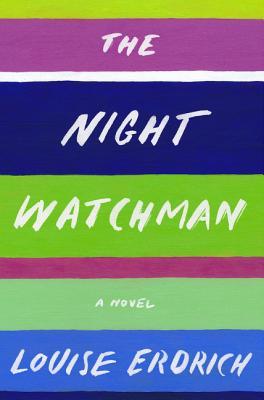
Thomas Wazhashk is a night watchman at a factory in the 1950s. That alone is interesting because there is no technology for security purposes, like cameras in every corner. Mostly, Thomas fights off drowsiness and sees the same ghost, a Chippewa boy who froze to death in a residential school, hanging around. Wazhashk means “muskrat” in Chippewa, and we learn the story of how the world was made. Animals keep swimming to the bottom of a great pool trying to scoop up some dirt, upon which the Earth would be created. No animal can do it except the muskrat, and once the muskrat makes it to the top with dirt in his paw, he dies from having been under water too long.
The muskrat is a great metaphor for Thomas’s story. He is also a Turtle Mountain Chippewa council member, tirelessly fighting by writing letters to government agencies and trying to keep the reservation in order. They have no money to maintain much, such as the door to the jail that has been broken since a drunk kicked it off. A senator –and this is based on history — has proposed that several tribes be disbanded, moved off their land into the cities where there are “better job opportunities” and lose financial and protective support from the U.S. government. It seems the muskrat must continue fighting in a small but mighty way to preserve the world as he knows it.
Erdrich doesn’t hold back from showing some shortcomings of life on the reservation. Many Chippewa still ride horses in the 1950s for lack of car, they don’t have indoor plumbing, people are scraping by on little food, and the best thing to happen for employment is a factory opening. However, the Chippewa don’t want to leave their homes for the cities. As a result, the novel has an authentic, complicated feel that doesn’t gloss over the duality of people living how they want and yet making due with what was left for them after colonization.
The problem is Erdrich has a bloated cast of characters — notably Pixie taking up loads of room — making for a flabby book lacking in direction. Pixie works at the factory that Thomas patrols at night. Her whole story is that there are two men in love with her, but she’s not sure she loves either. Then, her sister has been missing after the government sponsored a job for her in Minneapolis, so Pixie goes to find the sister with one of the young men in love with her. We spend chapters and chapters in Minneapolis. Because Pixie’s sister’s story did not tie in with the larger plot of stopping the senator from terminating the rights of the tribe, the novel felt bogged down. Truly, it’s hard to care about who is “in love” with Pixie when the tribe is going to be disbanded.
Erdrich does paint a picture of the full reservation, but sometimes the details become side plots. For instance, two Mormon youths go door to door to tell the Chippewa about Mormonism, which is an interesting juxtaposition of monotheism and polytheism, except then those Mormons get a couple of chapters of their own. Yes, we learn they are hypocrites because one is lusting after the girls on the reservation, but that doesn’t influence the reader’s feelings about the tribe being disbanded. If this were a novel about the Chippewa being dubbed sub-human and white people as good citizens, then the hypocrisy would highlight the argument. At 464 pages, The Night Watchman could have been at least two different books that really immersed themselves in a story, place, and time.
 Grab the Lapels
Oh, I felt exactly the same about this one! From my review: ‘I was disappointed by how much Pixie’s relatively cliched narrative dominated when I really wanted to know about Thomas’s campaign’. I’m still trying to find an Erdrich I love as much as The Sentence.
LikeLike
I think I originally meant to read The Sentence but bought The Night Watchman accidentally. I believe I’ve read her short stories, and those are quite good. Perhaps she does not excel in the long form. The Night Watchman felt a bit like many short stories. Even the Mormon door knockers kind of got a subplot.
LikeLiked by 2 people
I find Erdrich to be hit and miss. Some of her books are really good and others have left me wondering why I bothered. I have not read this one and now I can safely cross it off the list.
LikeLike
It felt like a bunch of short stories that made me want to cut them out of the book and organize each person so his/her story was all together. I’m going to give her short stories a try. The Red Convertible sounds good.
LikeLike
I’ve only read two books by her, and one who was with her late ex-husband Michael Dorris. I don’t remember much about that one, but I did read and review The Bingo Palace, which I did like. It’s interesting to hear the comments that she’s a bit hit and miss. This book sounds far too long for novella-loving me, but I really like your considered review.
LikeLike
Even though there were many plot arcs happening, it did not feel like the book was going anywhere because there were too many plot arcs. I was constantly waiting for one person’s story to get moving. The Bingo Place sounds interesting. I grew up next to a reservation that eventually put in a bingo hall and then a very large casino.
LikeLiked by 1 person
We drove through or near some reservations in Western US that had casinos or other gambling places. It was interesting to us but we understood that this was a sanctioned way for them to make money.
LikeLiked by 1 person
For a long time I thought my ideal retirement job would be nightwatchman, sitting huddled all night over a fire in an oil drum. Sadly, no longer an option. I’ve read a couple of Erdrich’s and mostly liked them. I think she likes to have a lot going on, but perhaps she overdid it here.
LikeLiked by 1 person
Sitting over a fire in an oil drum is how they represent homelessness in a big city in every 80’s movie, so now I’m having a hard time picturing it as part of a job. Yes, there is so much technology now that it’s interesting how much the watchman could get away with, including accidentally locking himself and breaking back in after doing a fancy dance under the stars.
LikeLiked by 1 person
I always find it frustrating when a novel seems to have two interesting novels in it that should have been told separately! I haven’t read any of Erdrich’s work – many years ago I tried one of her novels, I forget which now, and in the first couple of pages it had a very graphic depiction of a baby coming to a violent end. That’s the type of thing that normally puts me off an author for a very long time, and none of her work that I’ve heard of since then has sounded appealing enough to overcome that knee jerk reaction.
LikeLike
I absolutely sympathize with why you do not read books in which children come to harm. I just finished Flowers in the Attic, and I can’t imagine you finishing it. You’re right about books with two stories. A lot of novels told from two different time period feel the same way, and I’ve noticed so many have the most tenuous connection between the time periods that I have to ask what is the point other than it being well known that novels outset novellas. People want their money’s worth in page counts. I’d love more publishers to sell two or three novellas in one book.
LikeLike
Hmm yah this does sound a bit muddled – two major things going on here, that would have easily made up their own book individually. It’s always interesting to me to read / learn about the challenges of indigenous folks in the U.S. vs. Canada. Not surprisingly, much of it is similar. There are still a few reservations in Canada that don’t have clean drinking water coming from their taps, which is incredibly sad, but at the same time, I always wonder why you simply wouldn’t leave. I understand why they shouldn’t, it’s not fair that it hasn’t been fixed yet, but at the same time, I couldn’t imagine how incredibly difficult it would be to live like that day in and out.
LikeLike
I also wonder why people do not leave. I cannot understand the attachment, which simple is a giant red flag demonstrating that I am an outsider. It’s possible that moving people out of a community, even into other rural places, still displaces an entire community that was used to living and working in close quarters.
LikeLiked by 1 person
Hmmm. Well, having only read and loved the one by her – The Sentence – I will be forewarned that this one is meandering and unfocused. I want to go back in her catalog to the beginning and start from there.
LikeLike
Was The Sentence organized around a single main plot? The page count is quite long.
LikeLike
It was organized around a central character… dealing with the pandemic and the fallout of the George Floyd murder plus being haunted by a ghost (former bookstore patron.) it didn’t feel long to me! I was sad to leave that character’s company.
LikeLike
Oh, wow, that sounds interesting! And every time I read the synopsis, I want to read it again, LOL.
LikeLike
The only book by Erdrich I’ve read is The Sentence, which also has a fair bit going on. But I think she’s more successful in The Sentence, maybe because all the events are linked by occurring in the crazy year that was 2020.
LikeLiked by 1 person
That’s understandable. I’m getting the feeling she’s a more successful short story writer. When she has more space, she writes lots of short stories that don’t go together.
LikeLiked by 1 person
[…] The Night Watchman by Louise Erdrich (Biscuit Book Club) […]
LikeLike
I absolutely loved THE NIGHT WATCHMAN. I was not successful in finishing THE ROUNDHOUSE, but because of how much I loved THE NIGHT WATCHMAN, from which I learned so much, I will try THE ROUNDHOUSE again. And yes, if you don’t like to read about abject poverty, addiction, trafficking, unemployment, domestic and child abuse, a lack of health care, racism and/or historical injustice, then Louise Erdrich’s books are not for you. On the other hand, there is a lot of humor, grit, wisdom and transcendence in her books. The characters are connected to the spirit world and their dead — and the beauty and poetry of that kind of living really struck me. Still thinking about Millie who has to wear clothes with geometric patterns. Every time I see a graphic piece of clothing, I think of her. Also, I have a new appreciation for raisins.
LikeLike
I liked the central story but felt the side stories were distracting. She’s a great writer, I just think her short stories are more for me. I’m so glad you like this novel!
LikeLike