
Cursed Bunny by Bora Chung was originally written in Korean and translated into English by Anton Hur. I find the background of both the writer and translator interesting, so here is some context from their Wikipedia pages:
Chung was born in South Korea and earned her master’s degree in Russian studies from Yale and then her PhD in Slavic lit at Indiana University. She translates Russian and Polish works into Korean, so she herself is a translator, too. In South Korea, she taught Russian language and literature, and science fiction, and it is implied she still lives in Korea.
Anton Hur is listed as a Korean citizen on his Wikipedia page, though he was born in Sweden. He grew up moving around for his father’s job, including places like Hong Kong, Ethiopia, and Thailand. He moved to South Korea, went to college there and earned a degree in English lit, and now translates Korean works into English. Hur and his husband live in South Korea.
I mention Chung and Hur’s backgrounds because I believe I can see influence from all of the above. Chung’s stories have the rhythm of a Slavic fairy tale with the careful, buttoned up (dignified? modest?) sensibility of Koreans. Gender roles are emphasized and often challenged, possibly making Hur an even greater fit for this collection beyond his translation skills.
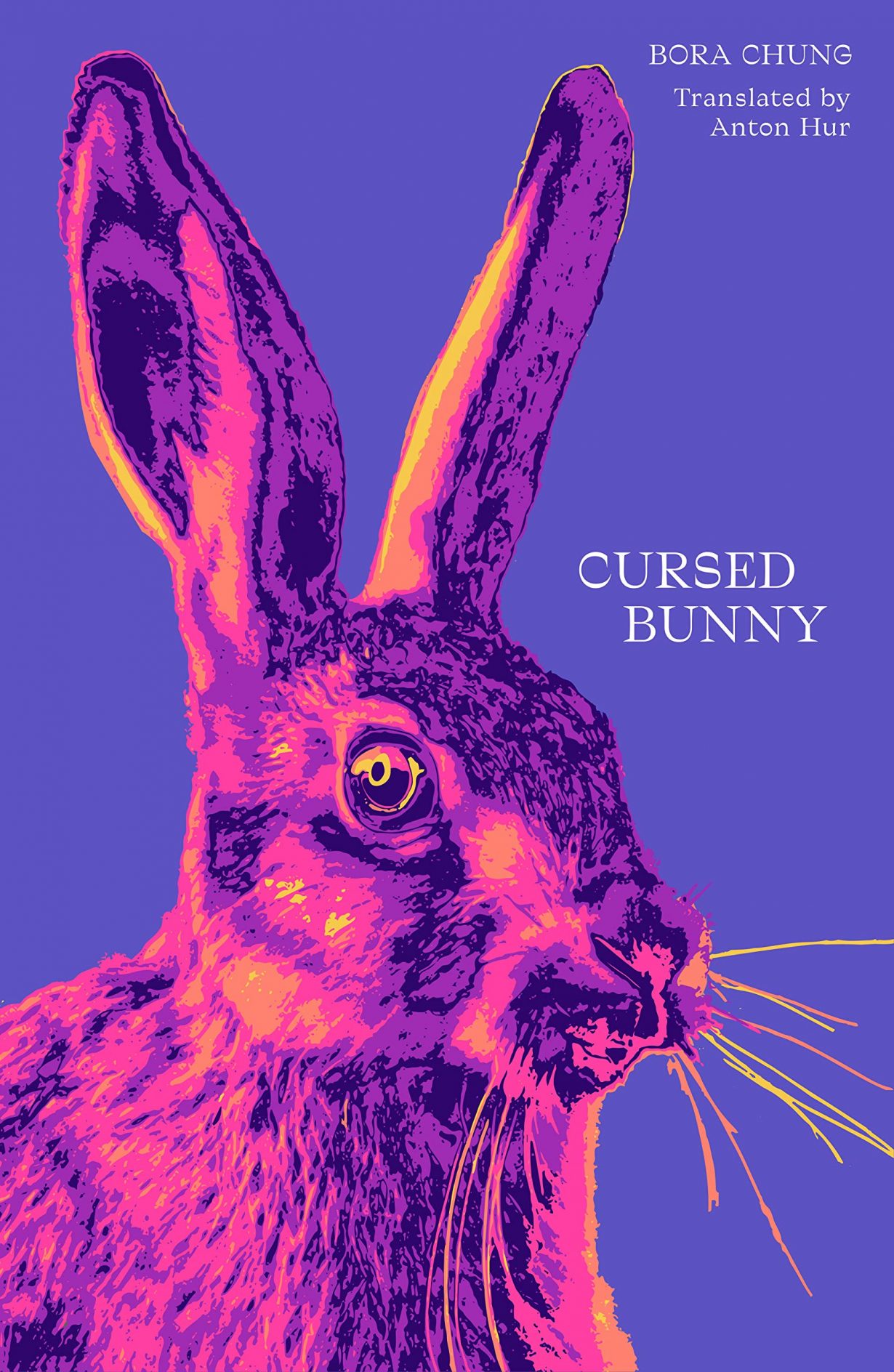
Cursed Bunny is described as “modern fables for the internet age, offering biting critiques on the patriarchy, capitalism, politics, and the reign of big tech. . . . [b]lending elements of horror, fantasy, surrealism and sci-fi . . ” I think that covers it, so I need not say more about this short story collection’s genre or themes.
Overall, the stories are varied enough that you don’t feel like you’re being hit over the head with a motif. However, issues around forced birth do come to the fore, but never in the same way. In “The Embodiment,” a young woman finds herself pregnant because she takes birth control pills too long. If she does not find a man to agree to be the father before the birth, the child will have problems. Like, how some chicken eggs are fertilized and others are not, she is told by the doctor. Whatever that means! The shame of being a single mother — Chung purposefully skips over any question of abortion — who hasn’t even given birth yet reflects the Korean attitude toward pregnancy done “the wrong way.” The woman begins going on “seon dates,” which I discovered are dates that Koreans go on specifically to find a marriage partner, and like most folks with a dating profile, she has to be cautious of scammers.
There is also a dark, comedic tone that Chung uses, which comes across in Hur’s translation, which sometimes uses incomplete sentences to give the meaning more rhythm, more depth: “Life is a series of problems. Especially when one is married and has a family. Because even when you manage to avoid the problems of the outside world and return home safely, your family is there waiting with a whole different set of problems of their own.” Doesn’t that just sum it up? Except in Chung’s stories, you may find your problems are a giant crow pecking you to death slowly over years. We get a couple of curse stories, a few ghosts, and a lot of greed and corruption (which leads to arguments about taxes . . .).
And even the horror can be absurd to the point of funny, like in the opening story. After a woman uses the toilet, she notices a head come out of the drain. Well, it kind of looks like a head, but it’s awfully lumpy and weird. The head claims that it is building itself out of whatever waste the woman flushes down the toilet. The woman throws a used pad in the toilet and flushes, to see what happens, and a male plumber shows up to scold her for being a careless woman. What a way to start a story collection! I read Cursed Bunny with my horror book club, and someone immediately messaged us when she finished “the first story “The Head.”
Not all of the stories are horror, but you can see the influences of government turmoil when the U.S.S.R. fell and the Korean War, which leave a horrifying scar on the people left behind. Many characters are old enough to remember harder times, or heard stories from parents or grandparents of survival. As I read, I thought some stories reminded me of Ludmilla Petrushevskaya’s work** only to learn that the Russian short story writer is one of Chung’s influences. So, thanks to a mishmash of cultures, languages, and histories, Cursed Bunny is a surprising, interesting read that never bored me.
** see my review of There Once Lived a Woman Who Tried to Kill Her Neighbor’s Baby and my review of There Once Lived a Girl Who Seduced Her Sister’s Husband, and He Hanged Himself: Love Stories
 Grab the Lapels
Varied stories, darkly comic tone, weirdness, pointed gender commentary… it sounds like a collection worth reading! How did you come across this title?
LikeLike
I kept seeing it in recommended lists. Then, I noticed it was on Hoopla, which is wild because Hoopla usually has books that are a bit meh compared to Libby. You know the licensing is different. Plus, I love South Korean works (film, books, etc).
LikeLiked by 1 person
This sounds weird but definitely fascinating. I don’t exactly want to rush out to find a copy but I’m curious to read more at the same time!
LikeLike
I wonder if she has one online that you could read instead of getting the whole book. Or, if your library has it, get it and just read one story?
LikeLiked by 1 person
I’ll check at the library and maybe that way get a flavour of it.
LikeLiked by 1 person
I’ve heard the buzz about this book, but I’m not much of a short story reader so am not tempted even though the background of both author and translator are super interesting and the stories sound good too.
LikeLike
I love how she thought no one would ever read her book in English, and then the publisher had it translated and sold in the U.S. South Korean culture is so interesting, and they’ve got some neat, bizarre ideas about what is horror.
LikeLiked by 1 person
Have you read anything by Han Kang? She’s Korean and The Vegetarian is so disturbing.
LikeLike
I’ve heard of her and that book, but have not yet read her work.
LikeLiked by 1 person
Great review! I’ve got this one on my shelf; I was very intrigued by “darkly comedic horror stories” as the selling point and am even more interested knowing a bit more of the background of the writers and setting that can be seen through the stories- thanks for that additional info! I’m hoping to get around to reading this one in the spring, it seems like something I’ll enjoy.
LikeLike
She might also be the kind of writer where you just read one story, maybe something online, if you’ve got a bunch of reading goals and not enough time.
LikeLiked by 1 person
Ah, ok. I did already buy the book, but in that case it might be helpful just to fit in a story or two here or there instead of trying to find time to read the entire set in one go. Thanks!
LikeLiked by 1 person
Good plan. You’re welcome!
LikeLiked by 1 person
This sounds like the sort of horror, speculative fiction, whatever, that I could read and get something out of. I probably won’t because of time, but if someone held a gun to my head (don’t please) and forced me to read it, I’d not complain (except about the gun at my head.)
I was interested in this, though, “the careful, buttoned up (dignified? modest?) sensibility of Koreans”. I think in all the modern westernisation of Korea, I had sort of forgotten this traditional side, so at first your comment surprised me. Then I thought, yes, of course, the older generation are just like this, while my sense is – generalising wildly – that the younger generation is more confidently gung-ho.
LikeLike
South Korean culture is super popular in the U.S. right now. For some reason K-pop bands are all the rage, learning Korean, the clothes, even the mannerisms are popular with younger people. I think seeing all of that makes me forget they are typically a modest, dignified but still collectivist culture by nature.
LikeLike
It’s popular here too – Korean movies, music, books, food. But you are right I guess – a bit like Japan. That quiet, collectivist/good of the community value is still there.
LikeLiked by 1 person
[…] to my review of Cursed Bunny by Bora Chung, translated by Anton […]
LikeLike
Sounds like an interesting collection of stories. Seon dates just sounds like dating. Lol.
LikeLike
Based on what I’ve heard about modern dating apps, they’re not looking to marry. Or date.
LikeLiked by 1 person
True.
LikeLiked by 1 person