
Jennifer Weiner is known for writing what people call “women’s fiction,” and sometimes she throws in a little mystery, romance, murder, etc. I’ve read Big Summer, which had a fat protagonist, an influencer who would receive free clothes, trips, etc. in exchange for her posting about them. I’ve noticed Weiner’s plots are always different enough to make me curious, which means I occasionally add a title to my TBR, such as her most recent release, The Breakaway.
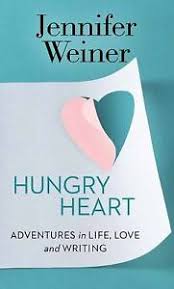
In Hungry Heart, the non-fiction book I’m reviewing today, Weiner shares personal stories about growing up a fat, Jewish girl whose father abandoned the family when she was in high school. She graduated from Princeton then worked as a journalist. An awkward breakup led her to writing a novel about a character like herself, which led to the publication of Good in Bed.
Good in Bed was a challenge to published because editors wanted Weiner to make the main character slender. However, Weiner kept thinking about how she never saw herself in fiction, so she pursued other options when editors dug in their heels. Thus, Weiner is one of the most well-known authors who writes fat female characters. She is vocal about discrimination in publishing, specifically how men are more often published and reviewed, and how books about women by women are called “women’s fiction” — a derivative label that does not have a counterpart for male authors. (Do you use “women’s fiction” as a label? Are you comfortable doing so??).
Hungry Heart is a highly readable essay collection/memoir in which Weiner notes her own problems, such as ill-advised things she Tweeted, or how she had no friends, so she became a bully herself. Throughout school, she tried various tactics to win people over:
How was I annoying everyone? I was barely talking to anyone! Silence was part of my plan. I had figured out, through close study of my peers, Seventeen magazine’s advice columns, and a handbook from the 1950s called How To Be Popular that I checked out of the library, that talking was surely one of my mistakes.
She’s relatable to anyone who struggled with being the early developer, the person awkward in her body, the person who wasn’t doing her hair right, shaving right, dating right, etc. And even though she was fat, Weiner had a strong body thanks to being a champ on the high school rowing team, which led to a scholarship at Princeton. However, society cannot reconcile a strong body and a fat body, and thanks to criticisms from others, Weiner internalized it.
Oddly, this is one of my complaints about the book; Weiner spends so much time harping that all bodies are good bodies, and that the goal of her life is not to be thin, that really much of her focus is still on weight. Saying, “it’s not about losing weight” all the time is still talking about weight. My goal is neutrality — I don’t talk about weight because weight isn’t important to me. I’m happy to talk about riding my bicycle or ways to decrease salt intake, but even saying “it’s not about weight” means it’s about weight. Perhaps Weiner is part of a generation that focuses more on body size, because I don’t hear this from my peers or Gen Z.
On the other hand, Hungry Heart is not one big acceptance journey. In fact, much is made of Weiner’s father, who for ten years was a caring parent and then deteriorated into mental illness, which led to him abandoning his family, taking on numerous girlfriends, and eventually succumbing to a drug overdose. Once her first novel, Good in Bed, was published and then made into a movie, her father kept showing up at her readings to ask for money and say embarrassing things during the author Q & A. At the time of his abandonment, Weiner’s family was plummeted into debt because her father was a psychologist, the sole income for the family, and then disappeared. As a result, Weiner is obsessed with making her own way financially, because she never wants to be harassed by debt collectors again. Truly, it’s a message about the ways instability affect us for the duration of our lives.
Also, there is a lot about motherhood and what it means to give birth during in the early 2000’s during the “birth at home, not hospitals” movement, and how not asking for help can lead to trouble in a marriage. Overall, there are a variety of topics that readers will enjoy and connect with. I liked Hungry Heart and was happy to keep reading. It’s one of those books that you’re happy to pick up and get back to.
 Grab the Lapels
I think you’re right that Weiner is part of a generation that focuses more on body size. I am too, and my mother had it even worse.
LikeLike
She’s right on the cusp of the change, so she’s aware that how she thinks about her body is wrong, but not enough to really let go.
LikeLiked by 1 person
That’s so sad about her dad, I didn’t know that about her. I totally know how financial instability during childhood can leave its emotional scars well into adulthood.
LikeLike
The scene in which he shows up to her reading with his girlfriend and is trying to get Weiner to acknowledge that your parents messing you up is great fodder for writing (and thus suggesting she owes her success to him) is so gross.
LikeLike
Oh no! 😟
LikeLiked by 1 person
I personally don’t like the label “women’s fiction”. Why give it a gender label? Fiction is fiction. Doesn’t matter who writes it or what group they expect it to appeal to.
LikeLike
I also don’t like the term “literature” to say something is “smart.” The same conversation happens in the horror community. People call movies like Get Out or Hereditary “elevated horror.” Like, gtfoh.
LikeLiked by 1 person
Ha! I didn’t know that about “elevated horror.’
LikeLike
Ari Aster, Darron Aronofsky, directors/films like that. Mike Flanagan gets on the list, Jordan Peele.
LikeLiked by 1 person
I’m a big Jordan Peele fan.
LikeLiked by 1 person
“Women’s fiction” is not a label I will ever use–so sexist and demeaning. I remember the Wiener-Franzen dust up and I was so glad about her speaking out, even though it cost her a lot. But I think it also emboldened others to speak out, which is always a good thing. Good on her for refusing to give in to editors’ demands to make her main character slender in Good in Bed! I’ve never read any of her books, but I appreciate her nonetheless!
LikeLike
What’s interesting is Franzen must have backed himself into a corner because while he was the “golden boy” for a few years, you don’t hear anything about him anymore. However, Jennifer Weiner has a bestselling book every year. So, HA. As the kids like to say, “Give me the confidence of a mediocre white man.” Is Franzen mediocre? I don’t know because I haven’t bothered to read his books because he’s such a tool, a siren song for other men who want to get away with being tools.
LikeLiked by 1 person
I’ve only ever read one Franzen book and it was nonfiction about birds and climate change and he even managed to piss me off with that! He is fraught over what climate change is doing to birds, but shrugs his shoulders and flies all over the world because there is nothing he can do to change things. I really wanted to punch him.
LikeLike
He’s white male privilege/totally inconvenienced that other people aren’t as clever as he…. incarnate.
LikeLiked by 1 person
I write about women’s writing all the time, so I can hardly deny it. To the extent that I am willing to generalize I think women write more often about characters (which is the sort of writing I prefer) and men write more often about action (which I loathe), and that this is particularly visible in SF.
In Australia, which has a very male-focussed self-image, the early writers were predominantly women but at the turn of the C20th and following, men in education and in charge of publishing characterised those women as ‘romance writers’ so that they stayed out of print for the best part of a century and are still not widely studied.
LikeLike
When you use “women’s writing,” it often has the implied “writing by women” in context. I don’t recall seeing you use “women’s writing” to refer to stories that should only be read by women, or were written for women. I think part of the problem is when men do write a story with good characterization and lots of emotion, they’re praised to the hills despite women writing that way frequently. On the other hand, “men’s fiction” isn’t even a genre label, though we can all think of a handful of books written with a male audience in mind. I’m not sure I mind that as much in young adult literature because in the U.S. boys’ literacy is quite low. Stories that have a peaceful boy character, like The Trumpet of the Swan, are ones I support.
LikeLike
No, it never occurred to me to use “women’s writing” as writing directed at women. Though we do seem to use “boys” and “girls” in that way, or at least we did when I was growing up.
My daughter, and I largely agree with her, prefers that the books I buy for her daughters (and for her) have female heroines and are written by women.
LikeLike
Oops, I didn’t read the comments before I wrote my response, because I wanted to comment before I forgot all my thoughts! But as you’ll see, I make a distinction between “women’s fiction” and “women’s writing”.
LikeLike
I tend to use “women authors,” but it’s the same idea, I think.
LikeLike
It’s such fun to buy books for children. I always hope to leave a little piece of my reading experience with them.
LikeLike
I don’t really use the term “women’s fiction”. I’m not even sure I know what it means! I mean, I read a lot of crime writing, where I believe women are more likely to be published and reviewed than men (at least in the UK) – but is a really gory procedural by someone like Val McDermid or Ruth Rendell “women’s fiction”? I don’t think the people who use that term would say so. And Sebastian Faulks, who is known for his historical romances, wouldn’t be classified as writing “women’s fiction”, even though I think his books are probably closer to what that term means (though I haven’t yet read him). I think that specific genre terms are more useful.
LikeLike
I agree that specific genre terms are more useful, too. Unfortunately, in the U.S. “women’s fiction” has become a genre term that lumps together books by women about women finding friendship, family, motherhood — things that “pertain to women,” despite also pertaining to men.
LikeLike
It seems to me that “women’s fiction” is what used to be labelled as “chick lit”. So that’s a slightly better term but it still sucks because, as you point out, there’s no equivalent for men. They get to just write fiction but women write “women’s fiction”. Personally, I really try not to gender writing but it’s something I find myself having to (gently) push against at my job a lot. Customers will be buying a gift and want book recommendations so they’ll tell me the person’s gender when all I want to know is what kind of books do they enjoy! This book sounds pretty interesting. I’m not sure I’ve ever read anything by her.
LikeLike
I wish the publishing industry would take cover art a little more seriously because then perhaps men would be more apt to pick up a book that interests them instead of wondering if it is for the right gender.
LikeLike
[…] the most part, readers commented on my Hungry Heart review their reaction to Jennifer Weiner’s fight against sexism in publishing, specifically the term […]
LikeLike
When it comes to all aspects of appearance, my goal is neutrality too. I will very occasionally comment on someone’s outfit but I will never comment on their looks. I won’t comment on hair colour changes either. I want to de-emphasise any focus on how we look.
I am horrified that her editor wanted her to make her protagonist slender.
And no, I don’t think I use “women’s fiction”. I don’t like the term. I don’t like “book club book” either. Both sounds condescending to me, in slightly different ways. I will use “women writers” though, or “First Nations writers”, etc, because I want people to diversify their reading.
(In my early library days we had subject headings for cataloguing – Library of Congress – that went like this : “doctors”, “women as doctors”, “pilots”, “women as pilots”, and so on. Even in cataloguing language conveys meaning!
LikeLike
That’s interesting about your cataloging days, because now I wonder if there were any “doctors,” “men as doctors,” etc. I doubt it, but it might be there now.
I love that you pointed out the phrase “book club book.” You’re right; it’s often used to dismiss a book as something women would get together and “jabber” about. I’ve heard “book club book” to mean easy reading, something you don’t have to think hard about, cozy, and not worth it.
LikeLike
No, no “men as doctors” JUST “doctors” and “women as doctors”. Now I think it is just doctors for everyone, which is how it should be. But of course there is the issue of people who particularly want to read about issues facing minority groups like women doctors. That’s always the challenge. And is why I have a “women writers” category for my blog. Affirmative action … make them easy to find.
Yes, and I think “book club book” means all that, but also something with capital-I -issues that they think women would like to talk about, without regard to writing quality as boing part of it.
LikeLiked by 1 person
So much to unpack here! I’ve definitely used the term ‘contemporary women’s fiction’ to refer to chick lit, generally lighter stuff, but I’ll rethink that now – it’s not a helpful term.
Gosh that’s so sad about her Dad showing up at her Q&A’s asking for money. ugh, how awful and sad for everyone involved. What embarrassing questions or comments would he make? I’m so curious now…
LikeLike
Weirdly, I think “chick lit” is a term that gets the attention of the intended audience, so in a way, it’s helpful. On the other hand, the label becomes low-hanging fruit for people who are judgmental about certain kinds of fiction.
LikeLiked by 1 person